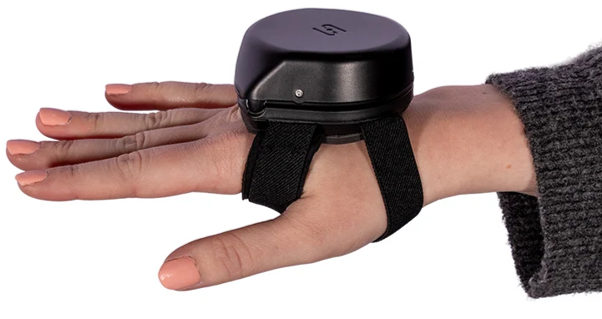
Hand tremors turn ordinary tasks into obstacles. Tapping a keypad, slicing a tomato, holding a glass of water, playing an instrument, putting a golf ball: each becomes a negotiation. The Steadi-3 Plus, a wrist-worn device from Toronto-based Steadiwear, addresses this with a pair of neodymium arc magnets, a mechanical spring and a moving mass, and nothing else.
There is no ferrofluid, no electromagnets, no battery, no software and no electronics of any kind. The device is completely passive. It sells for about $1,000.
Earthquake engineering at the scale of a wrist
“The easiest way to picture it is a skyscraper in an earthquake,” explains Mark Elias, co-founder, CEO and CTO of Steadiwear. “Many tall buildings use a tuned mass damper – a large weight that moves against the building’s sway to steady it. The Steadi-3 Plus uses the same principle on the scale of a wrist. Inside the device is a small moving mass and a spring that work against the shaking caused by a person’s tremor.”
The difficulty is that the two problems are not equivalent. “A building sways in a fairly predictable way,” Elias says. “Human tremor does not. It varies between individuals, and it varies within the same individual over the course of a day depending on fatigue, posture, medication timing and the task at hand. A classical tuned mass damper is tuned to one frequency. Tune it to 5 Hz and it performs well at 5 Hz, and then it stops helping, and past a certain point it starts making things worse.”
That is the constraint the magnets are there to solve.
Why arc magnets, and why N45
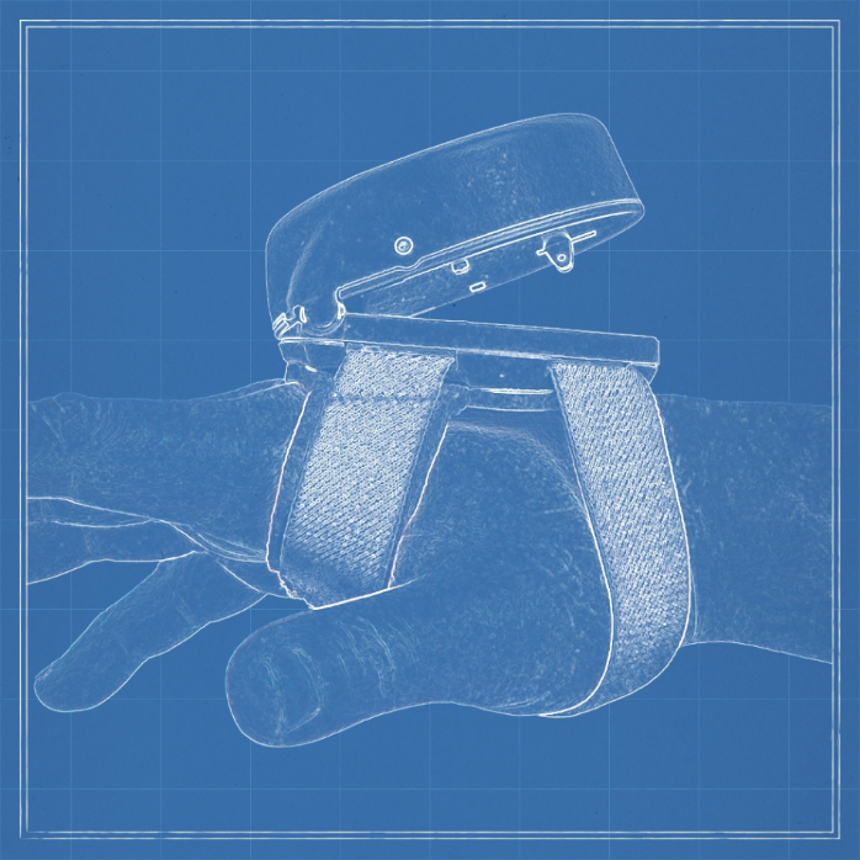
A conventional mechanical absorber has a single resonant frequency set by its mass and the stiffness of its spring. Steadiwear’s approach is to make the effective stiffness a function of displacement rather than a constant, by placing a pair of neodymium arc magnets in an attractive configuration alongside the mechanical spring.
As the mass travels, the magnetic force contribution changes with the gap between the magnet faces. The combined spring and magnet system therefore presents a different effective stiffness at different points in the stroke, which flattens and widens the attenuation curve instead of concentrating it at a single peak. The result is a device that reduces tremor across the range of motion people actually produce in daily life, rather than at one laboratory frequency.
Three properties drove the magnet selection.
Arc geometry. The arc profile lets the magnet faces follow the curved path of the moving mass, holding the working gap within a narrow band through the stroke. A flat block pair would open and close the gap much more aggressively over the same travel, making the stiffness curve harder to shape.
Grade N45. The device has to deliver a specific force in a small volume, on a wrist, without adding mass the user then carries all day. N45 sits at the point where the available energy product gives the required force in the available envelope.
Passive operation. Because the magnetic contribution requires no power, the system inherits the reliability characteristics of a purely mechanical assembly. Nothing charges, nothing updates and nothing fails on a duty cycle.
Two grandmothers
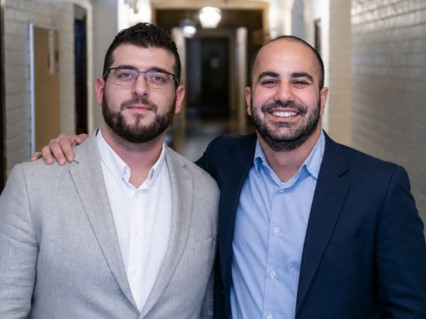
The device carries some personal history. When Elias and co-founder Emile Maamary met at university in 2014, they discovered that both of their grandmothers had essential tremor. That connection became the basis for the medtech company they founded in 2015. Elias’s background is in structural engineering, and his work on tuned mass damping systems for building vibration was the direct source of the concept.
The two spent roughly five years developing the first generation and brought it to market as the pandemic began. The timing was an obstacle, but the pause gave them room to reconsider the design. The first generation went out to early adopters and beta testers, and that cohort was enough to validate the concept and to secure Class I registration with the FDA and Health Canada.
Steadi-2 followed at half the weight and size of its predecessor. It introduced the magnetic element, and it was optimized specifically for essential tremor. Extending the effective band to cover Parkinsonian tremor as well required another design cycle, supported by $1 million in new investment.
The result is the Steadi-3 Plus: the smallest and lightest generation to date, effective for both essential tremor and Parkinson’s disease.
In a controlled performance evaluation, each of nine participants was recorded unaided, wearing a sham device, and wearing the active device, with task order randomized. Neurologists scored the video on a modified Fahn-Tolosa-Marin scale without being told which condition they were watching. Eighty percent of participants improved relative to the unaided condition and 70 percent improved relative to the sham. The active device outperformed both the sham and the unaided condition on all three tasks assessed: drinking, intention tremor and spiral drawing. The effect of condition was statistically significant, and no adverse events were reported.
“Separating from a sham is the part that matters,” Elias says. “Essential tremor has a strong placebo response. Any weight on the wrist does something. If you do not test against a sham with blinded raters, you have not measured your device, you have measured expectation and added mass.”
What comes next
A further round of $2.2 million closed in the fall of 2025. Steadiwear is now developing a miniaturized fourth generation built around an optimized version of the mechanism.
In August 2026, the Toyota Mobility Foundation selected Steadiwear for the Mobility Unlimited Hub, an acceleration program the foundation runs with the MaRS Discovery District in Toronto and ONOVOLAB in São Carlos, Brazil. The program targets products that improve autonomy, accessibility and inclusion for people with disabilities and reduced mobility, and provides specialized mentorship, strategic connections and market expansion support. For more information, see www.steadiwear.com.