Attendees at Coiltech Italia in September at Pordenone were able to learn more about Kite Magnetics’ low core-loss nanocrystalline magnetic material Aeroperm and how it can help maintain the magnetic performance of electric motors, stators, rotors and high-frequency magnetic systems. Since our earlier report two years ago on the Australian company, it has now established a 5 ton per year nanocrystalline stator core pilot production line and booked its first automotive tier 1 order.
Recent funding from the close of an investment round plus government grant are supporting the company’s A$4.1 million commercialization project aimed at expanding a pilot manufacturing line in Victoria and scaling up production of the Aeroperm electric motor core technology.
At Coiltech, CEO Richard Parsons explained deeper into the company’s technology in a presentation, “When low core loss is not enough: stress sensitivity in advanced stator core magnets”, which explored an important part of the advanced magnetics discussion that can easily get overlooked. Achieving extremely ultra-low core loss in a laboratory is one thing, but maintaining that magnetic performance once the material becomes part of a real, mechanically loaded motor is another, he emphasized.
The company is developing a mass production system that will enable automotive OEMs, Tier 1 and Tier 2 suppliers to manufacture Aeroperm stator cores in house. Designed for radial flux automotive traction motors, the system is being developed to produce finished stator cores at commercial scale. It is intended to support high volume manufacturing using Aeroperm as well as existing nanocrystalline and amorphous magnetic materials.
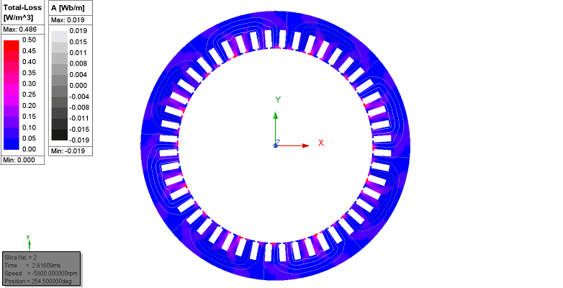
Aeroperm is a nanocrystalline magnetic material designed to reduce the losses in stator cores that limit high performance of electric motors. The material is designed to replace conventional iron silicon steel to achieve lower heat generation inside the motor, improving efficiency without increasing motor size. It’s applicable to automotive, UAV and other advanced electric propulsion platforms. The stator cores combine high magnetic saturation with low core loss, giving motor designers a larger efficiency envelope without sacrificing magnetic performance. The objective is to achieve the magnetic performance of conventional non-oriented electric steel with substantially lower core losses.
With a 2.0 T saturation magnetic polarization, it maintains the high flux capability required for compact, high-power-density electric machines, says the company. Its 0.024 mm lamination thickness helps reduce frequency-dependent losses, making it especially valuable in high-speed, high-efficiency, and thermally constrained motor designs.
Development of the nanocrystalline magnetic material began around 2016 at Monash University, from where Kite Magnetics was spun out in 2022 to commercialize and produce it. For more info, query in Magnetics Magazine for an earlier report, also see www.kitemagnetics.com.