The team at Magment in Germany has released a white paper titled “Magnetizable Concrete – Closing the Gap to Ferrites”, presenting the Bavarian company’s latest research and technological progress in high-power, high-frequency magnetic materials. The publication outlines how magnetizable concrete —a blend of cement and recycled magnetic ferrite particles — has evolved from an innovative concept into a scalable and high-performance material platform capable of challenging conventional ferrites in demanding energy applications.
The paper introduces a physics-based design framework centered on the tanδ/μ representation, enabling a new generation of optimized magnetic materials for applications such as solid-state transformers, high voltage DC systems, and megawatt-scale wireless charging infrastructure. According to the paper, Magment’s latest material generation, MCXX, demonstrates the potential to outperform standard ferrites in the 10–100 kHz and 5–200 mT operating range, while simultaneously offering advantages in scalability, mechanical robustness, and design flexibility.
Several key advancements are highlighted:
- Significant reduction of magnetic losses across multiple generations of magnetizable concrete.
- Tunable magnetic performance.
- Large-scale manufacturability without the brittleness and size limitations associated with ferrites.
- Enhanced thermal behavior.
- Opportunities for monolithic magnetic cores in power electronics.
Why a new loss framework was needed
Traditional magnetic design relies on Steinmetz‑type heuristics, which compress complex
hysteresis physics into a single exponent extracted from log–log fits. This approach was
serviceable in the datasheet era but is fundamentally blind to the underlying mechanisms that
govern losses, explains the company.
Modern materials, especially composites and heterogeneous structures, require a linear‑domain,
physics‑based metric. That metric is tanδ/μ, the loss factor normalized by permeability.
The paper begins with the theoretical foundation, then shows how magnetizable concrete
materials are engineered using this framework and demonstrates how the materials now
rival ferrites in real power‑loss testing and can be scaled economically to very large components.
Advanced high-frequency magnetic loss measurement and predictive modeling platform
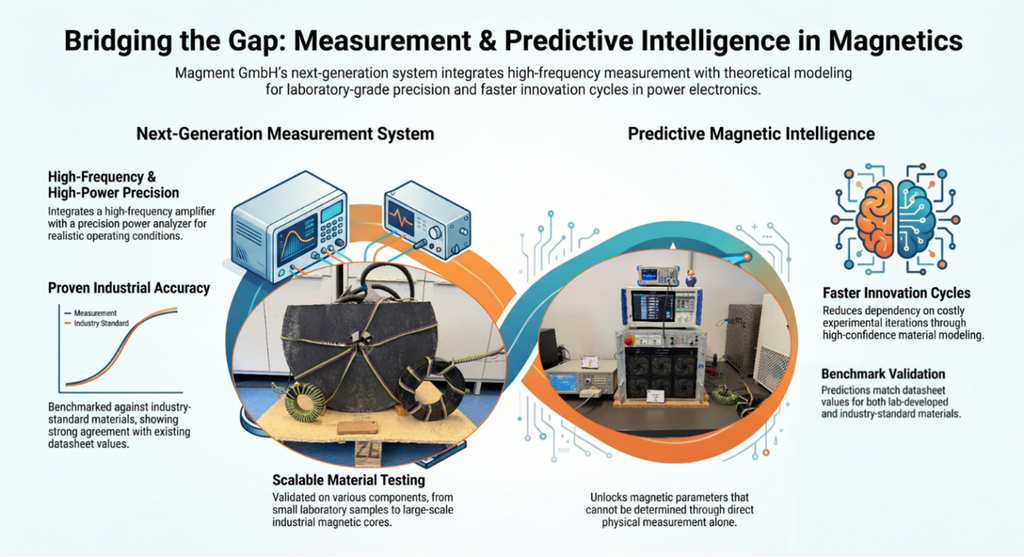
The company has developed an advanced high-frequency magnetic loss measurement system designed to improve the characterization, validation, and quality control of magnetic materials for next-generation power electronics applications. As depicted in the illustration at top, the newly developed platform combines a high-power, high-frequency amplifier with a precision power analyzer to accurately determine energy flow and magnetic losses under realistic operating conditions. The system enables reliable testing of magnetic materials over a wide frequency range and supports detailed analysis of ring-shaped magnetic samples commonly used in material validation processes.
To validate the performance of the measurement setup, an industry-standard magnetic material was tested and the measured losses were directly compared with the manufacturer’s datasheet values.
The results demonstrated strong agreement between measured and reference data, says the company. In parallel with the experimental setup, Magment developed a theoretical hysteresis model capable of predicting magnetic parameters that cannot be directly measured through conventional loss measurements.
Implications for Magnetic Material Development
The combination of precise experimental measurement and predictive magnetic modeling creates significant advantages for magnetic material development and industrial deployment, notes Magment:
- Faster development cycles for magnetic materials and power electronics components
- Reduced dependence on extensive experimental iterations
- Improved confidence in material behavior prediction under operating conditions
- Automated, data-driven quality control for production consistency
- Early detection of material deviations across manufacturing batches
Uniform magnetic properties from lab scale to megawatts
A persistent challenge in magnetic materials engineering is maintaining consistent properties when transitioning from laboratory samples to full-scale systems. Typically, geometric scaling introduces deviations in permeability, losses and overall magnetic behavior. The company’s magnetic concrete, however, demonstrates size- and shape-independent magnetic performance validated across multiple geometries and power classes—from small toroidal samples to megawatt-scale transformer cores, reports Magment. It recently produced and tested the material in two representative configurations — toroidal test cores for controlled material characterization and a 1 MVA solid-state transformer core manufactured as a continuous large-scale structure.
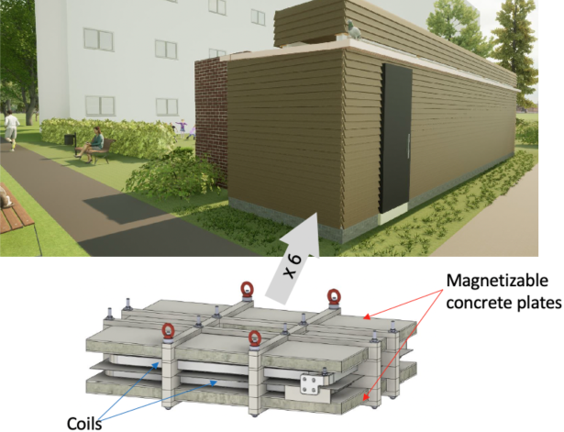
MagPower-3H transformer
“Magment’s research demonstrates that magnetizable concrete is no longer merely an alternative material concept, but a serious platform for future high-power magnetic systems,” the paper concludes.
The full white paper, “Magnetizable Concrete – Closing the Gap to Ferrites,” is available for download at the company’s website. Magment is located in Oberhaching, about 15 km south of Munich. See www.magment.co.