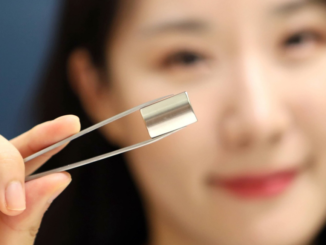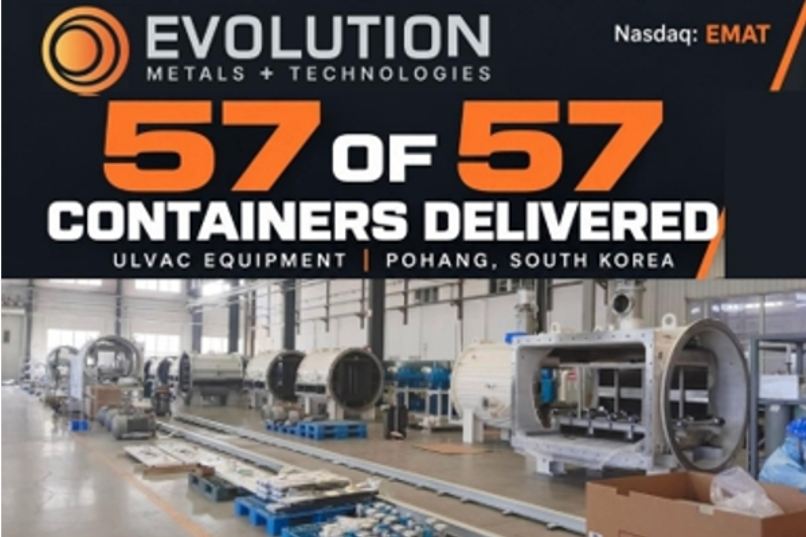
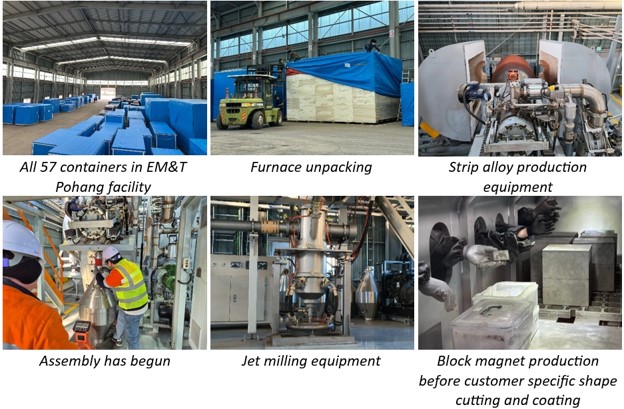
Evolution Metals & Technologies, a U.S.-based critical materials and advanced manufacturing company, reports that all 57 containers of rush-order Ulvac sintered-magnet production equipment have arrived at its expanded Pohang facility in the Republic of Korea, with commissioning scheduled to begin in November. Headquartered in Florida, the new publicly-held company is the outgrowth of a roll-up of several magnet manufacturing operations in Korea and now is poised for dramatic expansion there.
The equipment supports an expected tenfold increase in annual rare earth magnet production capacity in Pohang—from approximately 1,000 metric tons to approximately 10,000 metric tons, including approximately 6,000 metric tons of high-performance sintered magnets—once installation and commissioning are completed.
Based in Kanagawa, Japan, Ulvac is a maker of vacuum technology and related equipment which operates globally, providing systems to produce rare earth permanent magnets, advanced electronic devices, semiconductors, displays, automotive, and pharmaceuticals.
EM&T says it believes the new capability will make it the single largest producer of rare earth magnets globally, ex-China. Realization of that status, however, remains to be seen as it depends not only on its progress but also that of several other ex-China magnet producers currently planning expansions. Nevertheless, the activity represents a dramatic expansion at a single site for magnet manufacturing outside of China.
Equipment delivery amid China export-control uncertainty
The deliveries strengthen EM&T’s manufacturing position amid the uncertainty over China’s rare earth export controls, the company notes. Announcement No. 70, issued by China’s Ministry of Commerce and the General Administration of Customs on November 7, 2025, specifies a suspension through November 10, 2026. China subsequently announced an extension of the broader Kuala Lumpur trade arrangement to January 10, 2027; the application of that extension to specific export-control measures remains an important consideration for industry participants.

“Equipment like this does not come off a shelf. Sintered magnet production lines carry lead times of two years or more, and most companies haven’t even ordered equipment in this scale,” said Frank Moon, Co-Chief Executive Officer of EM&T, in late October when the successful delivery was announced. “We placed our orders in early 2025, and all 57 containers are now on the ground at our flagship Pohang facility which is under expansion. We are moving at warp speed, and commissioning and assembly of the additional equipment has already begun.”
“As November 10 approaches, more than 50% of our input material requirements are already on site, alongside contracted supply. Our eight Tier-1 OEM-certified grades address approximately 260,000 metric tons of an estimated 360,000-metric-ton annual market. Our experienced operators are in place, we are producing revenue selling tier one certified magnets today. Now with our expansion equipment, 880 megawatts of power, and additional land in place, we are in a unique position to be the market leader in the magnet business ex-China.”
“We are a producer of magnets and magnet materials. With local government support for our expansion, our priority is bringing the additional equipment into production, maintaining consistent quality at greater scale and converting customer demand into shipments.”
Local government framework supports Pohang expansion
On October 27, EM&T signed an investment framework with Pohang City. The local government is committed to actively support the expansion of rare earth and non-rare-earth magnet production on an approximately 1.27-million-square-foot site in Pohang’s Blue Valley National Industrial Complex.
“We already have revenue-generating commercial operations, customer-qualified products and experienced operators. More than 50% of our input material requirements are on site, alongside contracted supply, and commissioning has begun. With US$28 million in local government grant funding expected, subject to applicable conditions, our focus is bringing the additional equipment into production and expanding customer shipments,” said Moon.
An operating foundation built for expansion
EM&T generates revenue today through commercial magnet sales and has spent years assembling the capabilities supporting its Pohang expansion. Over the past six months, the company entered into a convertible financing facility of up to US$100 million with Yorkville Advisors, ordered 13 additional ULVAC magnet-production machines on an accelerated schedule, contracted non-China NdPr metal supply and appointed former JL MAG Chief Technology Officer Kenji Konishi to lead Magnet Engineering Production.
The Company also agreed principal terms with Korea Electric Power Corporation to expand the electrical infrastructure supporting its Pohang operations and reports that a substation with a stated capacity of 3 GW has been delivered.
EM&T believes its non-China sourcing and manufacturing platform positions it to address expanded requirements under DFARS 252.225-7052. Beginning January 1, 2027, those requirements extend restrictions across the supply chain for covered rare earth magnets—from mining through finished production—for qualifying U.S. defense deliveries, subject to applicable exceptions.
“It takes ten critical factors to manufacture rare earth magnets commercially at scale: land, power, equipment, permits, operators, feedstock, magnet products, buyers, customer certifications and capital,” said Christopher Clower, Chief Financial Officer and Chief Operating Officer of EM&T. “We believe we are the only company outside China that brings together all ten, and that our operating experience places us years ahead in delivering commercial-scale, non-China rare earth magnets to Western markets. Our focus is turning that foundation into expanded production, customer shipments and revenue.”
Magnet manufacturing and materials processing
EM&T’s strategy encompasses high-grade feedstock and the recovery of critical materials from end-of-life electronics and batteries to support its materials-processing and manufacturing platform. Its planned U.S. expansion would extend those capabilities into domestic critical materials recovery and magnet production.
“We are a magnet and magnet-materials producer, not a mining or exploration company,” emphasizes Moon. “Our operations turn rare earth materials into metals, alloys, powders, and finished magnets. We have commercial production generating revenue, existing customers buying magnets, experienced operators, and customer-qualified products. Our expansion builds on that operating foundation, with a clear focus on increasing consistent output and delivering for customers.”

Acquiring feedstock critical to revenue growth
On October 29, Evolution announced that it has secured approximately 754 metric tons of neodymium metal, sourced entirely outside China, which it expects is sufficient for approximately 50% of the feedstock it requires to deliver its full-year 2027 revenue guidance of $400 million to $460 million.
The total includes approximately 42 metric tons already delivered to Pohang, 72 metric tons pending shipment through March 2027, and 640 metric tons committed through the end of 2027, including a 600-metric-ton contract with Senri Trading for rapid delivery, with a further 1,000 metric tons in discussion for 2027 delivery. For heavy rare earths, the Company holds approximately 520 kilograms of dysprosium metal in Pohang, with 1.5 metric tons per month committed starting in February 2027.
The disclosure addresses what EM&T sees as the real constraint on magnet supply outside China. Rare earth ore is not scarce. What is scarce is converting that ore into midstream materials to support downstream magnet production. EM&T believes that upon completion of its current expansion it will be one of the largest known in-production magnet and magnet materials producer outside China.
That position is also drawing sellers to the company, it says. Producers of rare earth ore and upstream feedstock have historically had one meaningful buyer, China, and EM&T believes it is one of the few credible buyers outside China that is producing downstream products, including magnets, at commercial scale. Selling to EM&T lets those producers diversify their customer base, and the company reports that it is in dialogue with sellers of rare earth feedstock and end-of-life magnets in the U.S., Japan, India, West Africa, Malaysia, Indonesia and Thailand.
EM&T’s grain boundary diffusion technology reduces its heavy rare earth requirements: the company requires approximately 0.5% heavy rare earths, such as dysprosium and terbium, to produce high-performance sintered magnets, compared with the 3% to 4% historically required, stretching its heavy rare earth feedstock six to eight times further.
“There is no shortage of rare earth material. China is a net importer of rare earth ore, with approximately 60% of what it processes coming from outside China, and there is no shortage of investment in developing even more rare earth mines. What is in short supply, outside China, is commercial-scale magnet production and magnet materials producers,” said Moon:
“Approximately 360,000 tons of sintered magnets are made each year, and only about 14,000 tons of those are made outside China. But today, those 14,000 tons are dependent on midstream magnet materials bought from China. Evolution has the equipment and capability to avoid that very issue, with more than 14,000 tons per annum of strip alloy production coming online this year as part of our planned expansion. We have sourced rare earth magnet materials independent of China, but also continue to source from China. Our flexible, diversified business model serves both defense customers requiring DFARS compliance and commercial customers seeking non-China supply.”
Said Wilcox, executive chairman, “We will continue to source feed material wherever and whenever we can to support revenue and margin, and to deliver shareholder returns as we target profitability in 2027. DFARS sets the requirements for defense contractors, and we will also continue to produce magnets for commercial customers whose applications do not require traceability back to the ore. Evolution was built on a diversified strategy spanning input materials, midstream materials and downstream magnet production. That enables us to serve customers across all eight of our certified high-performance grades, grow our bonded magnet business, and supply customers—primarily in Japan—that require non-China intermediate magnet materials, as we scale production with our new strip cast alloy equipment and sintering vacuum furnace system lines.” For more info, see www.evolution-metals.com.