As more and more powerful quantum computers are being deployed, quantum processors are also growing in qubit count and complexity. For cryogenic systems, this means significant increases in the number of cryostats and even greater cooling and payload requirements that can quickly render existing infrastructure obsolete. Conventional platforms tightly couple cooling power and experimental payload, making upgrades costly, slow, and difficult to scale. To keep pace with the rate of quantum innovation, cryogenic infrastructure must adopt a fundamentally different approach, posits German cryogenic developer kiutra.
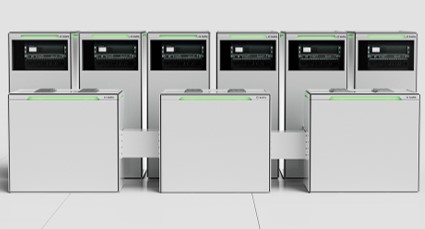
Now, based on magnetic refrigeration technology, the new X-Type system from the Munich-based company introduces independently scalable cooling and payload modules, making it the first millikelvin architecture built to grow with quantum computing, it says. Built on a fully modular architecture, the X-Type makes scalability a core capability through modules that can independently expand cooling power and payload capacity without redesigning the system.
The X-Type breaks the scale-up limitation by housing cooling power and payload within independent modules. Cooling modules can be added to increase thermal performance without interfering with payload infrastructure, and payload modules can expand line density and usable volume independently from the cooling side. This modular cryogenic approach removes the ceiling on scaling, allowing cryogenic infrastructure to grow with processor complexity.
“Scaling quantum computing requires rethinking cryogenic infrastructure from the ground up. The X-Type lets customers expand cooling capacity module by module, in step with their quantum hardware — without replacing the infrastructure they’ve already deployed,” comments Dr. Steffen Säubert, Senior Research & Innovation Lead at kiutra.
The X-Type is designed for operational efficiency as much as scalability. The separation between cooling and payload modules enables independent access to the quantum processor, wiring, and electronics, without interfering with the cooling infrastructure. Front-access installation and service further simplify payload work, reducing the labor overhead inherent in tightly integrated, monolithic cryostat designs.
The X-Type base configuration is delivered as one payload module and two cooling modules with the following specifications: 20 µW cooling power at 20 mK; 12 mK base temperature; up to 768 lines payload.
Beyond modularity, the X-Type is the first quantum cooling architecture of its kind to operate without helium-3. As quantum processing scales, helium-3 supply constraints and geopolitical sourcing pressures are compounding an already complex challenge. Rather than mitigating dependence, kiutra eliminates it by building on continuous adiabatic demagnetization refrigeration (cADR), a magnetic cooling process developed into a continuous, application-ready millikelvin cooling method.

“While the industry works to mitigate its helium-3 dependence, we made a different choice years ago: eliminate it entirely. The X-Type is the result of that decision, the first cooling architecture built from the ground up to scale with quantum computing, without pumps, pipes, and compromise,” asserts Dr. Alexander Regnat, CEO. The X-Type was introduced at the recent APS Global Physics Summit, with first deployments scheduled for 2027.
Adiabatic demagnetization refrigeration
Central to the design is the use of a fundamentally different technology in the cryostats. To reach sub-kelvin temperatures, kiutra units cool with paramagnetic solids in a process known as Adiabatic Demagnetization Refrigeration (ADR). While a well established technology, kiutra engineers harness it in a continuous configuration that can provide an alternative to helium-3-based cooling. Magnetic cooling has several advantages, notes the company, explaining as follows how its magnetic cooling works:
“A typical ADR configuration consists of a pre-cooling unit, typically a closed-cycle cryocooler, a heat switch, a superconducting magnet surrounding a solid-state cooling medium and a sample platform.
At the beginning of the ADR process, the heat switch connecting the ADR with the pre-cooling unit is closed and both the cooling medium and the attached sample stage are cooled to the cryocooler base temperature of about 4K.
While the heat switch is still closed, the cooling medium is magnetized by driving a current into the superconducting coil. The heat of magnetization is released and dissipated in the main thermal bath provided by the cryocooler.
Therefore, after the maximum magnetic field has been reached, the cooling medium will return to its base temperature. The entropy of the system is now essentially determined by the magnetic contribution of the spin sub-system of the cooling medium.
Then the heat switch is opened to break the thermal connection between the pre-cooling unit and the cooling medium. By reducing the magnetic field adiabatically, the temperature of the cooling medium drops thereby cooling the attached sample stage.
Usually, the medium is not completely demagnetized. Instead, the magnetic field is tuned to settle a target temperature, and the remaining magnetic field is used to compensate for heat leaks from radiation, the support structure and wiring, as well as heat generated by the experimental setup. Thus, by further reducing the magnetic field the sample temperature can be stabilized with high precision for a limited period, the hold time, which is typically several hours.
Once the magnetic field has been reduced to zero, the ADR process can be repeated. The time to regenerate, i.e. to re-magnetize and relax the cooling medium, will usually be 1-2 hours, resulting in typical duty cycles of 70 to 95%.” See www.kiutra.com.