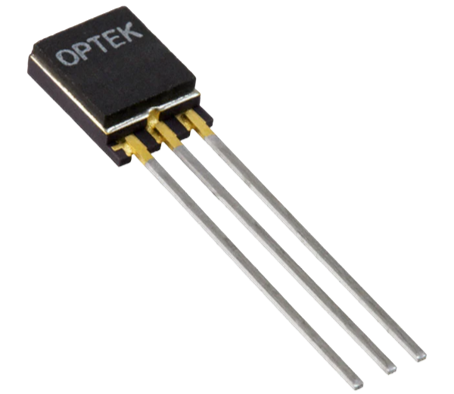
TT Electronics, a global provider of mission-critical power and sensing technology, has been selected to supply its Hallogic Hall-effect sensors for integration into fan assemblies on NASA’s Dragonfly rotorcraft mission. The sensors support a spacecraft subsystem where reliability and consistency are essential across the program lifecycle. Part of the company’s Optek portfolio, the sensors are designed for non-contact motion sensing and switching, with variants processed and screened for military and space-grade applications where consistency and reliability are design priorities.
Hallogic OMH3075S is a high-reliability Hall-effect sensor in the Optek portfolio, designed for non-contact switching and operation across a broad range of supply voltages. The device is specified for operation from -55 °C to +150°C, supporting applications that require reliable switching across wide temperature ranges, and is suitable for military and space applications.
Mission preparation underway
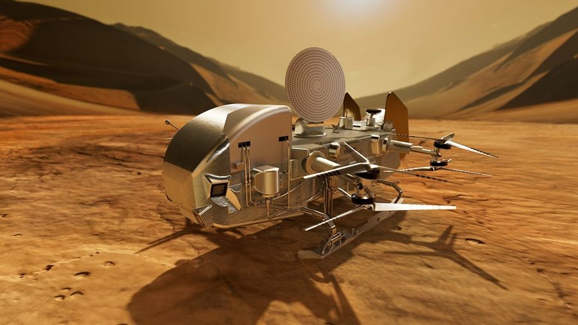
Dragonfly is a rotorcraft lander mission to Saturn’s largest moon, Titan, destined to conduct science across multiple locations by sampling surface materials to measure their detailed compositions, and observing geology and meteorology. The Johns Hopkins Applied Physics Laboratory (APL) manages the mission for NASA and is building the rotorcraft, which is scheduled to launch in 2028 and reach Titan in 2034.
“Dragonfly is a mission that demands exceptional reliability and consistency, and we’re proud that the Hallogic OMH3075S has been selected for this application,” said Klaus Zwerschina, VP Components, TT Electronics. “We work closely with customers to de-risk performance-critical designs, supporting programmes that value engineering continuity and a disciplined supply approach from design-in through production, for long service life.”
NASA’s Dragonfly mission will send a car-sized, nuclear-powered octocopter drone to Saturn’s moon Titan to search for the chemical building blocks of life. Scheduled to launch in July 2028 and arrive in 2034, it will use its eight rotors to fly between diverse locations, analyzing the surface with a suite of advanced instruments.
Never before have humans planned an airborne science mission to another world like Dragonfly. The Dragonfly rotorcraft will break the barriers for exploration of other planetary bodies. Instead of being limited to just the region around its landing site, Dragonfly’s rotors will carry it for miles across Titan during its planned 3.3-year mission, stopping to explore a variety of geologically interesting areas along the way, including dunes and Selk Crater. Dragonfly is expected to make one flight every 1-2 Titan days, which is called a Tsol and lasts about 16 Earth days.
The activities involved in assembling the mission’s rotorcraft lander and testing it for the rigors of launch and extreme conditions of space are currently underway in clean rooms and control rooms at the Johns Hopkins Applied Physics Laboratory (APL) in Laurel, Maryland.
In partnership with teams across government, industry and academia, APL is building the car-sized, nuclear-powered drone for NASA. Dragonfly is scheduled to launch no earlier than 2028 for a six-year voyage to Saturn’s moon Titan, where it will explore a range of diverse sites to study the chemistry, geology, and atmosphere of the terrestrial moon and ultimately advance our understanding of life’s chemical origins.
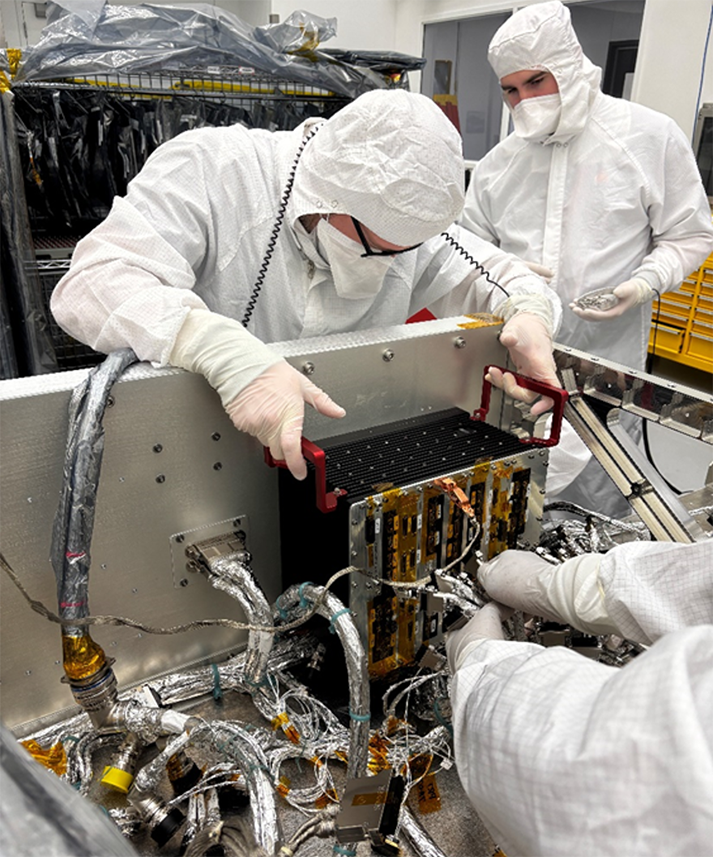
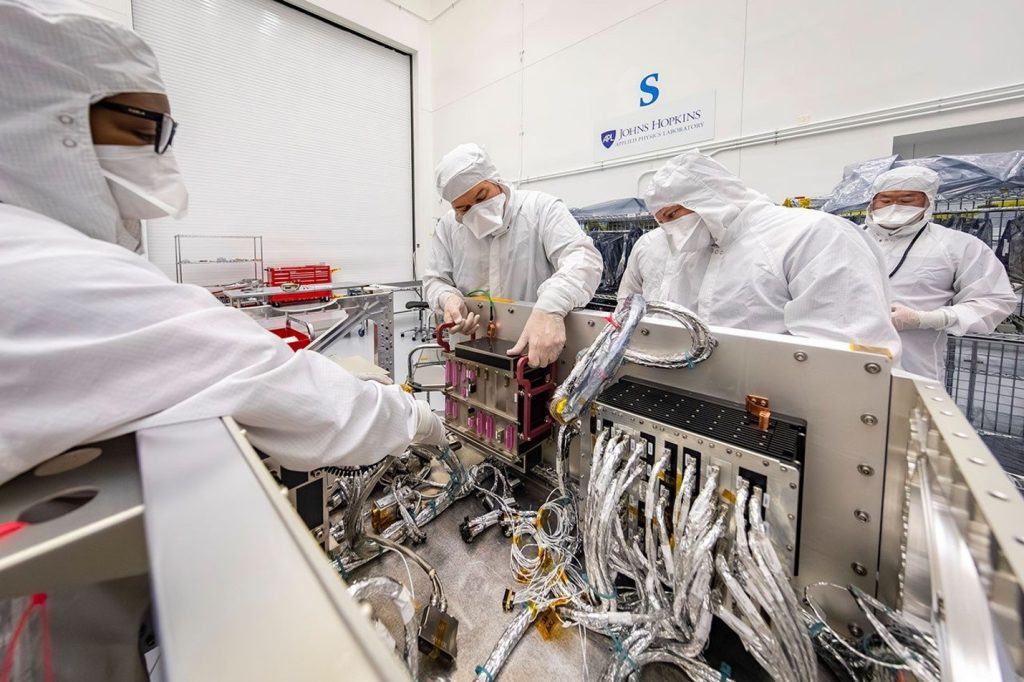
Primary activities during the first weeks of this effort included power and functional testing on two critical components: the Integrated Electronics Module (IEM) and the Power Switching Units (PSUs). Think of the IEM as Dragonfly’s “brain,” containing the spacecraft’s core avionics (such as command and data handling, guidance and navigation, and communications) in a single space-saving and power-efficient box. The IEM and both PSUs were connected to Dragonfly’s wiring system and passed their first power-service checks.
“This milestone essentially marks the birth of our flight system,” said Elizabeth Turtle, Dragonfly principal investigator from APL. “Building a first-of-its kind vehicle to fly across another ocean world in our solar system pushes us to the edge of what’s possible, but that’s exactly why this stage is so exciting. The team is doing an outstanding job, and every component we install and every test we run brings us one step closer to launching Dragonfly to Titan.”
Much work has led up to this point. The aeroshell and cruise-stage assemblies are moving forward with integration and testing at Lockheed Martin Space in Littleton, Colorado. The team completed a thorough aerodynamic test series in the wind tunnels of NASA’s Langley Research Center in Hampton, Virginia. Testing continues in the Titan Chamber at APL of the foam coating that will insulate the rotorcraft from Titan’s frigid temperatures. The science payload is coming together at locations around the country and internationally. Additional flight systems are scheduled for delivery and testing within the next six months.
Dragonfly integration and testing will continue at APL through this year and into early 2027, when system-level testing is planned at Lockheed Martin. Late next year, the lander returns to APL for final space-environment testing before heading to NASA’s Kennedy Space Center in Florida in spring 2028 for launch aboard a SpaceX Falcon Heavy rocket that summer.
“Starting integration and testing is a huge milestone for the Dragonfly team,” said Annette Dolbow, the Dragonfly integration and test lead at APL. “We’ve spent years designing and refining this amazing rotorcraft on computer screens and in laboratories, and now we get to bring all those elements together and transform Dragonfly into an actual flight system.”
For more info, see www.ttelectronics.com, www.jhuapl.edu, www.nasa.gov.