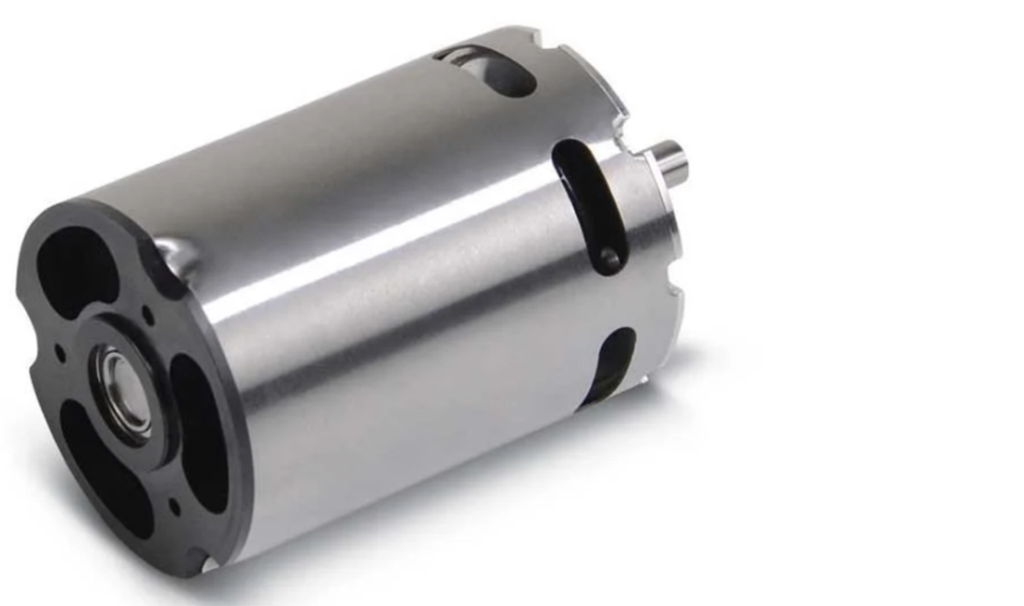
Using advanced electromagnetic design, Portescap has developed a new slotless motor that becomes its latest innovation for the industrial power tools market. With its slotless design, the new motor achieves speeds up to 30,000 rpm, ensuring high performance even at low voltage.
The advanced electromagnetic design allows it to sustain a peak torque of up to 1.1 Nm for 2 seconds. Weighing just 230 grams and having a compact 40mm diameter, it not only supports application miniaturization but also enhances tool ergonomics.
Suitable for battery-powered hand tools, especially those using 18V batteries, the motor comes in two lengths, the 40EC-Pro PT 44 at 44mm and the 40EC-Pro PT 55 at 55mm. Notably, PT 55 is Portescap’s first motor to feature an integrated fan which actively cools the motor and boosts its continuous power from 150W to 425W. Both models are cost-optimized through an innovative assembly process.
Slotless vs slotted brushless DC motor design
Due to their mechanical commutation, brushed dc motors have limited operational lifetime and are confined to low operating speeds typically less than 12K rpm, explains Portescap. This makes them not particularly suitable for certain medical and industrial tool applications. Electronically commutated miniature motors continue to gain interest due to their simple construction and long operational lifetime.
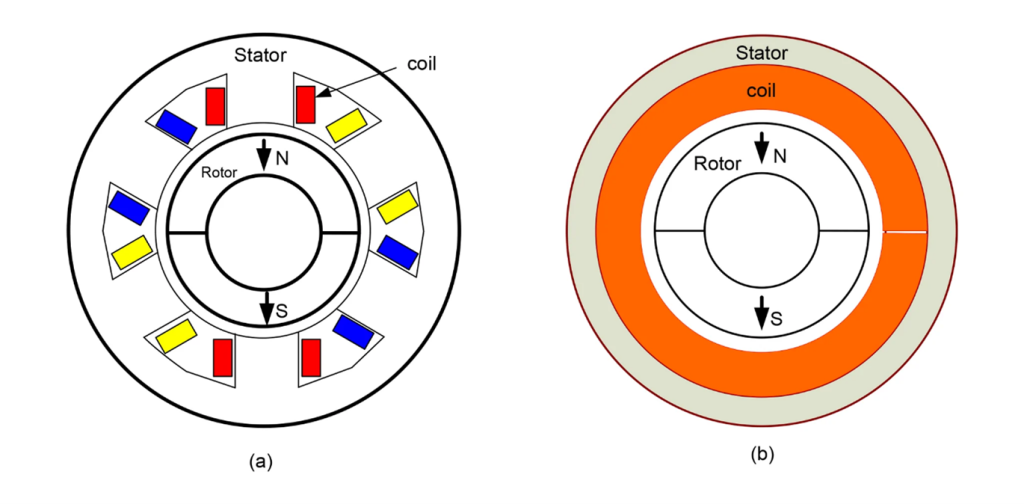
In slotted BLDC motors, the presence of stator teeth prevents the overall size of the motor from being minimized. Moreover, the winding process becomes progressively more difficult as the motor shrinks in size . On the other hand, the slotless BLDC motor has either skewed or axial type windings fixed on the cylindrical stator iron core providing several advantages as well as small size.
Although the power density of slotless BLDC motors may be lower than that for equivalent slotted motors, the emergence of high energy permanent magnets (ex : NdFeB and SmCo) and its magnetization arrangements (e.g., radial, parallel and Halbach) have promoted a renewed interest in slotless motors. Also, easier manufacturing of the stator core is possible and this allows the design of the motor parts with a low degree of complexity. On the other hand, slotted designs do not take advantage of high energy magnets due to the reduced slot area and therefore reduced ampere turns.
As a result, in slotted design, the thicker teeth are provided to increase the magnetic loading of the motor, but this reduces the slot area and therefore the electrical loading of the motor. Thus, slotted motors do not take the advantage of stronger magnets.
In order to obtain mechanical stabilization under high speed operation (ex: 40,000 to 60,000 rpm), the slotless rotor has a two-pole permanent magnet. In addition, the stator core losses are restricted to an acceptable range while the motor operates at high speed. Core losses are relatively small due to its slotless stator structure. As a result, in slotless motor design, stronger magnets barely impact the saturation level due to higher effective air-gap length. Thus, the impact of core losses is less at high speed operation.
In slotless BLDC motors, the cogging torque is extremely small, reducing the vibration and noise during operation. Also, the inductance is small compared to the slotted motors, therefore more accurate sensor-less driving is possible. However, low inductance results in higher losses if pulse width modulation control is applied.
In slotless BLDC motors, the stator winding differs from the conventional slotted motors which are inserted in the slots. For example, the windings in the slotless motors can be self-bonded with skewed and cup shaped windings placed on the air gap. This motor can be analyzed in simple two dimensional finite element method based model, if the rectangular windings or axial coils are used. See www.portescap.com.