By Martin Bannon, Innovation Manager, STFC
In the pursuit of scientific advancement, particle accelerators have long stood as symbols of technological prowess. Yet their immense power consumption and complex infrastructure pose significant environmental and operational challenges.
The Zero Power Tuneable Optics (ZEPTO) magnet was developed by the Accelerator Science and Technology Centre (ASTeC), part of the Science and Technology Facilities Council (STFC). This work was carried out in collaboration with CERN and Magnet Applications, a division of Bunting, who provided the magnet engineering and magnetisation expertise for the permanent magnet systems. Together, these efforts have produced a transformative solution that promises to reshape the future of accelerator design.
Reimagining Magnetism in Accelerators
Traditional quadrupole magnets rely on electromagnetism, demanding continuous electricity and cooling systems. ZEPTO magnets, by contrast, harness high-performance tuneable permanent magnets to generate the strong fields required for beam focusing without consuming power or emitting carbon dioxide.
The approach is proven in operation. A ZEPTO magnet was tested at Diamond Light Source, the UK’s national synchrotron science facility in Oxfordshire. A comparable electromagnet can account for ~136kg of CO₂ emissions per year; the ZEPTO demonstrator installed in August 2022 showed no radiation-induced degradation and saved ~700 kWh/year.
Engineers on the Compact Linear Accelerator for Research and Applications (CLARA) at STFC’s Daresbury Laboratory will install a ZEPTO magnet in 2026. It will replace an existing electromagnet, performing the same function with zero power draw, while maintaining precision and beam quality.
The current ZEPTO platform includes high-gradient quadrupoles (15–60 T/m), low-gradient quadrupoles (4-40 T/m), and dipoles (0.45-1.1 T central field). The Diamond prototype used samarium–cobalt (SmCo) for radiation resistance and thermal stability. Designs are covered by multiple patents and have undergone rigorous magnetic measurement and validation.
The ‘Ice Cube Tray’: overcoming engineering hurdles
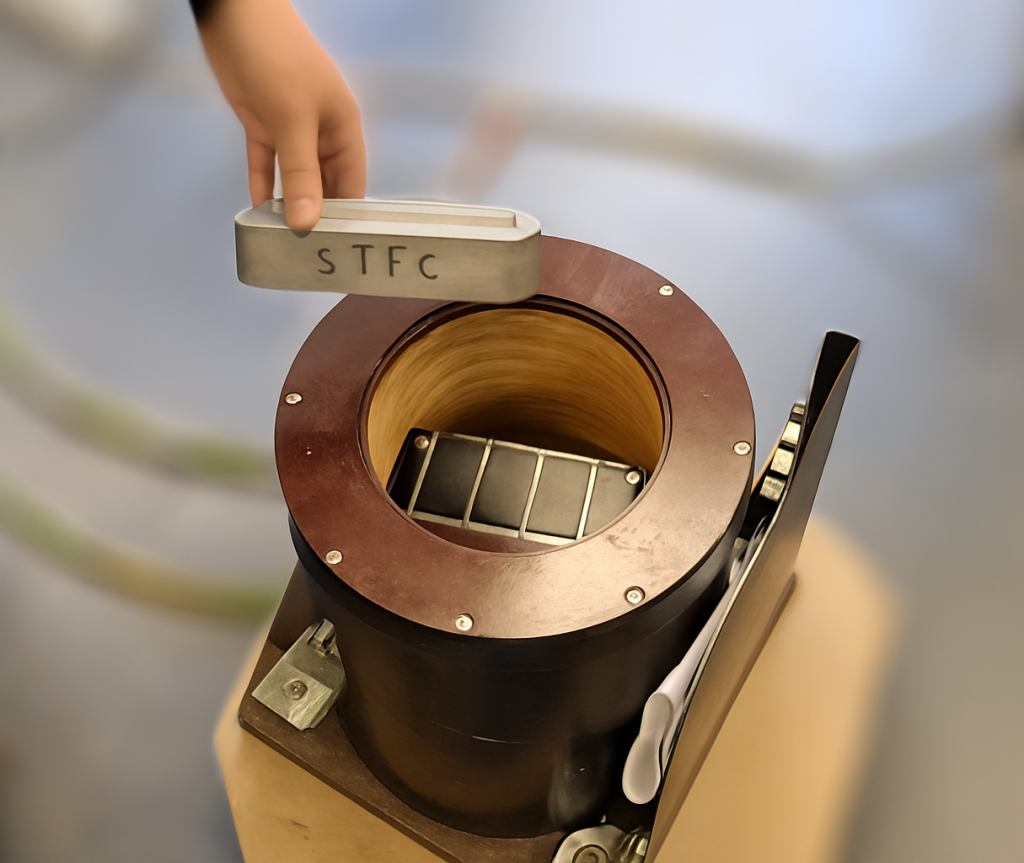
The development of ZEPTO magnets required overcoming formidable engineering challenges. Assembling large, high-strength magnets into precise geometries is akin to moving a car within a hair’s width. STFC and Magnet Applications therefore developed a post‑assembly magnetisation method, nicknamed the ‘Ice Cube Tray’ for its appearance, to achieve repeatable alignment and safe handling:
• Eight large N52 grade neodymium blocks loaded unmagnetised into the Ice Cube Tray.
• A 2300 kA/m magnetising fixture saturates the magnets post-assembly.
This approach eliminates risks of incorrect orientation and technician injury, while reducing build time from a full day to just two hours. It also preserves fragile coatings and enabled a redesign with fewer slots, larger blocks, and simplified carriers – without compromising magnetic performance.
Improved beam stability and tunability
ZEPTO magnets enhance beam stability and beam optics in several ways.
Stability:
• ZEPTO’s motors require only a few watts during adjustment, meaning minimal power draw.
• Passive operation without cooling systems and power supplies means ZEPTO has vibration-free operation.
• Without the problems of power fluctuations or interruptions, ZEPTO can maintain a stable magnetic field.
• ZEPTO’s diamond-shaped configuration creates a zero-field centre ideal for beam stability.
• Less jitter and fewer realignments are possible due to ZEPTO’s precise adjustability from 3% to 100% gradient.
• ZEPTO uses Samarium Cobalt materials to reduce field drift through improved thermal stability.
ZEPTO’s mechanical design allows precise adjustment of permanent magnet blocks, delivering flexibility for a range of beam conditions:
• Gradient control: Moving blocks relative to steel poles changes flux density, enabling fine control of field gradients.
• Independent carriage motion: Corrects field asymmetries and supports high-precision optics.
• Dynamic operation: Real-time adjustments without hardware changes allow rapid switching between energies and experiments.
• Compact layout options: The simplified lattice design supports compact and efficient infrastructure layouts.
These capabilities deliver 4–60 T/m gradients and 0.45–1.1 T central fields without active cooling or continuous electrical power, making ZEPTO a compelling alternative where electromagnets are typically assumed.
Collaborative innovation
ZEPTO exemplifies the power of collaboration. STFC’s ASTeC and Technology departments worked closely with CERN and Magnet Applications to refine the design and build process. ZEPTO’s unique diamond-shaped pole arrangement creates a zero-field centre, eliminating the need for continuous power and offering a scalable, environmentally sustainable solution.
Backed by a £250,000 Knowledge Asset Grant from the UK Government Office of Technology Transfer, ZEPTO is poised for further development. The grant supports the build and testing of the next iteration of the magnet, with installation on CLARA targeted for early 2026.
The successful implementation of ZEPTO magnets could revolutionise accelerator technology, making it more sustainable and cost-effective. Opportunities for commercial licensing are also on the horizon, with the potential to extend ZEPTO’s benefits beyond research facilities to industrial and medical applications.
Ben Shepherd, Head of the Magnetics and Radiation Sources Group at STFC, shares the enthusiasm:
“We’ve been developing our invention for a few years now. This grant is a great opportunity to take our work to the next level. I’m optimistic that ZEPTO could be incorporated into the early planning phases for future particle accelerators.”
Martin Bannon, Innovation Manager at STFC, adds that:
“ZEPTO shows how innovation can deliver sustainability without sacrificing performance. While it began in accelerator technology, ZEPTO’s principles of energy efficiency, precision, and tunability could be useful for many applications.”
Get in Touch
ZEPTO isn’t just for accelerators, it’s a smarter way to cut energy use and improve precision in sectors like medical imaging, industrial automation, and clean energy. Removing continuous power reduces both operational cost and carbon impact. STFC is keen to work with partners to turn this innovation into real-world solutions.
If your project needs precision magnetic engineering, low energy alternatives to electromagnets, or clever design thinking, I’d love to hear from you. Contact me at: martin.bannon@stfc.ac.uk
About Magnet Applications
Magnet Applications, a Division of Bunting, engineers permanent magnets, magnetic assemblies, and advanced magnetisation systems for demanding scientific, industrial, and accelerator applications.
As the industrial partner on the ZEPTO project, Magnet Applications designed, assembled, and magnetised the high-performance permanent magnet systems used in the demonstrator, helping translate the concept into a safe, repeatable, and production-ready solution.
About the Science and Technology Facilities Council
The UKRI Science and Technology Facilities Council (STFC) funds and supports research in particle and nuclear physics, astronomy, gravitational research and astrophysics, and space science and also operates a network of five national laboratories as well as supporting UK research at a number of international research facilities including CERN, FERMILAB and the ESO telescopes in Chile. STFC is keeping the UK at the forefront of international science and has a broad science portfolio and works with the academic and industrial communities to share its expertise.
For more information on permanent magnet engineering and magnetization solutions, visit www.magnetapplications.com