One of the world’s largest superconducting toroidal field coils, manufactured by the National Institutes for Quantum Science & Technology and Toshiba Corporation, has successfully passed excitation testing under cryogenic conditions at -269°C. The test replicates the actual operating conditions of the ITER2 nuclear fusion reactor and marks a major step toward start of operation of ITER.
Japan is contributing to the ITER Project, a global collaboration among 34 countries also representing one of the seven members, aimed at demonstrating the scientific and technological feasibility of fusion energy. At the construction site in Saint-Paul-lez-Durance in southern France, assembly of key components is progressing steadily toward the commencement of operations, while the manufacturing of ITER components by the participating members continues to advance.
The toroidal field coil is one of the most critical components of ITER, the generator of the powerful magnetic field required to confine the plasma. As ITER moves toward the start of operations, a key technical challenge for the project’s success is to strengthen the reliability of the integrated system through testing in conjunction with the power supply and cryogenic plant.
The coil was cooled from room temperature to its operating temperature of -269°C, confirming its transition to the superconducting state. The coil was then successfully energized up to 10,000 amperes for the first time under superconducting conditions. This is the first successful excitation test of an ITER TF coil under superconducting operating conditions.
The results validated the manufacturing method used to produce a large-scale coil employing niobium-tin (Nb₃Sn) superconducting conductors, which are highly sensitive to strain. The test also provided key data required to ensure stable operation under cryogenic conditions, including resistive heating at conductor joints and coolant flow characteristics at low temperatures. Both were confirmed to be within the design expectations. No abnormalities, such as coolant leakage during cool-down or energization, were observed, confirming the integrity of the TF coil.
This achievement demonstrates that Japan possesses world-leading core technologies for large-scale superconducting coils which are essential for the development of fusion energy. The test also represents a major step toward the start of ITER operations.
The superconducting conductor used for the TF coils consists of a cable made by cabling together 900 superconducting strands and 522 copper strands, each 0.82 mm in diameter, and enclosing the cable in a stainless-steel jacket. The superconducting material is niobium-tin (Nb₃Sn), which becomes superconducting when cooled below −255°C.
The magnet system is a massive assembly approximately 30 meters in diameter and weighing about 10,000 tons. The D-shaped toroidal field oils, 18 of which are arranged in a ring, generate the magnetic field required to confine the plasma. As one of the most important components of ITER, the reliability of the coils is essential to the project’s success. Japan was responsible for manufacturing 25% of the TF conductors, all 19 TF coil structures, and 9 of the 19 TF coils.
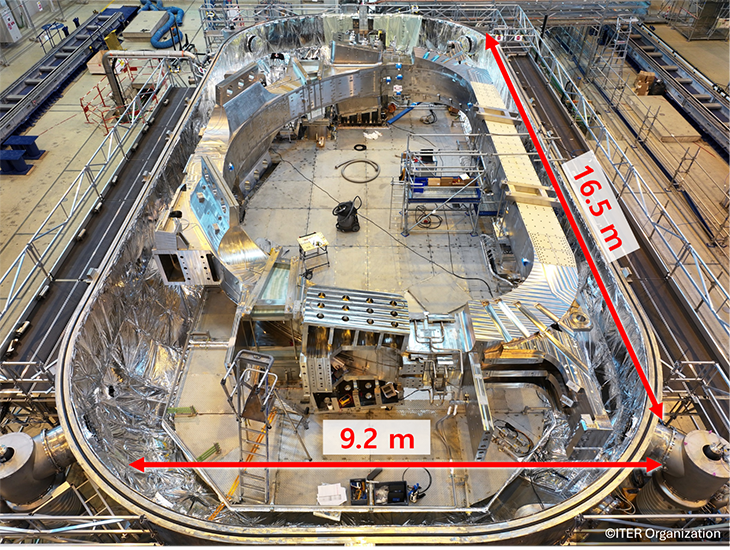
A large superconducting magnet measuring approximately 16.5 meters in height, 9.2 meters in width, and weighing 310 tons, each coil consists of a winding pack, which generates magnetic fields of up to 11.8 tesla, and a supporting structure that withstands electromagnetic forces of up to approximately 60,000 tons acting on the inboard side of the coil. The winding pack is made up of seven stacked double pancakes, each consisting of a D-shaped superconducting conductor and a radial plate with grooves that hold the conductor in place. See www.iter.org.