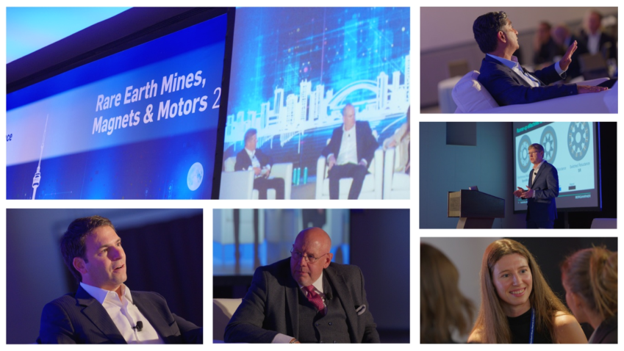
From September 28–30, 2026, Adamas Intelligence hosted Rare Earth Mines, Magnets & Motors 2026 in Toronto. The sold-out conference drew more than 370 delegates from across the mine-to-magnets-to-OEM supply chain and featured presentations, panel discussions and fireside chats with company leaders and technical experts from around the world.
In the twelve months since the last summit, a number of companies involved have been reshaped by investment, offtake, partnerships and M&A amidst a global effort by corporations, governments and investors to build an ex-China supply chain. For many companies, the groundwork has been laid and substantial build-outs and ramp-ups are underway.
This article highlights some of the key takeaways as presented by Adamas in a white paper summarizing the proceedings. Magnetics Magazine was a media partner of the conference.
Transformative announcements
On Day 1, Tronox announced a transformational agreement with JX Advanced Metals to jointly advance their rare earth strategy while Hertha Metals announced a $134 million Series A raise to produce iron for rare earth magnets in the U.S. On Day 2, Lynas Rare Earths announced the potential acquisition of Meteoric Resources for A$968 million. A number of other deals and transactions were discussed and explained.
Crisis level prices are not the future, but higher ones are
Prices were a central topic in both discussions and presentations. Speakers were unanimous that the “crisis-level” prices quoted to price reporting agencies by traders in Europe and the United States have no volume-backed basis in current or future trade.
As Adamas noted in a presentation, when prices sit far above the marginal cost of existing and emerging Western production, two things follow. Every project and producer in the pipeline looks highly profitable, and capital and operating decisions respond as expansions accelerate and new capacity is brought forward.
The resulting increase in non-Chinese supply then competes for a limited pool of Western and allied demand, and premiums compress toward the cost of the marginal Western producer plus a durable, but not extreme, security-of-supply margin. High prices, as the old adage has it, are the cure for high prices.
That dynamic is already visible in the data that matter most: actual Western-origin transactions analyzed by Adamas as part of its price discovery. In 2025, the sales-weighted average price of Western-produced dysprosium oxide was $365/kg. By mid-2026 it was just over $400/kg. That is meaningfully above, and independent of, Chinese benchmark levels, but far below the thinly traded peaks cited by many price reporting agencies.
Emerging Western producers of dysprosium, terbium, samarium, yttrium and other oxides for which China remains the only alternative supplier are not treating a first-mover position as a license to charge the highest price the market will bear. They are entering pragmatically, with an eye to long-term customer relationships and to the likelihood that others will follow, competition will pull prices toward the marginal cost of production, and buyers will remember how they were treated when the market becomes more diverse. That logic is already apparent in emerging Western dysprosium and terbium oxide supply, and the analysts at Adamas expect it will hold as samarium, yttrium and other product streams ramp as well.
Prices were a central topic in both discussions and presentations. Speakers were unanimous that the “crisis-level” prices quoted to price reporting agencies by traders in Europe and the United States have no volume-backed basis in current or future trade.
As Adamas noted in a presentation, when prices sit far above the marginal cost of existing and emerging Western production, two things follow. Every project and producer in the pipeline looks highly profitable, and capital and operating decisions respond as expansions accelerate and new capacity is brought forward.
The resulting increase in non-Chinese supply then competes for a limited pool of Western and allied demand, and premiums compress toward the cost of the marginal Western producer plus a durable, but not extreme, security-of-supply margin. High prices, as the old adage has it, are the cure for high prices.
That dynamic is already visible in the data that matter most: actual Western-origin transactions analyzed by Adamas as part of its price discovery. In 2025, the sales-weighted average price of Western-produced dysprosium oxide was $365/kg. By mid-2026 it was just over $400/kg. That is meaningfully above, and independent of, Chinese benchmark levels, but far below the thinly traded peaks cited by many price reporting agencies.
Emerging Western producers of dysprosium, terbium, samarium, yttrium and other oxides for which China remains the only alternative supplier are not treating a first-mover position as a license to charge the highest price the market will bear. They are entering pragmatically, with an eye to long-term customer relationships and to the likelihood that others will follow, competition will pull prices toward the marginal cost of production, and buyers will remember how they were treated when the market becomes more diverse. That logic is already apparent in emerging Western dysprosium and terbium oxide supply, and the analysts at Adamas expect it will hold as samarium, yttrium and other product streams ramp as well.
Potential for bottlenecks at every step of the chain
Looking ahead, emerging magnet producers will need to contend with potential bottlenecks at every step of the way as capacity outside China seeks to grow three-fold by 2030.
Upstream, a tripling of NdFeB production capacity outside China by 2030 would necessitate a tripling of NdPr oxide supplies and an order of magnitude increase in dysprosium and terbium oxide supplies in just 4 years. Further downstream, metal and alloy production capacity outside China also has potential to be a major bottleneck for the magnet supply chain. Japan and Vietnam are relatively self-sufficient in this regard. In the U.S. and Europe, some magnet makers overcome the issue through vertical integration, others by partnering with third parties.
Collectively, however, the metal making pipeline continues to lag behind the magnet production pipeline and thereby stands become a near-term bottleneck for some. Further down the chain, if oxide and metal supplies can keep up, there’s still a high probability in the view of Adamas that availability of the full spectrum of magnet grades and form factors outside China will also be a bottleneck in the near-term that hinders NdFeB makers from seizing the full spectrum of demand. Last but not least –
availability of critical inputs, like sulfuric acid, hydrochloric acid and extractants, as well as equipment, like vacuum furnaces or strip casters, also has potential catalyze bottlenecks at every step of the value chain; particularly with so many companies racing to build capacity at the same time.
As such, it is likely to be a bumpy few years ahead. Strong demand on one side of the market, potential supply constraints at every step of the other side, and this could mean price spikes for some and shortages for others as the market ramps up and matures.
Heavy rare earth thrifting remains a priority – for now
Panels and presenters devoted considerable time to the current push to reduce heavy rare earth concentrations in magnets. Driven almost entirely by China’s restrictions on dysprosium and terbium exports (and on magnets containing these elements) since April 2025, magnet makers and OEMs are placing strong emphasis on minimizing heavy rare earth consumption – the former to reduce costs, the latter to reduce supply risks.
In the opening fireside chat, James Litinsky highlighted MP Materials’ rapid progress, noting that the company has reduced heavy rare earth concentrations in EV-grade magnets by more than 50% over the past two years. He added that MP is currently roughly 6–12 months behind the most advanced magnet makers in China, but he believes (and is pressing the team) that MP will be the world’s most cutting-edge magnet producer – including relative to China – by the time its second magnet factory, 10X, comes online.
Can’t make magnets without iron or equipment
Two companies on stage offered a reminder that a mine-to-magnet chain still needs magnet-grade iron and the equipment to turn ore into oxides and oxides into metals. NdFeB magnets are nearly 70% high-purity iron by weight, and the U.S. imports nearly all of it. Hertha Metals, the Texas-based company founded by Dr. Laureen Meroueh, made that gap the subject of her presentation: the purity magnet makers require, and why a domestic iron supply matters as much as separated rare earths. Hertha produces high-purity iron and steel in a single continuous reactor at a demonstration plant in Conroe. On Day 1 the company announced a $134 million Series A, including $65 million from the U.S. government, to build Hertha Chalyx, a plant planned for 10,000 tonnes a year of steel-grade and magnet-grade iron. The company has since broken ground on the facility.
Tenova, the Italian metals-technology company in the Techint Group, spoke to the other missing piece: the furnaces, cells and process equipment Western producers need to stand up oxide separation and metal making. It designs and supplies plants for the steel and metals industries, including electrolytic cells for NdPr metal, and has already commissioned that equipment at MP Materials’ Independence facility in Texas.
Innovations abound
Delegates also heard from companies working on the next layer of the chain: rare-earth-free magnet materials, new ways of making magnets, and modular separation. Niron Magnetics discussed its ramp into iron nitride magnets, made from iron and nitrogen rather than rare earths. The Minnesota company already runs a commercial pilot in Minneapolis, broke ground in 2025 on a 1,500-tonne-a-year plant in Sartell due in 2027, and is sampling partners in automotive, industrial and electronics uses, from motors and robotics to data-center cooling and defense.
Advanced Magnet Lab (AML) showed how its PM-Wire process packs magnet alloy powder into thin-walled tubes, densifies it and sets the magnetization direction, producing straight, curved, ring or helical magnets in long lengths, with a jacket that seals the material. The configurations, including PM-Uniform, PM-Axial and PM-360, are aimed at motors and other assemblies where shape and magnetization direction matter as much as the alloy. AML can run the process on NdFeB and on lower-criticality or non-rare-earth materials such as samarium iron nitride.
Momentum Technologies described a different cut at separation. Its membrane solvent extraction system, licensed from work originating at Oak Ridge and scaled at a demonstration plant in Carrollton, Texas, recovers neodymium, praseodymium, dysprosium and other rare earths from magnet swarf and mining tailings in modular units, targeting high recovery and purity without a conventional large-scale separation plant.
Looking ahead
With the rare earth magnet factory boom still underway, a question came up on stage: is there enough demand to go around? The answer: Yes. But capturing it will be harder than building tons of nameplate capacity. Emerging magnet makers are chasing two pools of demand. One is new growth, from EVs, robotics and the rest of the electrified and connected economy.
The other is demand that Chinese magnet exports already fill. Taking on that second pool means displacing an incumbent, which takes a competitive cost base and a broad offering of grades, form factors and process capability that many of the plants now constructing will not have widely in commercial operation by 2030.
The full report is available for free on the Adamas website and for more info on Adamas Intelligence, see www.adamasintel.com.