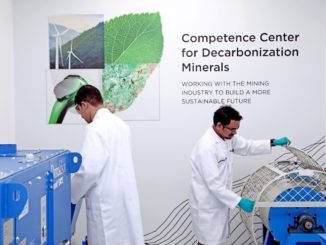
Australian metals company Metallium and its American subsidiary Flash Metals USA are expanding their collaboration with scientists at Rice University to determine if flash joule heating can be further advanced for directly separating individual rare earth elements. The research is designed to simplify or even bypass processes for upgrading rare earth element feedstocks across traditional flow sheets.
The process rapidly heats materials in a controlled atmosphere to extract metals from the feedstocks. Unlike conventional sulphuric-acid circuits, flash joule heating delivers what they consider to be a more elegant and efficient solution producing high-value intermediates that are directly compatible with existing solvent extraction (SX) separation plants. Metallium has licensing rights to the technology developed at Rice.

“Today, REE separation is dominated by SX, which requires huge industrial plants with very large footprints, high capital and operating costs, and commission timelines that can stretch for years,” explained Michael Walshe, Metallium managing director & CEO. More than 90% of this capacity is in China, he says.
“Our technology has already demonstrated its ability to upgrade multiple REE feedstocks into SX-ready products, providing Western supply chains a midstream solution today. In parallel, our Rice University collaboration is tackling the next frontier: using FJH to separate individual REEs directly, potentially bypassing solvent extraction,” Walshe said. He noted that with SX plants taking years, vast capex and footprint and massive solvent use, even partial success could be transformative. “Our continuing effort with Rice positions Metallium for near-term revenue from partnerships and licensing, and long-term leadership in REE refining.”
Metallium plans to deliver case studies across a variety of feedstocks as it works with Rice in further expanding the technology. The company’s modular facilities are designed to offer original equipment manufacturers and recyclers a clean, flexible solution to process complex materials quickly. It has recently secured its first commercial site in Texas via Flash Metals, and announced plans for two additional already-permitted sites in Massachusetts and Virginia.
“We work with rare earth developers and producers to treat a wide range of feedstocks including Mixed rare earth carbonate; monazite-rich tailings; flotation concentrates; magnet scrap and swarf and other high-value industrial residues,” explains Walshe. It is recovering neodymium-praseodymium (NdPr); dysprosium and terbium (DyTb), as well as other minerals. “Our technology has the potential to revolutionize metal recovery by reducing energy consumption, reagent use, and waste, offering a more economical and environmentally friendly alternative.”

At Rice, the progess is centered at the research lab of chemistry professor James Tour. Last year it announced the development of a new method known as flash-within-flash Joule heating that could transform the synthesis of high-quality solid-state materials, offering a cleaner, faster and more sustainable manufacturing process.
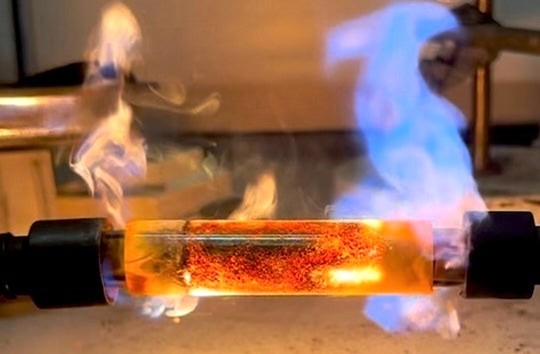
The latest research builds on Tour’s 2020 development of waste disposal and upcycling applications using flash joule heating to pass a current through a moderately resistive material to quickly heat it to over 3,000 degrees Celsius and transform it into other substances. The new process opened the viability to flash-synthesize more elements than was previously possible.
In June, Metallium, formerly named MTM Critical Metals Ltd., announced that it has secured about $32.5 million in a private placement from institutional investors to support its plans. “With high-grade feedstock secured and commissioning under, MTM is now positioned to deliver commercial output from the US in the near term,” said Walshe. See www.metalliuminc.com, www.rice.edu.