Across marine, government and industrial sectors, electrification is accelerating—but the requirements are rarely simple. Platform designers and system integrators are being asked to deliver more power in less space, improve overall energy utilization, and maintain performance in harsh operating environments. At the same time, they are managing integration risk, schedule pressure, and lifecycle expectations that can span decades.
In this environment, many teams face the same tradeoff: custom solutions can meet unique requirements but often bring cost and schedule complexity—while off-the-shelf options may fall short when packaging, thermal margin, or controllability are mission-critical.
Addressing these issues, defense technology company Leonardo DRS is developing the PR72 — a standard product family of permanent magnet electric machines engineered to deliver high power density, high efficiency and responsive controllability for an array of electrification applications. Designed in a modular building block architecture, they are intended to scale across a broad set of power levels and propulsion or drive architectures without forcing customers into a one-off design path.
For many electrification programs, the company notes, the technical requirement isn’t just a motor. It’s an electric machine that can adapt—across platforms, evolving requirements and different system architectures, helping customers reduce integration risk and keep programs moving—while still enabling configuration for platform-specific needs.
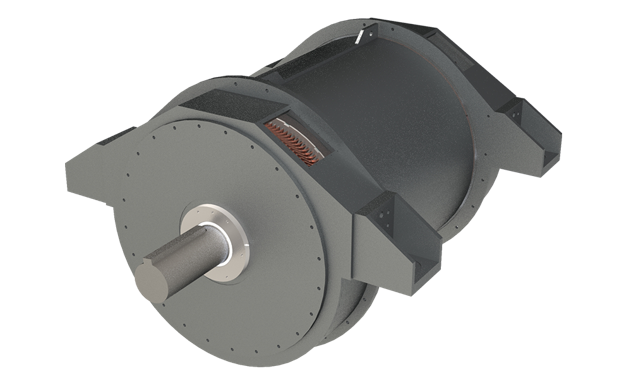
The series span 500 kW to 9 MW, with rated speeds from 300 to 1,800 RPM and efficiency greater than 98%. They align to IEC 60034 commercial standards and can be suitable for classification society type approval. They support continuous duty – S1 with a minimum 25-year design life.
Key attributes of PR72 are high power density to support compact integration and reduce system weight, high efficiency across operating ranges to improve energy utilization and thermal management, along with fast dynamic response and precise control for demanding motor-drive applications. They are designed to be ruggedized for harsh environments, shock and vibration and wide temperature ranges. Their integration-ready architecture is aligned to modern power electronics and control strategies, with engineering and manufacturing support from DRS for long-term program execution.
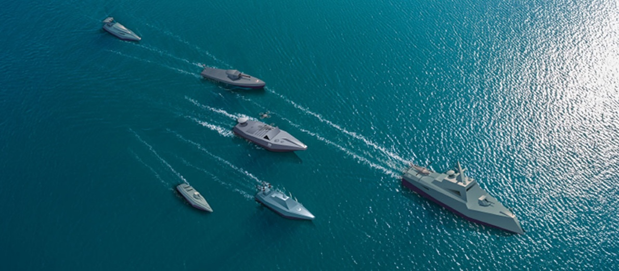
Applications are broad. The series is engineered for various naval applications including USV propulsion, marine propulsion, power generation and hybrid electric drive systems—including alignment with the company’s variable frequency drives. It is also engineered for flexibility and affordability across commercial applications such as:
- Offshore and onshore oil and gas – top drives, mud pumps, drawworks, compressor drives
- Power generation – variable-speed diesel-electric and gas turbine-electric configurations
- Mining and minerals processing – conveyor drives, hoisting, mill drives
- Industrial process drives – pumping, mixing, fan and blower applications
- Rail and heavy transportation traction drives
- Renewable energy – wind turbine generators and energy storage flywheel systems
As customers scale electrification, many are looking for solutions that deliver performance while minimizing the burden of a bespoke development cycle, says DRS. The market need is for a scalable, high-performance permanent magnet machine that can be configured for specific applications—without the cost and schedule of a custom-engineered solution—and supported by deep engineering, manufacturing, and lifecycle capability.
The PR Series machines utilize a conventional stator and rotor configuration with a cylindrical rotor positioned inside of the stator assembly. The motors and generators are designed to maximize the benefits of a direct drive mud pump configuration, for example. Inherently more efficient than a belt drive configuration, they can significantly reduce fuel consumption, operate more efficiently, and reduce parts and maintenance expenditures. The configuration can reduce footprint and weight by eliminating the back half of a pump skid.
Designed for power-dense performance & industrial reliability, they are built for continuous-duty industrial service, highly suitable for marine propulsion, hybrid electric drives, power generation, pumping, hoisting and drilling applications in the defense and commercial markets. They can be operated with a variable frequency drive and can be electrically connected to accommodate 1 to 4 drives.
As a standard, catalog product family in contrast to a custom-engineered solution, the design approach provides flexibility for customer-defined interfaces. Each motor configuration is built from a common set of subassemblies, enabling competitive pricing, short lead times and repeatable quality across all applications. The modular building block approach to active length allows customers to select the optimal torque rating for their application without incurring non-recurring engineering costs. See www.drs.com.