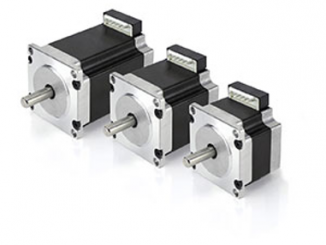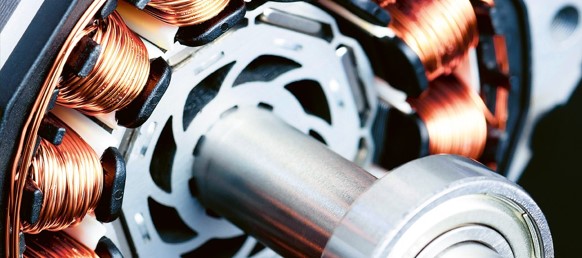
Inside many motors is a permanent magnet: the driving force behind the motor’s rotation and the smooth operation of the machine it powers. Their invisible force can attract, repel or set things in motion, making magnet an integral part of the machinery we use every day. Not commonly known, a vacuum pump can ensure the high quality and resilience required of a magnet. (Perhaps ironically, some of those magnets produced end up as key components driving the performance of vacuum pumps themselves.)
The unassuming but vital component begins as an ordinary metal. To turn a metal into a magnet, it takes an electromagnetic charge and a series of mixing, grinding, heating and pressing, assisted by a vacuum pump such as those made by Busch Vacuum Solutions. This article highlights a largely unseen aspect about the process, as explained in an issue of the company’s World of Vacuum newsletter. We also cover a new vacuum pump from Busch where permanent magnets are put to work.
Of course, only a few metals have the correct properties to make a permanent magnet. These are the ferromagnetic elements, which include iron, nickel and cobalt. By mixing these base metals with other materials, such as strontium carbonate, both their magnetic force and physical strength can be increased.
Aligning the charge
Ferromagnetic metals are made up of different regions called domains. Each domain has a magnetic charge – as though the piece of metal contains hundreds or thousands of tiny individual magnets. However, before the metal is processed, the domains are not aligned, and so they cancel each other out. In order to make an entire piece of metal magnetic, the domains must be aligned. To achieve this, the metal mixture is ground multiple times until each particle contains just one domain. First, the metal is ground in a dry process. Then it is ground again, with water added to the fine powder to create a slurry.
From mass to magnet
The wet process is what allows the new magnet to be formed into the shape required for a motor. The slurry is compacted into a form – in this case, small, curved rectangles that fit either side of the rotor. Once shaped, the excess water must be removed. First, the mass is pressed in the form and the resulting liquid removed.
Then, a vacuum pump is used. It gently draws out the humidity so that it can be drained off. Putting the mass under vacuum also eliminates any small water or air pockets that might still be present, which could otherwise lead to unwanted porosity and weakness in the finished product. Degassing of liquid, paste-like and moist products is one of the most important applications of modern vacuum technology
Once sufficient moisture has been removed, it’s time for the metal to become a magnet. The form is sintered in an oven at 1200 °C, then cooled. Finally, a strong electromagnetic charge is applied. This pulls all the previously jumbled domains into alignment and creates a coherent magnetic field. And so, a magnet is born, ready to turn a motor.
The Mink Ecotorque Claw Vacuum Pump
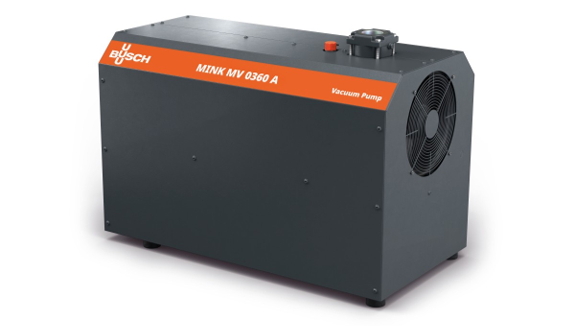
In February, Busch Vacuum introduced the Intelligent MINK MV 0360 A ECOTORQUE Claw Vacuum Pump, an intelligent and energy-efficient addition to its family of claw vacuum pumps. According to the company, it becomes the first claw vacuum pump worldwide equipped with an IE5 integrated permanent magnet motor, achieving up to 10% energy savings compared to conventional IE3 asynchronous motors.
The integrated variable speed drive ECOTORQUE automatically adapts performance to process demands, further reducing energy consumption and operating costs by an additional 50% across the entire vacuum range. Its compact, efficient, and low-maintenance construction makes the pump well suited for energy-conscious use in woodworking, pneumatic conveying, vacuum lifting, and pick-and-place applications.
Based in Maulberg, Germany, Busch Vacuum is part of the global Busch Group. One of the world’s largest manufacturers of vacuum pumps, the group also includes Pfeiffer Vacuum+Fab Solutions. See www.buschvacuum.com.