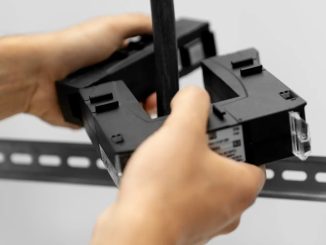
Danish transducer company Danisense has acquired specialist winding company Scanwinding of Poland. The move marks a significant milestone in Danisense’s growth trajectory, enhancing its manufacturing capabilities and market reach. Winding is a key process in the manufacture of precision current sense transducers, so the acquisition ensures the quality of Danisense’s product range and supports increased flexibility of customer service.
“Our acquisition of Scanwinding aligns perfectly with our vision of continuous improvement and excellence,” says Henrik Elbæk Pedersen, CEO at Danisense. “We are excited to combine our strengths and expertise with the talented team at Scanwinding to deliver enhanced value to our customers.”
Located in Skierniewice in central Poland, Scanwinding is a well-established company in the winding industry, with 15 employees led by CEO Magdalena Dziarmaga.
Danisense, founded in 2012 and with operations already in Denmark and Japan, focuses its developments on high precision current transducers that enable quick and easy measurement of AC and DC currents down to 1ppm. An extremely flat frequency response and DC stability are hallmarks of its products. By combining complex magnetic performance with advanced electronics it provides efficient and precise solutions for customers in demanding industries worldwide.
Danisense has also very recently achieved full ISO/IEC 17025 accreditation for AC calibration services at its state-of-the-art in-house calibration laboratory. This milestone follows the laboratory’s ISO/IEC 17025 accreditation for DC current transducer calibration up to 21 kA, obtained in September 2022, and further strengthens Danisense’s commitment to accuracy, high quality and fully traceable measurement results. The calibration laboratory is now equipped to handle a wide range of calibration requirements, including DC calibration from 1 A to 21 kA as well as AC calibration (53 Hz) from 1 A to 1.2 kA for gain error and phase shift. This extensive capability enables the calibration of a broad range of current transducers with either current or voltage outputs, supporting demanding applications across power electronics, energy, automotive, rail, and industrial sectors.
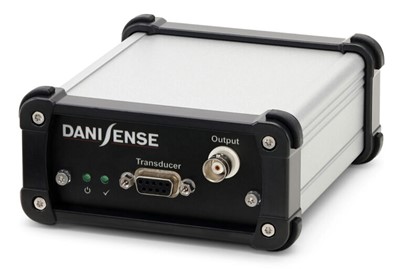
A recent product introduction from the company is a compact 1-channel system interface unit for ultra-stable, high precision flux gate technology current transducers. The DSSIU-1-V, a low-noise power supply and interface unit designed to support a wide range of its flux gate current transducers. The compact device (130mm x 116mm x 56mm) is equipped with an integrated Voltage Output Module, which precisely converts the measured current into an easily accessible voltage output via a BNC connector. With both 1V and 10V output options, and powered by universal mains, it can be an ideal solution for users who need to power only one transducer.
“By offering such a voltage conversion, Danisense is simplifying the measuring chain by enabling its customers to have a direct connection of the transducer to instruments like e.g. an oscilloscope,” comments Loic Moreau, Sales & Marketing Director. Main target applications include flux gate DCCTs, hall effect DCCTs, electric vehicle (EV) test benches, power measurement and power analysis, current calibration purposes as well as precision current sensing.

A fluxgate current transducer is a highly accurate sensor that measures AC/DC currents by detecting the magnetic field from the current using a ferromagnetic core, often in a toroid, and applying a closed-loop feedback system (zero-flux principle) to nullify this field, producing a proportional output signal. It works by driving the core into saturation with an excitation signal, and any external magnetic flux from the primary current causes an imbalance (asymmetry in the waveform), which is precisely measured and compensated for, allowing for extremely precise current measurement. For more info, see www.danisense.com.