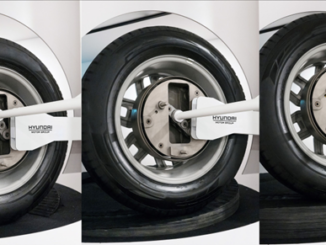
Innovations in powertrain architecture and power electronics from Denso are key elements of Toyota’s new all-electric bZ4X sedan for 2026, first introduced in 2022 and now also known as the bZ.
The newly adopted eAxle, new inverter with a flat, double-sided cooling structure incorporates advanced SiC (silicon carbide) power semiconductors and cooling technology, enhancing output density and efficiency. Transmission efficiency has been improved by enhancing gear precision and reducing oil agitation resistance through casing shape optimization.
The innovations were jointly developed by BluE Nexus, Aisin and Denso. BluE Nexus is a Japanese joint venture between Aisin and Denso that specializes in developing electric drive modules for hybrid and electric vehicles, particularly its core product, the e-Axle, which integrates a motor, inverter and transaxle. A key factor in achieving mileage capability has involved optimal magnetic design of the motor and the joining technology to shorten coil ends.
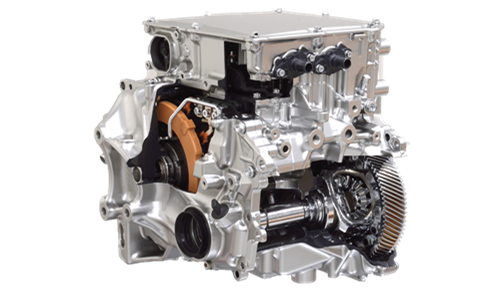
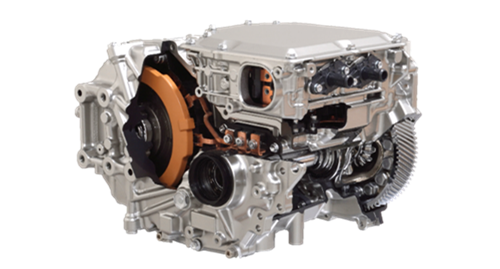
Electrification & power electronics developments boost power density
Newly developed electrification products comprise the inverter in the new eAxle, along with a battery cell supervising circuit designed to measure battery voltage and temperature, and a shunt current sensor for measuring current.
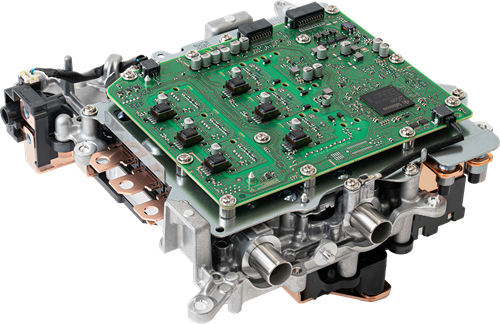
Using silicon carbide power semiconductors and a flat dual-sided cooling structure, Denso’s new inverter reduces power loss by about 70% and has been downsized about 30% compared to previous models. Drive technology helps maximize device performance, says the development team: “Through innovations in resin-insulated substrates and current pathways, we achieved approximately 50% reduction in inductance compared to our conventional products.”
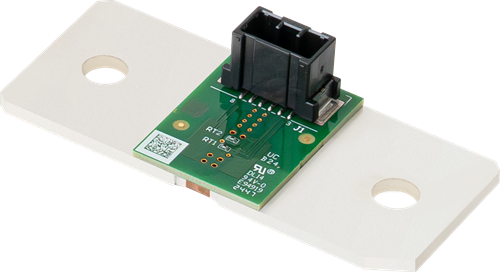
A shunt resistor method for current monitoring was adopted to achieve highly accurate current detection. Correction technology is a key factor, say the engineers. “Due to variations in resistance values caused by ambient temperature and individual differences, such as those arising from welding with copper, correction is necessary for shunt resistors. To address this, we conducted a material characteristic evaluation of shunt resistors and clarified the temperature range in which such variations occur.” For more info, see www.denso.com.