Making a custom magnetic assembly often calls for an orchestration of intricate design engineering and skillful fabrication. Perhaps that is truer nowhere than at ITER in France where engineers and technicians are wrestling with the demands of building a massive magnetic tokomak for the purpose of generating fusion energy. They are developing welding procedures for crafting first-of-a-kind components and devising strategies for welding in the confined spaces of a revolutionary creation, helping to define the techniques and standards that may shape fusion projects for decades to come.
Derived from a Russian acronym that translates to “toroidal chamber with magnetic coils” tokamaks rely upon magnetics for the foundation of their operation. Confinement of the plasma fuel is paramount. Reaching temperatures over 100 million°C (hotter than the sun’s core), it cannot touch the metal walls of the reactor. Powerful magnetic fields trap and levitate the charged particles in a doughnut shape, known as a torus. Magnetic coils also compress, shape and drive electrical currents through the plasma to keep the superheated gas stable. Without massive, highly advanced superconducting magnets, the tokamak concept would be impossible.
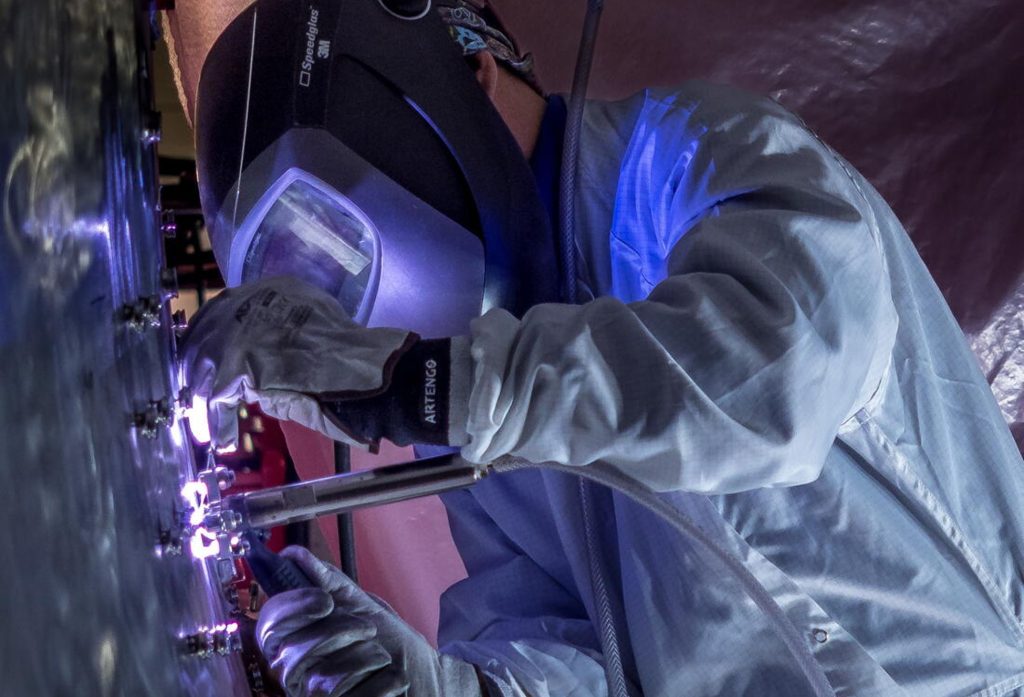
Welding is fundamental at ITER. Everything on the tokamak is metallic and every major system relies on welding—from joining cooling pipes or attaching diagnostic sensors, to joining the nine vacuum vessel sectors into a single plasma chamber. Yet while the basics of the welding methods used at ITER are the same as those found in fission projects and across heavy industry, there are challenges that are unique to fusion and to ITER.
“Because of the size of the tokamak, the complexity of the instrumentation, and the space constraints, we are solving problems that nobody has encountered before,” says Frédéric Lobinger, an ITER welding engineer in the Machine Assembly Program who focuses on port cells, diagnostics, and other tokamak systems. “Accessibility, shrinkage, installation sequencing, repair strategies, quality requirements, and integration of diagnostics are all areas where ITER is creating new knowledge.”
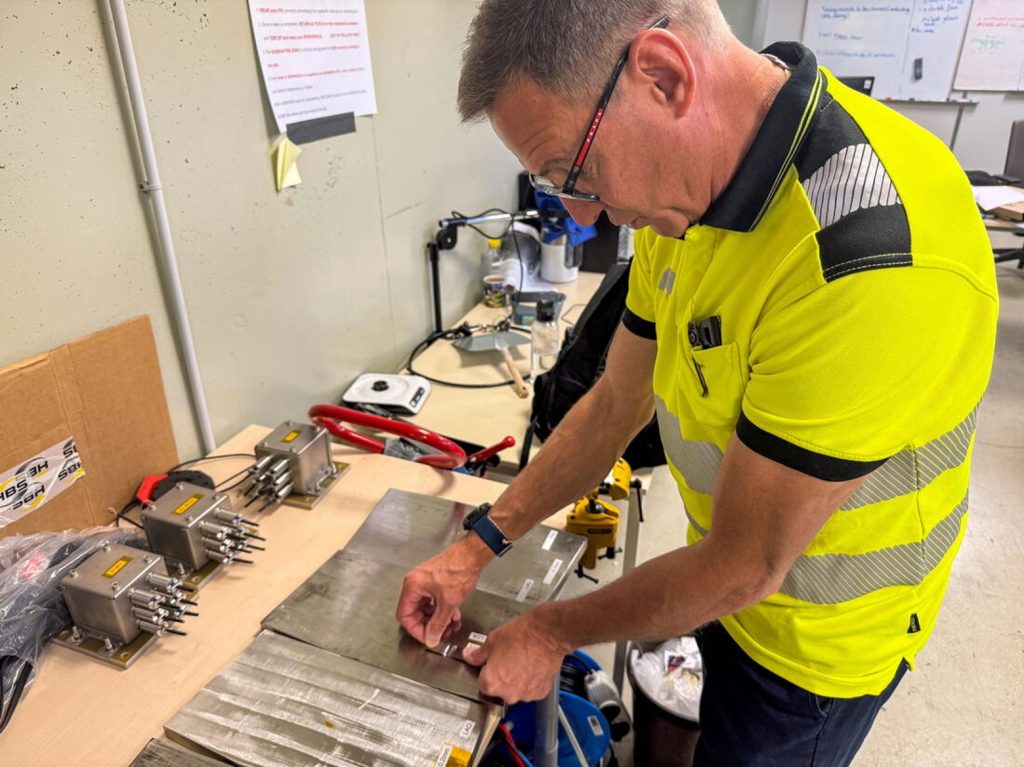
Welding at ITER can be measured in both small and big ways. Welds range from the miniscule (0.1 mm-thick welds to attach temperature sensors on the central solenoid magnet) to the mammoth (105 mm-thick closure welds on the toroidal field coils). In between, there are so many welds of all sizes that the cumulative volume is colossal: 10 tons of weld metal will be deposited on the plasma chamber, while a further 40 tons will be deposited in the port cells.
One of the welding challenges at ITER is that the project involves first-of-a-kind components and new instrumentation configurations. While the fission sector has had 60 years of experience building reactors and optimizing designs to facilitate welding, there have only been a handful of tokamaks built and none have been as big as ITER.
“The standards we use are based on proven industrial experience, but ITER’s designs are often unlike anything that has been built before,” says Hoyoung Kim, a welding engineer at ITER who supports assembly activities for systems such as cooling water and cryogenic networks, thermal shields, magnet feeders and the central solenoid. “The welding process itself is not fundamentally different. The difference is that in the fission industry, decades of experience have led to standardized designs that are practical to manufacture and weld. Fusion systems are newer and many of the component designs have not yet been fully optimized for welding. Future fusion projects will benefit from the experience gained here.”
Another challenge is “shrinkage.” When metal is welded, it heats up. As the weld cools, both the deposited metal and the surrounding material contract. In stainless steel this shrinkage can be significant, and it becomes more pronounced as thickness increases. Work is ongoing to model the welding shrinkage of the ITER vacuum vessel because of the importance shrinkage will have on final dimensions, alignment, and assembly tolerances.
But perhaps the most daunting challenge welders face is space constraint. When components are manufactured in factories or welds are performed on-site in ITER’s support buildings or sector sub-assembly tools, there is room to work. Inside the tokamak, though, space is becoming increasingly constrained.
“Now that five sector modules have been installed in the tokamak pit, everyone can see how limited the available space is becoming,” says Frédéric Lobinger. “The machine is large, but once dozens of workers, tools, pipes, diagnostics, and support structures occupy the same area, access is an issue. Accessibility will be one of the defining challenges of welding.”
What is ITER?
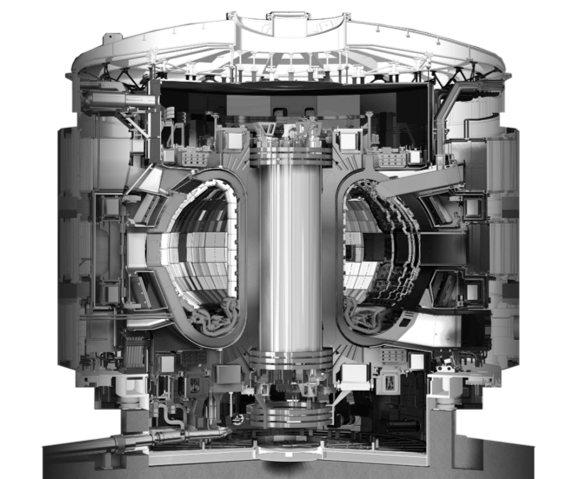
In southern France, 34 nations are collaborating to build the world’s largest tokamak, a magnetic fusion device that has been designed to prove the feasibility of fusion as a large-scale and carbon-free source of energy based on the same principle that powers our Sun and stars. The experimental campaign that will be carried out at ITER is crucial to advancing fusion science and preparing the way for the fusion power plants of tomorrow.
The primary objective of ITER is the investigation and demonstration of burning plasmas—plasmas in which the energy of the helium nuclei produced by the fusion reactions is enough to maintain the temperature of the plasma, thereby reducing or eliminating the need for external heating. ITER will also test the availability and integration of technologies essential for a fusion reactor (such as superconducting magnets, remote maintenance, and systems to exhaust power from the plasma) and the validity of tritium breeding module concepts that would lead in a future reactor to tritium self-sufficiency.
Thousands of engineers and scientists have contributed to the design of ITER since the idea for an international joint experiment in fusion was first launched in 1985. The ITER Members—China, the European Union, India, Japan, Korea, Russia and the United States—are now engaged in a decades-long collaboration to build and operate the ITER experimental device, and together bring fusion to the point where a demonstration fusion reactor can be designed.
ITER’s superconducting magnets
The ITER magnet system is the largest and most integrated superconducting magnet system ever built. Eighteen D-shaped toroidal field coils, six ring-shaped poloidal field coils, and the six independent modules of the central solenoid—with a combined stored magnetic energy of 51 Gigajoules —will produce the magnetic fields that initiate, confine, shape and control the ITER plasma. The toroidal field magnets weigh in excess of 300 tons, the poloidal field coils weigh 200 tons.
Manufactured from niobium-tin (Nb3Sn) or niobium-titanium (Nb-Ti), the magnets become superconducting when cooled with supercritical helium in the range of 4 Kelvin (-269 °C). Superconducting magnets are able to carry higher current and produce stronger magnetic field than conventional counterparts. They also consume less power and are cheaper to operate, making superconducting magnet technology the only option for ITER’s huge magnet systems.
Superconductivity can be maintained as long as certain threshold conditions are respected (cryogenic temperatures, current density, magnetic field). Outside of these boundary conditions, a magnet will return to its normal resistive state and the high current will produce high heat and voltage. This transition from superconducting to resistive is referred to as a quench. See www.iter.org.