It’s not easy for the careful designer to select a soft magnetic alloy that is best for an application, and also priced right. Special care must be exercised to find the necessary properties and characteristics, without over-specifying. There are many specialty alloys to choose from, each with its own unique properties.
Understandably, many designers find the selection process confusing and tedious. The information needed to make a decision is often not in one place. That’s why we like the detailed presentation from Carpenter Technology, a leading producer of soft magnetic alloys, called “A Simplified Method of Selecting Soft Magnetic Alloys”.
While the underlying focus is on alloys which Carpenter produces, the principles represented and organized treatment of the subject are also instructive on the subject in general. A few highlights are presented in this article but much more detail and explanation is available in the complete blog on Carpenter’s website.
As the authors explain, even when the criteria are available, comparing several candidate alloys still can be a challenge. Soft magnetic alloys are materials that can be easily magnetized — thus exhibiting high permeability — and just as easily demagnetized. In general, high permeability allows the design of smaller, more efficient components.
Several factors have a bearing on the soft magnetic alloy choice. One external factor is corrosion resistance, which is essential for devices exposed to weather or other corrosive environments.
Another is electrical resistivity, a measure of how easily electrical current can pass through an alloy. The higher the resistivity, the lower the eddy current losses in alternating magnetic field applications. The lower the eddy current losses, the lower the wasted energy. Excessive eddy current losses are to be avoided because, for example, they can overheat a motor.
Selection Matrix comparing key values
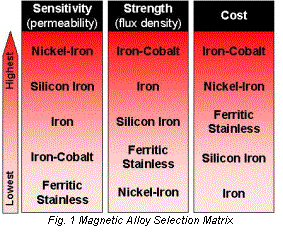
The most important magnetic criteria to consider, however, are the relative performance characteristics known as sensitivity (permeability) and strength (flux density), along with the respective cost of the alloys considered. In Fig. 1, a matrix that compares these key values can serve as an initial guide for the designer in selecting which groups of alloys to explore for a specific application. The groups include currently available nickel-iron alloys, silicon iron alloys, iron-base alloys, iron-cobalt alloys, and ferritic stainless steels.
Permeability and magnetic performance
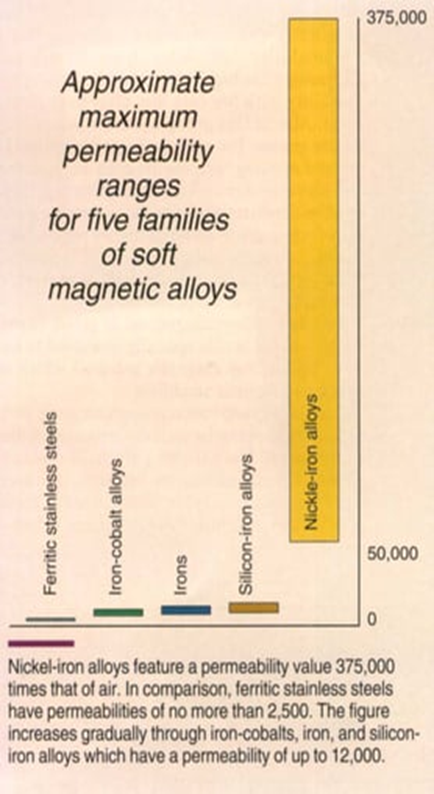
In Fig. 2, the five alloy families are positioned according to the approximate permeability range for each one. Permeability is a ratio of the magnetic induction output (B) to the magnetic field strength input (H) that produced the induction. The higher the permeability, the better the magnetic performance. The chart compares the relative permeability of alloys in each family.
The impact of flux densities is also covered in detail, also appropriate alloys for specific applications, as well as cost factors. For the complete blog, see the Resources section at www.carpentertechnology.com.