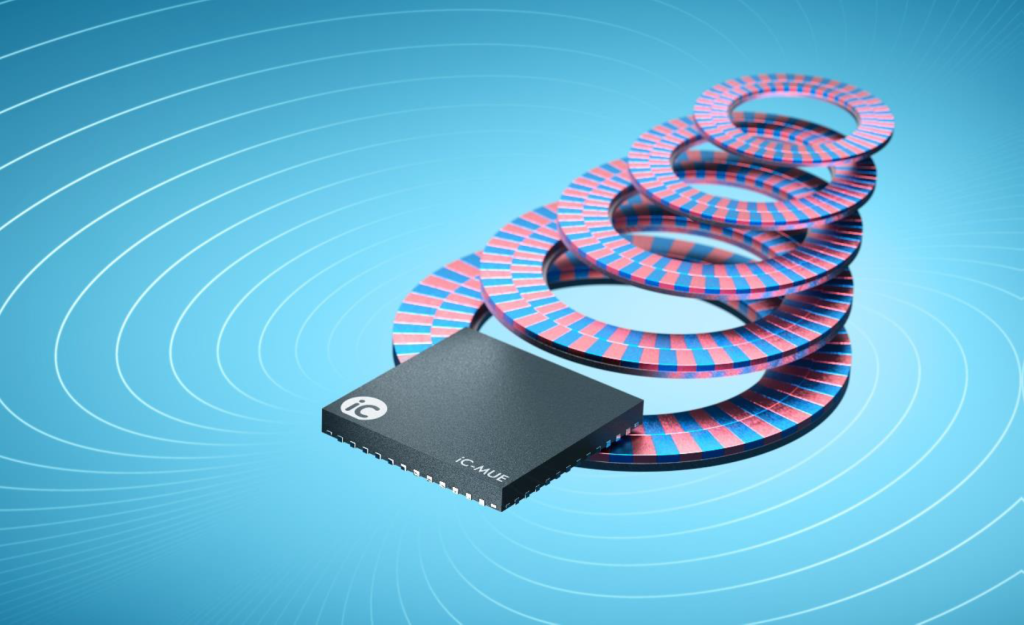
iC-Haus presents the iC-MUE, a new product development in the field of magnetic position sensors. This highly integrated, absolute, system-on-chip encoder has been specially designed for hollow-shaft applications, meeting the growing demands of modern robotics and motor feedback systems. Users benefit from maximum precision, flexible integration and generous alignment tolerances. Thanks to its robust magnetic sensor technology, the iC-MUE operates reliably even in harsh environments and is particularly simple to set up.
Requirements of modern applications
Modern robotics and motor feedback applications require position sensors that are highly accurate, adaptable, and easy to commission. At the same time, they must be robust against contamination and compensate for mechanical tolerances during installation and operation. iC-Haus successfully meets this demanding requirement profile with the new iC-MUE: a system-on-chip that sets new standards in the field of magnetic Nonius encoder technology.
Further development of the established iC-MU Series
Many users are already familiar with the reliable components of the iC-MU Series, which is used in numerous robotics and position sensor applications. The iC-MUE builds on this technology, combining iC-Haus’s many years of experience in this field. Thanks to modern process technology, users now have access to a variety of innovative system functions.
Flexible integration and high precision
The decimal Nonius engine enables the magnetic scale geometry to be adapted flexibly and allows easy integration into demanding and individual installation conditions. For instance, rotary axial magnetic scales can achieve a scanning diameter ranging from 20 mm to 85 mm. Advanced interpolator architecture and filter technology enable position resolution of 21 bits for a typical 44 mm measuring scale (32 pole pairs). To ensure the encoder system can be commissioned seamlessly, all necessary calibration functions are fully integrated into the iC and can be performed via command or at the push of a button. Optional eccentricity and high-resolution look-up table correction take the encoder system to a new level of accuracy. In typical applications, an angular accuracy of better than 0.04° can easily be achieved. Differential magnetic scanning suppresses external magnetic stray fields and ensures reliable position data.
Versatile interfaces and system extensions
The sensor data is available to the user via three interfaces that can be used simultaneously. BiSS, SSI, SPI, ABZ, UVW, and analog signal formats are supported. An additional I²C slave is available for configuration and diagnostic data. If required, external multiturn sensors can be integrated via the Absolute Data Interface or a second iC-MUE to extend the absolute measuring range. The iC-MUE operates at 3.3 V – 5 V in the industrial temperature range of -40 – 125 °C. Numerous additional features such as extensive configurable diagnostic functions, an integrated temperature sensor, and a “safety-ready” analog output complete the overall package and position the iC-MUE as a universally applicable magnetic sensor powerhouse.
Further information on the iC-MUE:
https://www.ichaus.de/product/ic-MUE
Live demonstration at SPS 2025
Nuremberg, November 25–27, 2025
Hall 4A, Booth 146
Your contact person for further questions:
Patrick Stahl
Sales and applications
iC-Haus GmbH, Am Kuemmerling 18, 55294 Bodenheim, Deutschland
Tel. +49 6135/9292-321 Web: www.ichaus.de
Fax +49 3135/9292-192 E-Mail: Patrick.Stahl@ichaus.de
Introducing iC-Haus
iC-Haus GmbH is a leading, independent German manufacturer of standard iCs (ASSP) and customized ASiC semiconductor solutions with worldwide representation. The company has been active in the design, production, and sales of application-specific iCs for industrial, automotive, and medical applications for over 40 years.
The iC-Haus cell libraries in CMOS, bipolar, and BCD technologies are specifically suited to realize the design of sensor, laser/opto, and actuator ASiCs, among others. The iCs are assembled in standard plastic packages or using the iC-Haus chip-on-board technology to manufacture complete microsystems, multichip modules, and optoBGA/QFN in conjunction with sensors.
Further information can be found at www.ichaus.de.