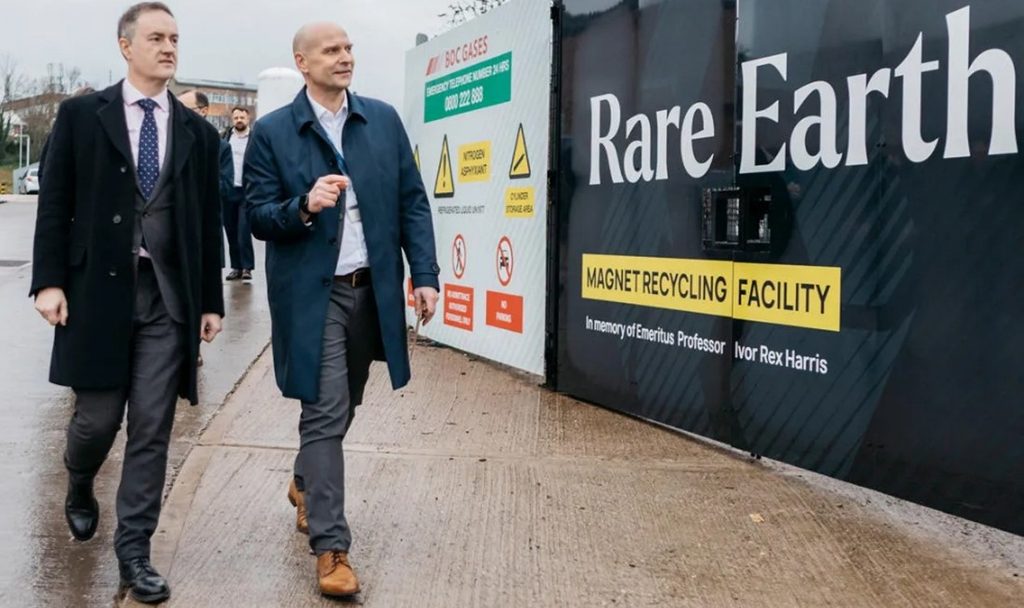
Bringing sintered magnet manufacturing back to the UK for the first time in 25 years, the University of Birmingham has launched a new facility for separating and recycling rare earth magnets that will help to reduce the country’s reliance on imports of rare earth metals, alloys and magnets. It was officially opened in January by Chris McDonald MP, Minister for Industry in the Department for Energy Security and Net Zero and the Department for Business and Trade, shown above with Professor Allan Walton, Professor of Critical & Magnetic Materials and Co-Director of the Birmingham Centre for Strategic Elements & Critical Materials.
The plant uses an innovative hydrogen-based process for rare earth recycling developed by researchers at the university and licensed to Mkango Resources. (On September 21, Mkango officially changed its name to Mkango Magnetic Materials Ltd.)
The technology is noted for being an extremely efficient method to extract rare earth magnets from end-of-life products without the need to fully disassemble them. It transforms waste into a sustainable source of rare earths that can be used to manufacture new metals, alloys and magnets while reducing both environmental impact, cost and supply chain risk.
Sited at Tyseley Energy Park in Birmingham, the facility scales the process to commercial production levels. A previous proof of concept operation handled batches of 50-100kg size while the new scaled-up facility can recover over 400kg of rare earth alloy per batch and into new sintered magnets at 100 ton capacity per year on a single shift and over 300 tons on multiple shifts. Magnets can be produced at a fraction of the environmental impact and cost compared to primary production methods. It can be used for primary production of magnets as well as from recycled feeds.
“Supported directly by the University itself and through the allocation of QR funding from Research England and programme funding from UKRI, this is a brilliant development of the UK’s competitive advantage,” said Professor Rachel O’Reilly, pro-vice chancellor of research. “Opening the Birmingham magnet recycling facility highlights the vital role of university-led research and development in delivering industrial capabilities and addressing national resilience and sustainability goals identified among the UK Government’s strategic and societal priorities.” About £4.5 million in funding for the operation has been pledged by a number of agencies and organizations.
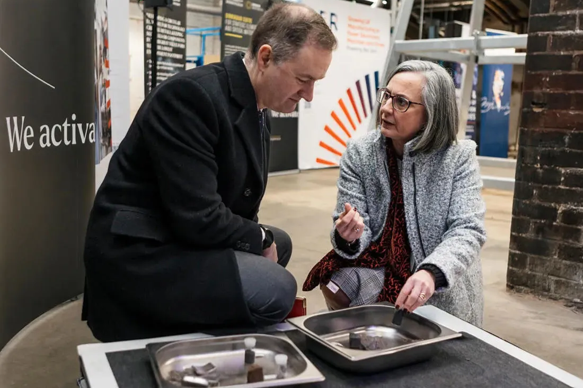
Recycling technologies developed by the Magnetic Materials Group at the University of Birmingham have been exclusively licensed to Birmingham-based Hypromag Ltd, which is now 100% owned by Maginito Ltd, a subsidiary of Mkango Resources, headquartered in Vancouver, Canada. It is employing the platform for further scale-up in the UK and international roll-out, already underway in Germany, USA, and other countries, noted William Dawes, CEO of Mkango and director of HyProMag. For more info, see www.birmingham.ac.uk, www.mkango.ca.