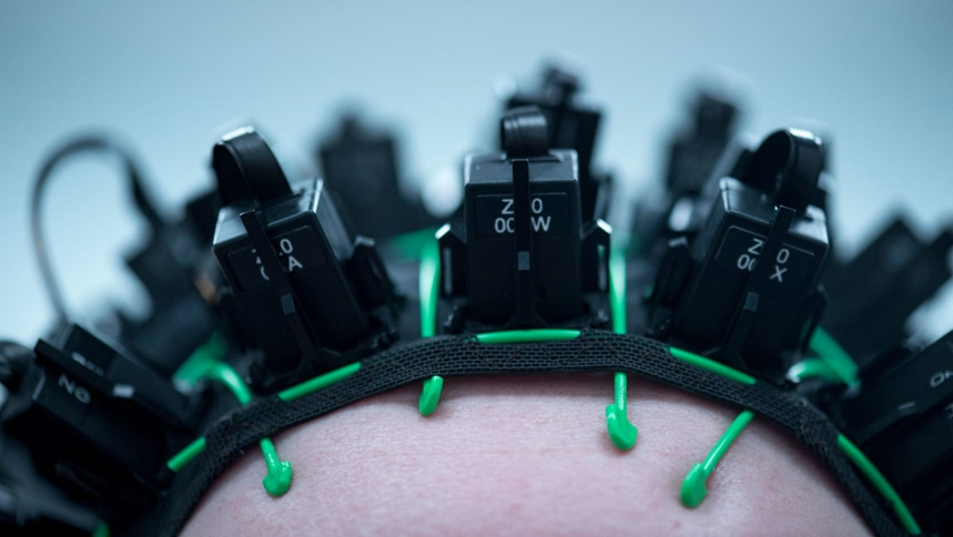
Cerca Magnetics, the British developer of a wearable brain scanner using quantum sensors to measure neural activity, is gaining traction commercially with recent investment funding, a military-backed project and continued placements. The scanner uses an array of optically pumped magnetometers positioned into a flexible helmet.
The technology replaces traditional fixed systems with lightweight, wearable sensors, allowing patients to move naturally during scans and enabling brain imaging in infants for the first time. The technology is being applied to conditions including epilepsy, multiple sclerosis and dementia, with clinical approval pathways underway in the UK and the United States.
A venture funding in April, led by Guinness Ventures, brought in £3.8 million to support clinical approval, manufacturing scale-up and international expansion as the business progresses towards broader use in healthcare settings. “This investment enables us to move decisively into clinical applications, scaling our technology for routine use in hospitals in the UK and internationally,” said David Woolger, CEO. “Our goal is to make advanced brain imaging more accessible, supporting earlier diagnosis and better treatment of neurological conditions.”
The company has already sold 19 systems to neuroscience centers across 12 countries and has delivered annual sales growth of more than 100 per cent over the past three years. Customers include The Hospital for Sick Children in Toronto to study autism and a UK Ministry of Defence project to help assess the effects of blast exposure on military personnel.
Studying effects of blast exposure on military personnel
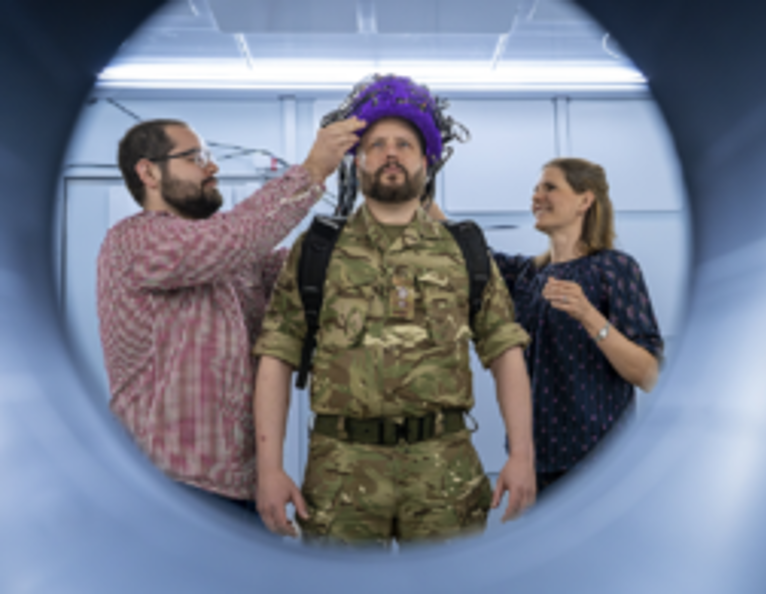
To better protect military personnel, the UK military is providing £3.1m to assess how blast exposure from weapons training affects the brain. Scientists will develop the world’s first fully mobile magnetoencephalography (MEG) brain scanner capable of measuring the effects of blast exposure on military personnel in real time at training sites. The scanner, which will be used for the first time ever by the UK’s Cyber & Specialist Operations Command’s Defence Medical Services, will enable researchers to see exactly what happens to brain function within minutes of blast exposure and watch how personnel recover — potentially transforming how those who serve are protected.
The mobile laboratory will deploy directly to military firing ranges, field hospitals and rehabilitation centers. The system will be built by Cerca Magnetics and used by the Defence Medical Services, in collaboration with scientists from the Universities of Nottingham and Birmingham. Other collaborators on the project include UK-based technology company Magnetic Shields Ltd and US-based atomic device company QuSpin, developer of the magnetometer sensing system.
“This new system, a world first, will be transformative for research into the effects of blast exposure on our personnel,” said Lt Col James Mitchell, Consultant Neurologist and Chief Investigator of the UK Military Blast Study at the UK Defence Medical Services. “For the first time we will be able to build a time-stamped, accurate picture of exactly what happens to the brain in the minutes and hours after blast exposure and track recovery over time. Ultimately, we expect this system to help provide robust, scientifically informed policy on safe working practices for blast exposure.”
“The breakthrough addresses a critical defence challenge: repeated exposure to shock waves from high-power weapons might cause subtle changes in brain function, which, over a career, may increase the likelihood of serious brain health conditions. Yet safe exposure levels remain unknown because the effects are subtle and fleeting – often disappearing within 24-48 hours – making them impossible to capture with conventional laboratory-based scanners.”
Professor Matthew Brookes, professor of physics at the University of Nottingham and chairman of Cerca Magnetics, who has pioneered OPM-MEG technology for a decade, had this to say: “This new generation of MEG lifts limitations that have historically confined scanners to universities, paving the way for mobile systems that can be taken directly to those who will benefit most. The introduction of mobile systems will likely revolutionise other fields too, whether parked outside hospitals to assess neurological conditions or at sports grounds to scan players following concussion.”
Optically pumped magnetometer –- how it works
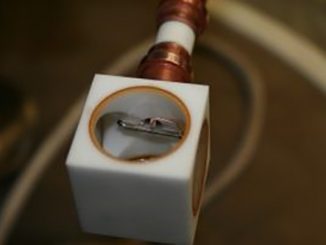
QuSpin, developer of the magnetometer, gives this description of the underlying technology: OPMs are passive magnetic field sensors, and they have three main components: (1) a laser, (2) a glass vapor cell containing ‘sensing’ atoms in a gaseous state, and (3) a photodetector.
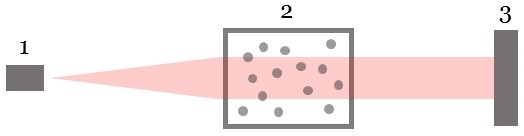
Zero-Field OPMs exhibit extreme sensitivity when the magnetic background is small. When the field is nearly zero, the atoms in the vapor cell become mostly transparent allowing maximum light onto the photodetector. Any change in the field induces a change in the transparency of the atoms. The resulting change in the photocurrent gives a measure of the magnetic field signal. Our ZF-OPM sensors measure field components along the sensitive axes and provide ultra-high sensitivity for detecting very weak magnetic fields, such as biomagnetic signals.
For more info, see www.cercamagnetics.com, www.quspin.com.