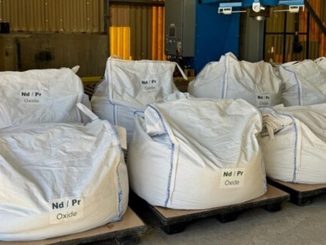
The U.S. Department of Energy’s Office of Critical Minerals and Energy Innovation has announced $45.7 million for 19 projects that will unleash American energy innovation by addressing and filling domestic critical minerals and materials supply chain gaps. The funding supports the development of novel technologies that will be used in the production of critical materials by developing pilot-scale facilities for processing magnesium, lithium and rare earth magnetic elements.
Led by a $19.3 million grant to USA Rare Earths in Stillwater, Oklahoma, awards in the rare earths magnetic sector totaled about $23 million. Others included awards to research labs exploring the use of lasers, genetic engineering and microorganisms.
“Reshoring minerals production and processing will strengthen our domestic rare earth supply chains from end to end,” said Assistant Secretary of Energy Audrey Robertson. “By ensuring the minerals that are mined in America can be processed in America and manufactured into American technologies, these investments will bolster America’s national security and energy independence.”
Projects in the magnetics rare earths sector accounted for five of the awards, as described below by DOE:
USA Rare Earths awarded $19.3 million to accompany $31.2 million in non-DOE funding for total project value of $50.5 million.
USA Rare Earth in Stillwater, Oklahoma will build, demonstrate, and operate a pilot-scale continuous ion exchange (CIX) rare earth element (REE) production plant in Stillwater, Oklahoma. The objective of this effort is to build USA Rare Earth’s first-of-its-kind bench-scale CIX separations process into a viable pre-commercial unit that demonstrates a superior process to the incumbent solvent extraction technology.
USA Rare Earth’s bench-scale program has demonstrated that REEs can be extracted from domestic resources in a totally closed-loop process. USA Rare Earth’s process uses established CIX separations science, first invented during the Manhattan Project, coupled with innovations developed by other, non-REE industries to create a fully automated, continuously operating process. USARE seeks to establish CIX as an economical, environmentally benign technology platform for the U.S. REE industry.
Columbia University extraction from mine tailings awarded $780,000 for Fast, Room-Temperature Extraction of Nickel and Cobalt from Ore-Concentrate and Mine Tailings.
Researchers at Columbia University in New York City will develop a technological method based on novel chemistry to extract nickel and cobalt from sulfidic ores, providing an alternative to traditional smelters. The purpose of this project is to find a new method to meet the growing demand for critical minerals nickel and cobalt.
The technology uses bromine as an extraction reagent, which can be recycled and regenerated using electrochemical cells akin to those already deployed at equivalent scales for flow batteries. Furthermore, the hydrometallurgical process may be economically attractive even at modest scales, making it viable to produce high-value nickel and cobalt at a mine location, thereby reducing transportation and tailings management costs. If successful, this hydrometallurgical approach would allow for domestic production of nickel and cobalt, mitigating current supply chain bottlenecks..
Savannah River National Laboratory gets $1 million for Rare Earth Metallization by Eutectic at Low Temperatures (REMELT)
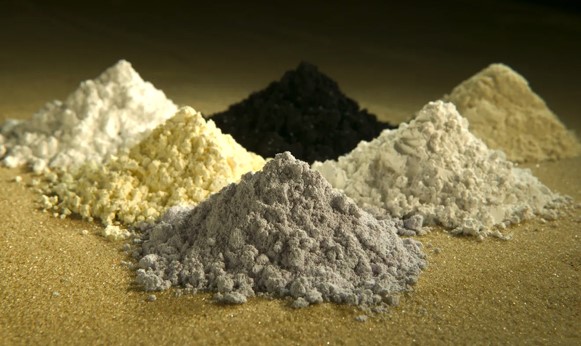
Researchers at Savannah River National Laboratory in Aiken, South Carolina will develop a next-generation, industrially viable process to convert separated rare earth feedstock into highly pure metallic form. Rare earth oxides and metals are key components of these supply chains, due to their application across the energy, industry, and technology sectors. Yet, converting these oxides into metals remains costly and energy intensive. This project addresses these issues by utilizing mixtures (eutectics) of molten salts and/or metals that melt at temperatures much lower than their individual constituents, achieving less than 900°C (60% of the original) temperatures. If successful, the project could establish a domestic production of RE feedstock on a commercial scale.
Ames National Laboratory awarded $1 million for Laser-Assisted Separation of Rare Earth Metals. Researchers at Ames National Laboratory (Ames, Iowa) will develop a laser-assisted separation of rare earth metals technology designed for processing end-of-life magnets. Utilizing laser technology creates a less energy-intensive pathway for extracting rare earth metals from end-of-life magnets compared to traditional methods.
This project will develop a laser processing testbed that integrates a high-power and high-repetition frequency picosecond pulsed laser to process REE compounds at rate of grams/mins in a controlled environment, utilizing digital twin-based process design to scale up the proposed technology. Successful completion will result in REE reduction and recycling technology with minimum energy requirements and environmental impact.
University of Idaho and partners receive $1 million for Innovative and Low-Emission Manufacturing Pathways of Mixed Rare Earth Metals from Idaho Sourced Minerals.
Researchers at the University of Idaho (Idaho Falls, Idaho), with project partners Idaho National Laboratory, Idaho Strategic Resources Inc., and Idaho Geological Survey, will advance the exploration and extraction of Idaho-sourced rare earth elements for potential commercialization of rare earth metals using innovative and efficient manufacturing pathways.
This project will pursue two low technology level pathways, constructing and advancing REEs extraction pathways. Specifically, this project will (1) construct a next-generation, disruptive REEs extraction pathway using genetically engineered phytomining, continuous sono-bioleaching, and pseudocapacitive driven REE separation and concentration, and electrolysis; and (2) advance the existing low-emission extraction pathway, using microorganisms engineered sono-bioleaching and pseudocapacitive driven REE separation and concentration, and electrolysis. The targeted REEs for mixed REM manufacturing are neodymium, praseodymium, and dysprosium.
See www.energy.gov.