Magnetics Magazine
  • Home
  • Magazine
    • Read the Latest Issue
    • About
    • Digital Back Issues
    • Writer’s Guidelines
    • Editorial Contact
  • E-Newsletters
  • Subscribe
    • Print
    • Digital
  • Technology Center
    • Electromagnetics
    • Magnetics/Assemblies
    • Materials/Manufacturing
    • Research & Development
    • Software & Design
    • Test & Measurement
  • Knowledge Center
    • Featured Articles
    • Tech Tips
    • Industry Events
    • Industry News
    • Spontaneous Thoughts
    • White Papers
  • Advertise
    • 2026 Media Kit
    • 2025 Media Kit
    • Resource Guide
    • Special Issue: Europe & UK
    • E-Marketing
    • Special Offers
    • Contact Sales
News
  • [ December 4, 2025 ] Ultrasensitive Off-Axis Rotation Sensor Developed by NVE  Electromagnetics
  • [ December 4, 2025 ] Niron Sets Path to Establish Manufacturing of Rare Earth-Free Magnets  Materials/Manufacturing
  • [ December 3, 2025 ] Microtest Builds Portfolio of Test Equipment for Semiconductor Manufacturers  News
  • [ December 3, 2025 ] United Imaging Triples MRI & Radiotherapy Production Capacity at in Houston  News
  • [ December 3, 2025 ] Magnetic Technology & Materials Seminar Set for Essen in February by HDT  Materials/Manufacturing
HomeChannelsElectromagneticsHaptic Technology 101: A Guide by TITAN Haptics to the Different Types of Vibration Motors 

Haptic Technology 101: A Guide by TITAN Haptics to the Different Types of Vibration Motors 

February 15, 2024 Editorial Staff Electromagnetics, News Comments Off on Haptic Technology 101: A Guide by TITAN Haptics to the Different Types of Vibration Motors 

Haptic feedback has become an integral part of our daily lives, often without us even realizing it. The term “haptic” comes from the Greek word “haptikos,” which pertains to our sense of touch. Haptic technology uses our sense of touch to communicate by applying forces, vibrations, or motions, further enhancing the immersion into the digital world. Nowadays, the most common haptics use case is in smartphones—your phone vibrating whenever you get a call or text message—but it is also used in gaming, virtual reality, automotive, accessibility, and medical applications. 

In order to create haptic effects, there’s one crucial piece of technology needed: the haptic motor. In this blog we love by TITAN Haptics, a developer of innovative magnetic haptic motors, the most popular types of haptic motors in the market are explained. Some employ magnetic technology, others do not. Titan Haptics exhibited its technology at this year’s Consumer Electronics Show in Las Vegas. See more in our series of articles about innovative technology at the event. 

Special Report: Magnetic Technology Innovation at CES 2024 

1. Eccentric Rotating Mass (ERMs) 

An Eccentric Rotating Mass (ERM) is a rotating electric motor with an off-center mass. As the ERM rotates, the mass becomes displaced, creating the ‘rumble’ or vibration feeling. 

For many years, ERMs have been the most popular type of haptic motor due to their low cost, simplicity, and effectiveness. However, their vibrations lack precision, and they can be slow to start and stop, limiting the range of sensations they can produce. 
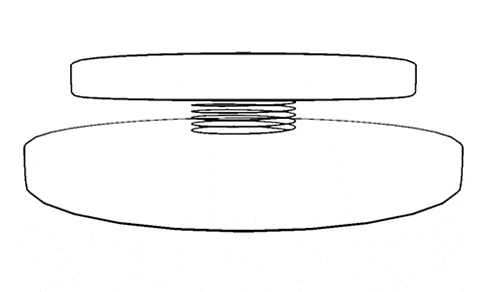
A type of LRA Motor 

ERMs are most often found in gaming controllers and have recently been found in automotive use cases, due to their ability to produce strong and active vibrations. However, as of 2022, market analysts predict a slow shift towards LRAs within gaming, spearheaded by the launch of the PlayStation 5 DualSense controllers. Other industries, such as smartphones and wearables, are also shifting to LRA adoption. 

2. Linear Resonant Actuator (LRA) Motors: 

Linear Resonant Actuators (LRAs) are commonly found in wearables and smartphones. LRA motors consist of a magnet attached to a spring, surrounded by an electromagnetic coil and housed in a casing. The coil is used to drive the motor by moving the mass back and forth within the housing, creating the vibrations we feel. 

LRAs offer faster response times and more efficient power usage than ERMs, making them a popular choice for devices that require quick haptic feedback. However, they’re more expensive than ERMs, and the spring is susceptible to wear and tear. 
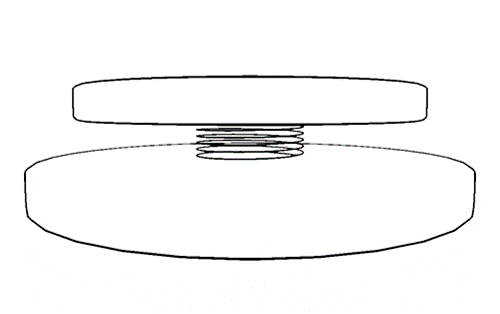
A type of LRA Motor 

The most ubiquitous LRA motor is Apple’s Taptic Engine, used in every Apple smartphone since the iPhone 6s. After its release in 2015, other smartphone companies followed this trend, adding using LRAs for their high-end and mid-end models. Most smartphones now use LRAs rather than ERMs for their haptic effects (source). 
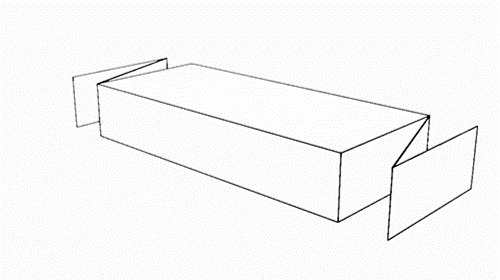
A type of LRA Motor 

3. Piezoelectric Actuators: 

Piezoelectric actuators work by applying a voltage to piezoelectric material, which causes it to change shape and produce vibration. These actuators can produce highly detailed haptic feedback, making them ideal for applications where precision is key, such as in advanced medical devices. However, they’re considered to be rather fragile and are susceptible to breaking. 
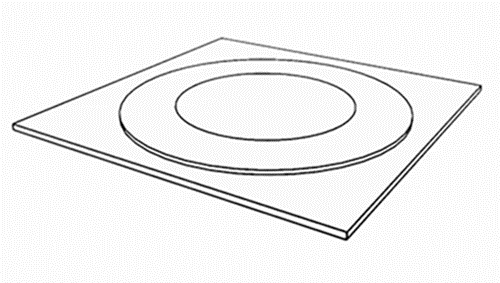
A Piezoelectric Actuator 

Despite their small market share in the actuator industry, piezoelectric actuators are still widely used today. They can be found in laptop trackpads, satellites, and small medical devices. Piezoelectric actuators also have a good opportunity to grow in emerging markets such as AR/VR and wearable technology, where ERMs have been deemed to be a poor fit. 

4. Linear Magnetic Ram (LMR) Motors 

Linear Magnetic Ram (LMR) is one of the latest additions to the haptics industry. Based on solid-state magnetic suspension technology, it works by driving a suspended mass through a magnetic field. This movement is controlled by an electric current, which can be adjusted to change the position, speed, and force of the mass. This allows for precise control over haptic feedback. 
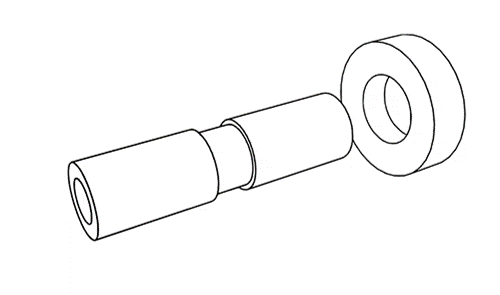
An LMR Motor 

What sets LMRs apart from other haptic actuators in the market is their wideband capability, with the ability to cover anything from 10 Hz – 300Hz. They also use no springs or flexures, which makes them more durable than other haptic motors in the market. Moreover, they consume significantly less power compared to LRAs and ERMs, making them a more efficient choice for haptic motors. 

LMRs are extremely versatile and can be utilized in a wide range of applications. These include gaming controllers, VR/XR peripherals, wearable technology, and in the automotive industry. 

Haptics All Around Us 

In this age of technology, we are constantly interacting with various electronic devices. Haptics is sure to become an integral part of our future, making the virtual world not just a visual, but a tactile experience. As technology continues to advance, we can expect to see a wider variety of haptic motors in the future. 

We hope this guide helps to shed some light on haptic technology and makes you curious about the different types of motors you encounter in your daily lives. At TITAN Haptics, one of our goals is to share as much haptic information and resources as possible. We plan to continue developing more tutorials and introductory materials like this in the future. If you have any questions about our LMR technology, don’t hesitate to get in touch with us here. 

The full presentation is available on the TITAN Haptics website. 
  • actuator
  • current
  • electric motor
  • electronics
  • haptic feedback
  • haptics
  • Motor
  • TITAN Haptics
  • vibration
Previous

Neuranics: Glasgow Spin-out Develops Tiny TMR Sensors for Biomagnetic Sensing 

Next

Dias Leverages SQUID Magnetometry from Supracon to Advance Minerals Exploration 

Related Articles

e-Power Technology

Inductive Position Sensor from Microchip for EV Motor Control 

November 14, 2022 Editorial Staff e-Power Technology, Electromagnetics Comments Off on Inductive Position Sensor from Microchip for EV Motor Control 

Developers of some motor control systems are finding it advantageous to replace Hall Effect position sensors and older magnetic resolver solutions with inductive alternatives that eliminate expensive magnets and other heavy transformer-based structures so they […]

Electromagnetics

New Current Sensor ICs with Common Mode Field Rejection

March 24, 2015 Editorial Staff Electromagnetics Comments Off on New Current Sensor ICs with Common Mode Field Rejection
e-Power Technology

AAM Creates Versatile Electrification Platform for Auto & Truck Manufacturers with Configurable Motors, EDUs & e-Beam Technology 

April 8, 2024 Editorial Staff e-Power Technology, Electromagnetics, News Comments Off on AAM Creates Versatile Electrification Platform for Auto & Truck Manufacturers with Configurable Motors, EDUs & e-Beam Technology 

Tier-1 automotive supplier American Axle & Manufacturing (AAM) has built a versatile, configurable platform for auto and truck manufacturers to employ in electrifying their model lineups. The electric drive units incorporate permanent-magnet or induction motors with power up to 800V and can be fully integrated with the company’s e-Beam Axles. AAM’s 3-in-1 e-Drive technology features an integrated motor, inverter and gearbox into a single assembly for advantages in packaging, performance and simplified integration.  […]

Read the Latest Issue

MAGNETICS NEWS

CRYOGENIC & SUPERCONDUCTOR NEWS

  • Home
  • Magazine
    • Read the Latest Issue
    • About
    • Digital Back Issues
    • Writer’s Guidelines
    • Editorial Contact
  • E-Newsletters
  • Subscribe
    • Print
    • Digital
  • Technology Center
    • Electromagnetics
    • Magnetics/Assemblies
    • Materials/Manufacturing
    • Research & Development
    • Software & Design
    • Test & Measurement
  • Knowledge Center
    • Featured Articles
    • Tech Tips
    • Industry Events
    • Industry News
    • Spontaneous Thoughts
    • White Papers
  • Advertise
    • 2026 Media Kit
    • 2025 Media Kit
    • Resource Guide
    • Special Issue: Europe & UK
    • E-Marketing
    • Special Offers
    • Contact Sales

Copyright © 2025 | MH Magazine WordPress Theme by MH Themes

Magnetics Magazine
This site uses cookies to improve your browsing experience. By continuing to use this site, you agree to our privacy policy.

Cookie SettingsAccept
Manage consent

Privacy Overview

This website uses cookies to improve your experience while you navigate through the website. Out of these, the cookies that are categorized as necessary are stored on your browser as they are essential for the working of basic functionalities of the website. We also use third-party cookies that help us analyze and understand how you use this website. These cookies will be stored in your browser only with your consent. You also have the option to opt-out of these cookies. But opting out of some of these cookies may affect your browsing experience.
Necessary
Always Enabled
Necessary cookies are absolutely essential for the website to function properly. These cookies ensure basic functionalities and security features of the website, anonymously.
CookieDurationDescription
cookielawinfo-checkbox-analytics11 monthsThis cookie is set by GDPR Cookie Consent plugin. The cookie is used to store the user consent for the cookies in the category "Analytics".
cookielawinfo-checkbox-functional11 monthsThe cookie is set by GDPR cookie consent to record the user consent for the cookies in the category "Functional".
cookielawinfo-checkbox-necessary11 monthsThis cookie is set by GDPR Cookie Consent plugin. The cookies is used to store the user consent for the cookies in the category "Necessary".
cookielawinfo-checkbox-others11 monthsThis cookie is set by GDPR Cookie Consent plugin. The cookie is used to store the user consent for the cookies in the category "Other.
cookielawinfo-checkbox-performance11 monthsThis cookie is set by GDPR Cookie Consent plugin. The cookie is used to store the user consent for the cookies in the category "Performance".
viewed_cookie_policy11 monthsThe cookie is set by the GDPR Cookie Consent plugin and is used to store whether or not user has consented to the use of cookies. It does not store any personal data.
Functional
Functional cookies help to perform certain functionalities like sharing the content of the website on social media platforms, collect feedbacks, and other third-party features.
Performance
Performance cookies are used to understand and analyze the key performance indexes of the website which helps in delivering a better user experience for the visitors.
Analytics
Analytical cookies are used to understand how visitors interact with the website. These cookies help provide information on metrics the number of visitors, bounce rate, traffic source, etc.
Advertisement
Advertisement cookies are used to provide visitors with relevant ads and marketing campaigns. These cookies track visitors across websites and collect information to provide customized ads.
Others
Other uncategorized cookies are those that are being analyzed and have not been classified into a category as yet.
SAVE & ACCEPT