United Imaging, a rapidly growing developer and manufacturer of advanced medical imaging and radiotherapy equipment that is based in Shanghai, is planning to triple the manufacturing space at its North American headquarters in Houston. The move comes only four years since the facility was established, becoming a new hub for the manufacture of magnetic resonance systems and other imaging equipment made by the company.
Output has steadily been increasing at the site with products in all four imaging modalities it currently sells achieving local production in Texas over the last four years. All critical spare parts are already stored in Houston and in stocking locations across the country.
“With the steadily spiking demand and manufacturing capacity also has come an increase in hiring” said Jeffrey Bundy, CEO for North America. Since 2021, U.S. headcount growth has averaged 60% annually. The proximity to Houston’s ports provides strategic opportunity the global company has been investing in for years, with increasing operations in South America and across the world. It also announced recently its first product registrations in Canada as units installed globally rose to 300,000.
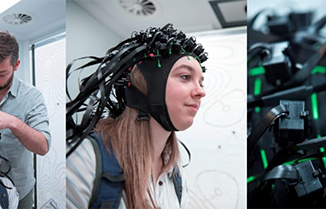
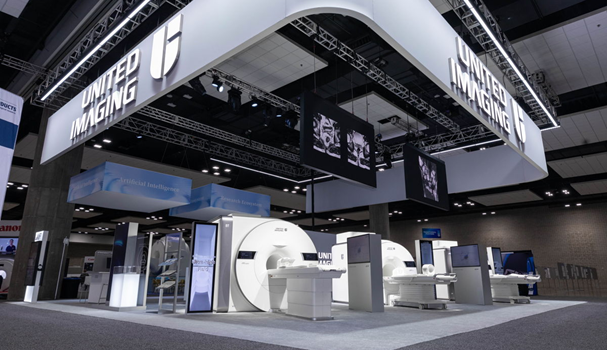
The company was prominent at this year’s meeting of the International Society for Magnetic Resonance in Medicine (ISMRM 2025) held in Honolulu, displaying a variety of its systems and technologies. A highlight was industry’s first and only whole-body 8-channel parallel transmit coil. What differentiates the system is its ability to provide uniform B1 field Ultra-High-Field imaging, independent control of Tx architecture, fully automatic and fast calibration, and optimization for specific body parts; also the new uMR Ultra, an advanced 3T MRI system that has the capability to observe and analyze body movement within the scan yielding detailed visualizations of the body in motion that enable the transition of MRI from static “photography” to dynamic “videography.”
Development of high-field magnets are a core technology
High-field magnets are core components for the company’s MRI systems. A presentation available on its website describes some of the intricacies of their development and is highlighted here.
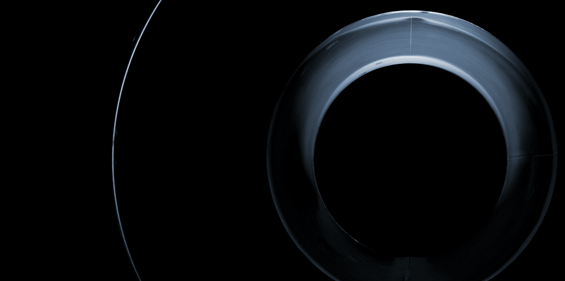
As the “heart” of MRI, the magnet can be called the “core element” — to provide the magnetic field conditions necessary for MRI imaging, the higher the magnetic field, the clearer the image resolution,” it notes. However, high-field magnets for MRI present inherent difficulty for development and manufacturing teams to overcome. In the world, there are only a few manufacturers with the capability to produce systems of 3.0T and higher.
There are unique challenges in the development process, it explains. “The R&D process for magnets is like feeling one’s way forward in a huge maze. Just like rocket launch doesn’t allow real-world simulation in advance, the magnet can’t be tested before execution or be repaired after failure.” Since one failed trial can cost hundreds of thousands of dollars, without a narrow trial-and-error strategy in advance, all resources could be used up in one fell swoop.
It’s necessary to be very careful for every step, emphasizes the company. The superconducting wire that is tens of kilometers in the magnet is placed in -269℃ ultra-low temperature liquid helium, and the maximum force of the coil after power is on may exceed 1,000 tons, which is equivalent to the force produced by 10,000 horses running in one direction at the same time. Under the huge force and low temperature, all materials would have reached their limits. At that point, even if energy reaches the coil that’s as small as the energy produced by a peanut slipping from the hand to the ground, it will cause the magnet to quench, instantly releasing several tens of thousands of volts of high voltage, and therefore huge energy. Any carelessness will pose a huge risk of partial burnout and complete failure.
The company’s development team has created a rigorous and efficient innovation model in response to this dilemma: 30,000 hours of in-depth exploration of only one technical point. Engineers carry out a large number of joint designs of electromagnetic field and stress, seeking the balance point of electromagnetic field and stress in a small space, and selected aerospace-grade unique materials from the physical properties at extremely low temperatures. Numerous analyses and tests are performed to avoid potential risks. The outcome is a string of new high field strength magnets and MRI systems progressively entering medical centers around the world. For more info, see www.united-healthcare.com.