e-Power Technology

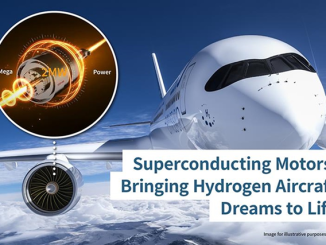
Breakthrough Superconducting Motor from Toshiba Being Applied to Hydrogen Flight with Airbus; Ships & Space Envisioned Next 

As the aviation industry works toward the ambitious goal of net-zero CO2 emissions by 2050, the shift to sustainable aviation fuel such as hydrogen is gaining momentum. However, truly effective reductions in the environmental impacts of aviation likely require innovation that goes beyond fuel to embrace the entire aircraft system.  […]

e-Power Technology

Researchers Design Cryogenic Storage & Delivery System for H2 Aircraft 

Researchers at the FAMU-FSU College of Engineering have designed a cryogenic liquid hydrogen storage and delivery system that could help make zero-emission aviation a reality. Their work outlines a scalable, integrated system that addresses several engineering challenges at once by enabling hydrogen to be used as a clean fuel and also as a built-in cooling medium for critical power systems aboard electric-powered aircraft. The research was conducted at the National High Magnetic Field Laboratory which is headquartered at FSU in Tallahasee. 
[…]

e-Power Technology

eVTOL from Joby Aviation Flies Toward Air Taxi Service & Mass Production Backed by Toyota 

Powered by six permanent-magnet motors and fueled by either battery power or hydrogen, electric vertical take-off and landing aircraft by Joby Aviation are taking to the skies in strategic test flights. In Japan, Toyota has stepped up its collaboration with the company in the form of a fresh $500 million investment while in Dubai a new air taxi terminal is taking shape.  […]

Electromagnetics

Airbus Engineers Advance Cryogenic Superconductivity for Flight Powered by Hydrogen Fuel Cells 

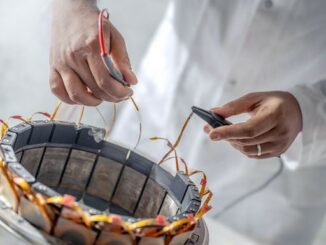
Carefully winding their cryogenically-cooled permanent magnet motor with superconducting tape instead of copper magnet wire, Airbus engineers in France have been meeting with success in their efforts to develop an electric propulsion system for aircraft that be powered by hydrogen fuel cells. The team powered-on their 500 kilowatt powertrain at the system’s core recently, marking a breakthrough in their quest to marry hydrogen-powered fuel cells and superconductivity for game-changing flight propulsion. […]

Research & Development

CERN and Airbus Partnership on Future Clean Aviation

CERN and Airbus UpNext, a wholly owned subsidiary of Airbus, have launched an innovative collaboration to explore the potential use of superconducting technologies developed by CERN for particle accelerators in the electrical distribution systems of future hydrogen-powered aircraft. […]