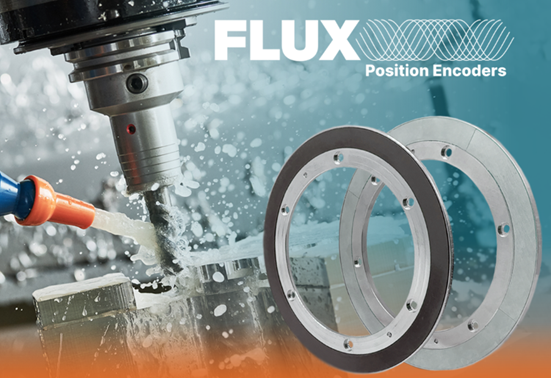
Austrian encoder specialist Flux GmbH is harnessing the principle of giant magneto impedance (GMI) to bring new levels of precision and adaptability for developers of machine tools, gyro-stabilized platforms and test stands.
The GMI effect involves a material’s change in impedance when exposed to an external magnetic field, which can then be used to measure rotational or linear movement with extremely high accuracy. Generally, the effect is most notable in soft magnetic materials, especially where domain walls are oriented perpendicular to the current direction.
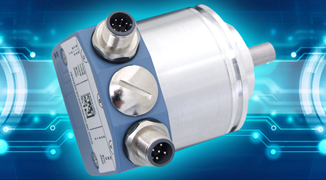
Flux’s GMI encoders leverage the principle to deliver performance that goes beyond the limitations of many traditional sensors:
- For machine tools the company’s GMI angle encoders excel due to their bearing-less design which eliminates wear and tear issues associated with traditional encoders. They offer real-time data collection with angular accuracy of ±4 arcseconds.
- Gyro-stabilized platforms used in cameras and optical devices require encoders that can withstand vibrations and temperature extremes. Flux’s GMI rotary encoders meet these demands with their compact design, high resolution and resistance to thermal drift.
- For test stands used in material and product testing, where extreme accelerations and speeds are common, the GMI encoders yield precise results without being affected by high vibrations or rapid changes in movement.
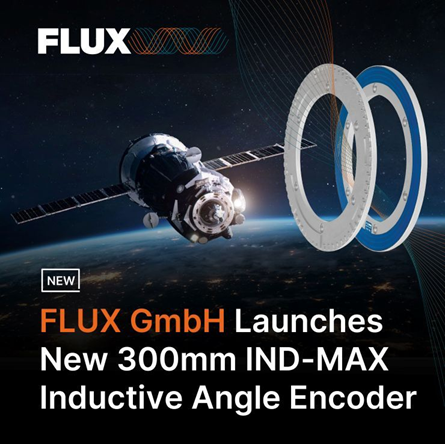
Besides the GMI products, Flux also develops inductive angle encoders. In March, for example, it launched a new 300mm size option for its IND-MAX range of inductive angle encoders for harsh environments. They use inductive technology, immune to magnetic and electromagnetic interference, with thousands of configuration options in sizes ranging from 125 to 375 mm in outer diameter.
“We’re seeing a lot of demand for larger diameter encoders, so the 300mm unit is a natural extension to our IND-MAX family of products,” said Paul Tutzu, managing director & founder. For more info, see www.flux.gmbh.