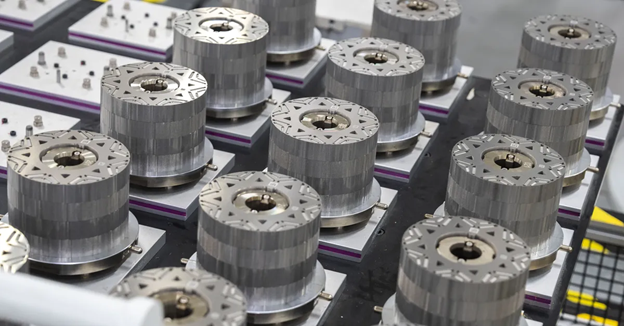
European Metals Recycling, a progressive company in sustainable materials and recycling based in the UK, is building its capabilities to develop advanced circular supply chains for rare-earth magnets.
- Its latest move has been to join CirculaREEconomy (CREEM), a pioneering £11 million research and development consortium in the UK that seeks to revolutionize rare-earth magnet recycling for electric vehicles.
- It has recently established a new pilot line for magnet reprocessing at an EMR site in Birmingham that will be used in the project.
- Another key step has been to establish a pilot recycling center for wind turbines in Glasgow, Scotland designed to harvest magnets and other materials.
Led by Rare Earth recycling innovator Ionic Technologies, the CREEM initiative brings together automotive manufacturers as well as rare-earth metals and magnet manufacturers to establish a scalable and sustainable method of recovering and reusing rare-earth magnets from end-of-life vehicles. The project forms a key part of the UK’s Department of Business and Trade’s £2.5 billion DRIVE35 campaign, announced in July, to support projects which will help the transition to zero-emission vehicle manufacturing. CREEM is supported by funding from the Advanced Propulsion Centre.
Ionic Technologies is a Northern Ireland-based subsidiary of Australian minerals company Ionic Rare Earths, and has secured several grants from the British government that support developing collaborative rare earth element supply chains within the UK. (See here for a previous article in Magnetics Magazine.)
EMR is investing £730,000 (including match funding) to develop the collection, recovery and recycling technology that will enable rare-earth magnets to be recovered more efficiently, sustainably and safely from EV motors and other assemblies. Building on experience gained during the recently completed SCREAM and Re-Rewind projects, EMR will work alongside Ionic Technologies and other consortium partners including Ford Technologies, Bentley Motors, Bamford Bus Company (Wrightbus), Less Common Metals (LCM) and the British Geological Survey (BGS).
Recycling rare-earth magnets can be a slow, expensive and labor-intensive process. From a brand-new pilot line at EMR Birmingham, teams will explore ways to make this process more efficient to liberate the rare-earth magnets contained within EV motors. This will allow them to be safely and efficiently processed as part of a ‘long-loop circular supply chain’ – where materials re-enter the manufacturing cycle with a high level of purity and function.
Carefully separating magnets in this way allow Ionic Technologies to break them down to their constituent rare-earth oxides using a range of solvents and other chemical processes. This approach offers the industry flexibility in the chemistry of the recycled magnets it can produce, enabling rare-earth magnets from older EVs to become brand-new magnets that meet the exact specification required for future vehicles, reflecting the fast pace of innovation.
The project will also allow EMR to safeguard the high-grade steel often used to build these motors – which can be downcycled during some recycling processes. By limiting the demand for virgin materials, a sophisticated circular supply chain for rare-earth magnets will reduce the biodiversity loss associated with extracting primary materials, as well as boost the UK’s resource security. Early analysis by Ionic Technologies suggests refining this secondary (recycled) material can reduce the carbon impact by around 60% compared to virgin alternatives. As part of CREEM, the British Geological Survey will be tasked with quantifying these benefits even more accurately, producing a material flow and Life Cycle Assessment (LCA) of recycled components.
“We’re really excited to reveal the next stage of EMR’s mission to create a circular economy for rare-earth magnets – crucial to the green transition,” notes Roger Morton, Managing Director for Technology & Innovation at EMR. “CirculaREEconomy continues EMR’s investment in the recycling of the neodymium (NdFeB) magnets, which can be found in everything from electric vehicles and hi-fi equipment to the largest offshore wind turbines, as reflected by the recently completed SCREAM and Re-Rewind projects.
“A circular economy for these materials won’t only safeguard the planet’s biodiversity and add resilience to vital supply chains, it will also allow our customers to achieve circularity and their net zero targets in line with the ELV Regulations and the EU’s Critical Raw Materials Act, which mandates a quarter of demand for this material must be met by recycling by 2030.
“In addition, EMR’s long-term commitment to recycling these powerful magnets has enabled our teams to develop the highest safety standards when handling what can be very difficult materials. “We’ll now take everything we’ve learned so far and join forces with the rest of the consortium to build an efficient, scalable and flexible long-loop supply chain which complements our previous development projects for these increasingly crucial magnets.”
EMR’s new Wind Turbine Processing Centre in Scotland
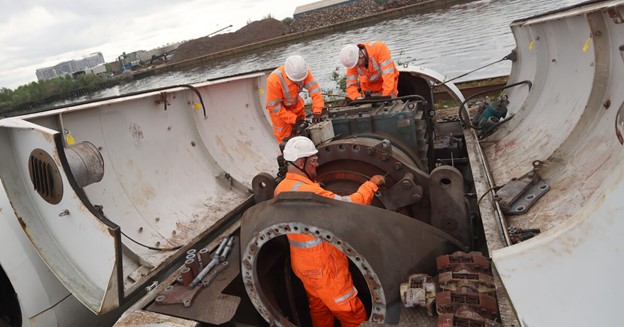
Close to the vast wind farms of the North Sea, EMR established a wind turbine processing facility at its Glasgow South Street site in October last year. With nearly 90% of a wind turbine containing infinitely recyclable materials such as steel, aluminium, copper – and magnets –EMR’s new facility enables these metals to re-enter the circular economy.
The project is part of Re-Rewind, a partnership between industry and academia – spearheaded by EMR – which aims to create a circular supply chain for the rare earth magnets used within modern wind turbines. Research and development projects to boost magnet reclamation will also be based at the new processing center. Re-Rewind is part-funded by the UK Government through Innovate UK.
The new facility is, itself, an embodiment of the “reuse” ethos it promotes, having been built inside a more than 100-year-old warehouse that was originally constructed for the North British Engine Works (also known as the Barclay Curle Complex) in around 1913.
Dr Charlotte Stamper, Strategic Partnerships Manager at EMR said: “The positive impact of renewable technologies such as wind power is clear. However, with this facility, all materials used in the construction of wind turbines can be put back into the supply chain, creating a circular economy. EMR’s decommissioning hub will create a new pathway for used turbines to be efficiently dismantled, with most components either being immediately recycled by our expert teams or refurbished and made available for reuse.”
With facilities across the globe, including about 70 sites in Europe and more than 50 sites in the U.S., and a team of over 3,000 people, EMR operations put 10 million tons of material back into the supply chain annually. See www.emrgroup.com.