Disk-drive leader Western Digital, along with Microsoft and others are collaborating in a rare earth element recovery and circular recycling program using environmentally friendly chemistry to help build up critical rare earth element reserves and enhance supply chains.
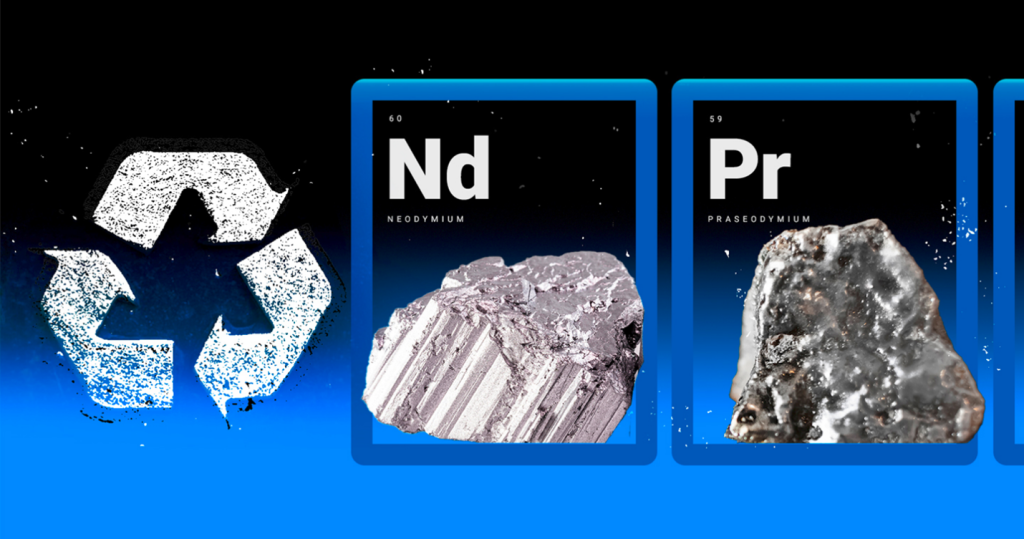
Essential to cloud data center infrastructure, hard disk drives (HDDs) are complex devices that blend material science, mechanical engineering and physics. HDDs use a range of rare earth elements like Neodymium (Nd), Praseodymium (Pr) and Dysprosium (Dy), prized for their magnetic properties to help HDDs precisely read and write data. Yet, traditional recycling methods recover only a fraction of these valuable materials, often missing rare earths entirely, leading to unnecessary waste.
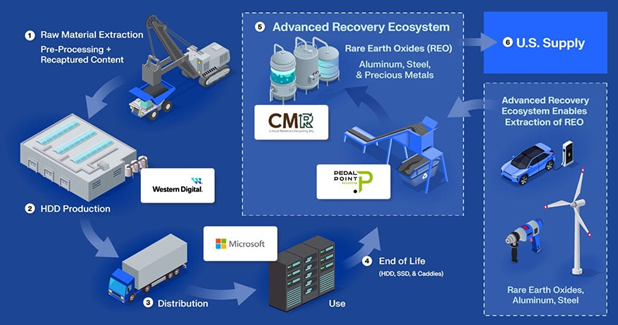
In a multi-party pilot program, Western Digital, in collaboration with Microsoft, Critical Materials Recycling and PedalPoint have taken a major step toward closing that loop. Together, the companies transformed about 50,000 pounds of shredded end-of-life HDDs, mounting caddies and other materials into critical high-value materials, all while significantly reducing environmental impact.
The pioneering process of creating a new advanced sorting ecosystem with an eco-friendly non-acid process not only recaptures essential rare earth elements but also extracts metals like gold (Au), copper (Cu), aluminum (Al) and steel, feeding them back into the U.S. supply chain, supporting industries that rely on these resources—such as electric vehicles, wind turbines, and advanced electronics. When scaled worldwide, this new recycling process could return a lot of recovered rare earths to the American supply pool. Today, most primary production (>85%) of REEs occurs outside of the U.S. and the current domestic recycling rate for REEs is very low (<10%).
The materials were collected from several Microsoft data centers located in the United States. The program showcases a highly efficient, economically viable system that achieved an impressive ~90% high-yield recovery of elemental and rare earth materials that can be used. Advanced chemical processes, combined with meticulous segregation of components, also allowed the system to recapture ~80% by mass of the feedstock turning potential waste into valuable assets.
The innovation doesn’t stop there. Based on life cycle analysis, there is an estimated 95% reduction in greenhouse gas emissions compared to traditional mining and processing practices. By performing the entire rare earth oxide (REO) production process domestically, the program minimizes transportation emissions and boosts the resilience of the domestic supply chain, decreasing dependency on imported materials.
The ripple effects can be significant. By enabling industries to access high-purity, more sustainably sourced materials, this program can reduce the environmental footprint not only of data centers but also of the industries that depend on rare earth elements.

“This initiative sets a new standard for end-of-life data storage management,” said Jackie Jung, vice president of Global Operations Strategy and Corporate Sustainability at Western Digital. “In today’s rapidly evolving data landscape, innovation must extend beyond a device’s lifecycle. Western Digital and its partners are leading the way, transforming retired storage devices into critical resources that power our future—while protecting the planet and strengthening the economy and U.S. supply chain. This project isn’t just a milestone; it’s a blueprint for large-scale, domestic recycling of essential metals and materials that will drive sustainable progress for years to come.”
“This is a tremendous effort by all parties involved. This pilot program has shown that a sustainable and economically viable end-of-life management for HDDs is achievable,” said Chuck Graham, corporate vice president, Cloud Sourcing, Supply Chain, Sustainability, and Security at Microsoft. “HDDs are vital to our data center infrastructure, and advancing a circular supply chain is a core focus for Microsoft. We’re proud to be a part of this initiative with our partners, creating opportunities to reuse and recycle materials, reduce waste, and lower carbon impacts across the industry.”

The environmentally friendly, acid-free dissolution recycling (ADR) technology used in this project was invented and initially developed at the Critical Materials Innovation (CMI) Hub, located at Ames National Laboratory, a U.S. Department of Energy laboratory at the University of Iowa . “Scaling the ADR technology from lab to demonstration scale in just eight years is a testament to the incredible work by the team at CMR. This project is significant because HDD feedstock will continue to grow globally as AI continues to drive the demand for HDD data storage. CMI is proud to have supported the initial development, along with the Ames National Laboratory, to support this program’s growth and reach as a viable green approach to recover rare earth elements using environmentally friendly chemistry,” said Tom Lograsso, director of CMI.
“At PedalPoint Recycling, our mission is to secure and properly recover strategic metals from recycling. This is an exciting project that clearly demonstrates the positive impact companies can have on recycling when they partner and collaborate,” said Brian Diesselhorst, CEO, PedalPoint Recycling. A subsidiary of Korea Zinc, PedalPoint has quickly grown into one of the largest electronics recyclers in North America. Founded in 2021, its subsidiary evTerra currently operates four shredding facilities spread across the U.S. that have the capacity to receive, shred and sort over 200 million pounds of electronics per year. The sites are committed to properly managing all types of end-of-life electronics, especially those seen as undesirable by other recyclers.
Giving HDD rare earth elements new life
Some of the intricacies of the program are explained by Jung in a blog available on the WDC website, highlighted here:
“HDDs are—and will continue to be—the foundational storage medium for hyperscale cloud data centers. IDC projects1 that global data generation will increase from 132.4 zettabytes (ZB) in 2023 to 393.9ZB in 2028, almost tripling, and HDDs will continue to account for nearly 80% of the storage capacity used in hyperscale and cloud data centers through 2028. HDDs are not just here to stay—they’re essential for enabling the next wave of innovation.
When an HDD reaches its end of life, how can its components be used for the greater good?
Rhownica Birch, who is director of Global Operations Product Sustainability on my team, asked just that question. As part of her quest to identify how recycled and recovered content is used in the company’s products and packaging, she decided to take it one step further and examine what happens to HDDs once they reach the end of their lifecycle.
It was from this exercise that she, our team, and partners created the Advanced Recovery and Rare Earth Material Capture Program, an ambitious effort in the U.S. to capture rare earths from destroyed, shredded hard drives at scale.
An opportunity to make a significant impact
An HDD is a modern marvel. HDD innovation blends many facets of material and mechanical sciences, and the HDD itself is composed of hundreds of components, with materials ranging from aluminum to steel to rare earth materials such as neodymium, dysprosium, and praseodymium.
Aluminum and steel are key components that house, protect, and compose a hard drive’s internal elements, such as its platters, spindle motor, actuator, and other structural parts. Rare earth elements are critical to the magnetic capabilities of HDDs. Neodymium magnets, for example, allow HDDs to read and write data. These and other rare earth elements contribute to an HDD’s high performance and durability.
When a data center is ready to retire a generation of its HDDs, many of them are destroyed for security reasons. Rare earths are often melted down with steel because many recovery processes involve a highly corrosive process that is not eco-friendly nor economical—and the rare earths are lost. Our department sought a different approach in the quest to increase the material recovery rate of end-of-life HDDs and their valuable materials.
Sustainability is a team sport
Western Digital’s Office of the CTO had insight into a new recapturing process through their associations with the National Science Foundation and the Critical Materials Innovation Hub at Ames National Laboratory. It was there that they learned of Critical Materials Recycling’s (CMR’s) acid-free dissolution recovery (ADR) technology, which was invented over eight years ago.
Birch, along with Dr. Inez Hua, Engineering Advisor for Environmental Sustainability, and Dr. Qing Dai, Distinguished Engineer at Western Digital, enlisted CMR for a controlled study to evaluate the rare earth reclaiming process and its output. Once the initial pilot program achieved reclaim percentages of over 90%, Microsoft and its recovery partner, PedalPoint Recycling, were enlisted to participate in a subsequent large-scale pilot program in 2024 along with CMR and Western Digital.
The hard drives were collected from several Microsoft data centers in the United States and sent to the recovery partners. Shreds of HDDs, SSDs, and caddies were sent to PedalPoint where they were sorted and processed. The magnets and steel were then sent to CMR to figure out the best way to sort and size the materials and extract the valuable rare earth elements using CMR’s environmentally friendly and economically competitive ADR recovery process.
The four companies went through multiple pilots and invested in both new equipment and innovations to create a mass production ecosystem at scale for retrieval of rare earths, which was completed in December 2024. Together the companies have transformed close to 50,000 pounds of end-of-life drives, mounting caddies, and other materials into critical, high-value materials, all while significantly reducing environmental impact.
This multi-party at-scale recovery has demonstrated that an ecosystem of socially and environmentally responsible EOL management is possible through a combination of careful segregation, technologically enabled chemical processes, and sustainable resources that result in ~90% high-yield elemental and rare earth recovery and ~80% capture rate of all shredded material. On top of that, the carbon footprint shows 95% less carbon than virgin mining.
Driving change and fueling new ecosystems with an eco-friendly handprint
What’s even more exciting is the potential for this program to benefit other industries. The technology, process, and ecosystem help Western Digital’s data center customers as well as supply chains in unrelated industries. After the elements are recovered, they can be fed back into the U.S. market for rare earths and other materials.
As Daniel Bina, CEO of CMR, put it, “The advancements and success achieved with rare earth recovery from HDDs can be directly applied to rare earth recovery from electric vehicles (EVs) and wind turbines.”
“We became the model for the ecosystem with our carbon handprint; it’s something we created but can translate outside of our industry,” said Birch. “This process is expected to mature over time toward the north star of closed-loop circularity.” [Editor’s Note: Located in Boone, Iowa, nearby Ames Lab, CMR is an outgrowth of Ames Lab organized as a multi-phase Small Business Technology Transfer project.]
Western Digital’s goal is to encourage more of its cloud customers and partners to engage in this advanced recovery ecosystem to help develop and work toward a closed-loop system. This initiative is setting a new standard for end-of-life data storage management. The project isn’t just a milestone; it’s a blueprint for large-scale, domestic recovery of essential metals and materials that will drive sustainable progress for years to come.”
For more info, see www.wdc.com, www.criticalmaterialsrecycling.com, www.ameslab.gov/cmi, www.pedalpoint.co, www.microsoft.com.