Infineon Technologies is expanding its XENSIV magnetic sensing portfolio with a comprehensive range of tunnel magnetoresistance sensors. Complementing the company’s established Hall, GMR and AMR sensing solutions, the new TMR technology unlocks more capabilities in magnetic sensing for product and system developers.
“Magnetic sensing is becoming a critical enabler across an ever-growing range of applications. In consumer wearables, industrial automation as well as automotive safety systems alike, our XENSIV sensor portfolio is giving developers the tools to push boundaries,” says Thomas Schafbauer, Executive Vice President Sensor Units & RF, at Infineon. “By further expanding our TMR portfolio, we are adding higher sensitivity, lower noise, and robust functional safety that are all backed by Infineon’s manufacturing scale and decades of application know-how to help customers design smarter, and bring products to market faster.”
The platform delivers exceptional sensitivity and a high signal-to-noise ratio, enabling accurate parameter retrieval and reliable sensing from smaller magnets without bandwidth limitations. Performance is maintained across larger airgaps and with increased mechanical tolerances. This makes the sensors ideal for low power position sensing in gaming and human-machine interface, health and lifestyle wearables, and for position and current sensing in automotive and industrial applications.
TMR technology directly addresses the industry trend of design engineers seeking smaller, highly adaptable systems and fast control and protection loops, notes the company. For current sensing, the portfolio offers inherently insulated, in plane sensing with wide range measurement capabilities. This enables exceptionally low noise measurements with higher bandwidths and minimal signal delay times. The position sensors combine high sensitivity and low noise for fine motion resolution with low power consumption and robust, contactless operation that remains stable over temperature. For safety-critical environments, there are automotive-qualified TMR sensors designed according to ISO 26262. Single-die configurations achieve ASIL D (fail-safe) compliance. Dual-die configurations deliver up to 2xASIL D (fail-operational) performance.
The portfolio is engineered to help developers reach their project goals with minimal troubleshooting. Field strength can be measured directly through linear measurement. This is enabled by advanced Vortex structures that make linear sensing practical and robust. Monolithic CMOS + TMR integration brings sensing and signal-processing functions together on a single die.
Key product families address distinct application needs:
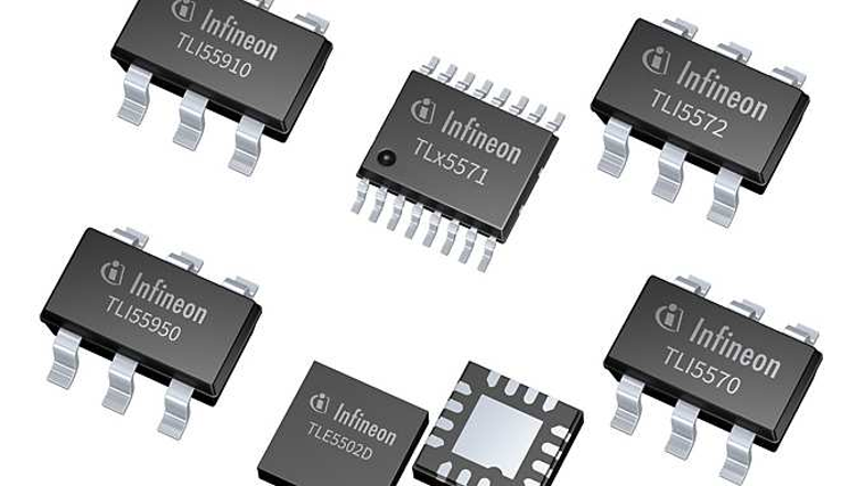
- Position sensing: XENSIV TLI55910, TLI55950, and the forthcoming TLV552D linear sensors and TLV55624-1O switch target gaming (joysticks, key switches) and wearable applications, where high resolution, low power consumption, small package size, and cost efficiency are paramount.
- Current sensing: XENSIV TLI5570 and the forthcoming TLI5572 serve PV inverters, energy storage systems, and high-current motor control in power tools and drones. TLx5572 current sensor will be showcased as part of the robotics demonstration at PCIM.
- Overcurrent detection: The forthcoming TLE5571 current sensor addresses solid-state circuit breaking, solid-state relays, power tool battery management systems, and similar protection applications. TLE5571 will also be featured in the PCIM robotics demo.
- Automotive: TLE5502 angle sensor automotive-qualified, dual ASIL D targets BLDC motor control, electric power steering, and industrial drives.
For more info, see www.infineon.com.