For a design engineer selecting a sensor for a product development effort, the most fundamental thing, of course, is to determine the correct type of sensor with the right capability. Then, however, there is the nagging question, what about reliability?
Sensor expert Baumer, a global leader in sensor products — many of which involve magnetic sensing such as with its recently lauded encoder with low harmonics technology — has ramped up its programs to put its sensors to rigorous testing by clustering its expertise in test and inspection routines for innovative developments with a newly established Innovation Lab. Located in the spacious basement of the Innovation Center headquartered in Frauenfeld, Switzerland, the sensors from the company’s research and development centers undergo rigorous testing there.
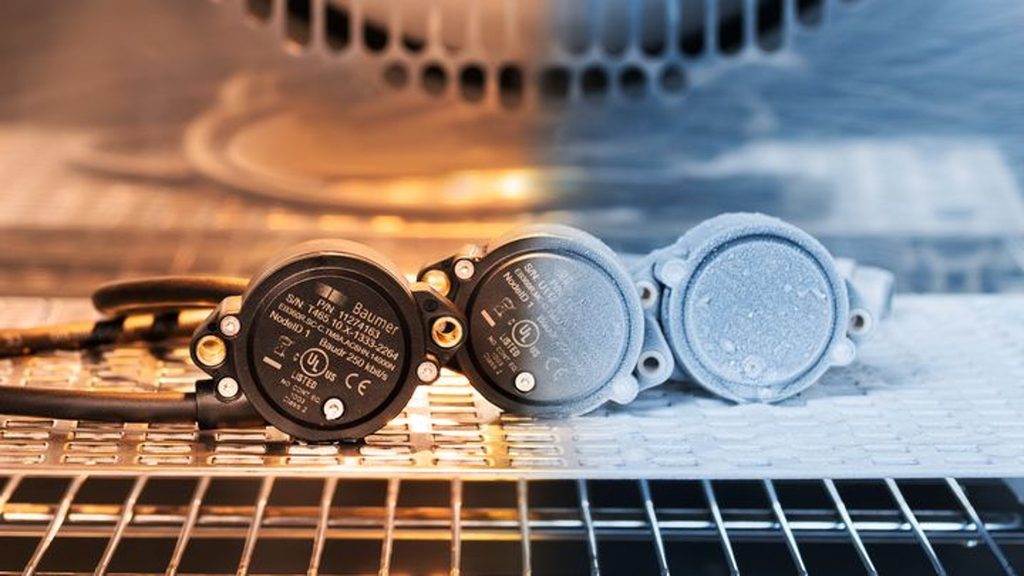
The new lab is equipped to simulate extreme conditions and to enable collaboration with the world’s leading OEM manufacturers. Before the actual tests, Baumer simulates the effects of sensor aging, for example, in temperature shocks, as depicted in the photo at top. The test routines aim at pushing every sensor to its limits, at identifying and eliminating weak points and thereby setting new benchmarks.

In the 1,300-square-meter Innovation Lab with cutting edge equipment, tests and simulations run around the clock to ensure flawless and continuous operation for customers. These include: leakage tests in the water chamber; shock tests on the seismic shock bench; vibration tests on shakers; temperature tests and artificial aging in climate chambers; performance tests on linearity, repeatability and resolution independent of the object and throughout the entire measurement and temperature range; plus verification tests on response times, ambient light immunity, resistance to mutual interference, spot size, sonic cones and more.
The sophisticated testing environment is particularly suitable for users of Baumer sensor solutions in outdoor applications like in mobile machines and the railway industry. “To these customers, it is crucial that the sensors deliver precise data in continuous operation even after years of deployment in most demanding environments. To meet this requirement, the testing routines in the Innovation Lab are a key component in the Baumer quality strategy,” says Wolfgang Wehrle, Head of Development at Baumer.
Smart encoder with LowHarmonics technology
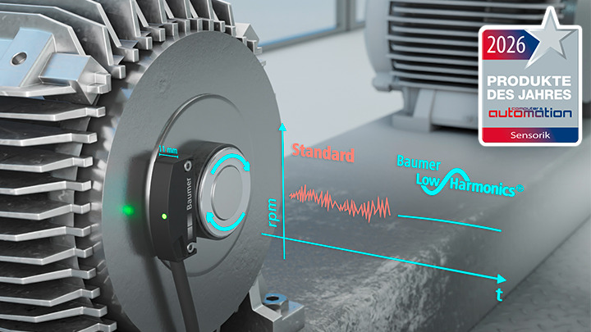
The recently developed EB260 magnetic ring encoder from Baumer with LowHarmonics technology merges the precision of optical sensing with the durability and cost-efficiency of magnetic systems. Its first LowHarmonics product, the compact incremental encoder was awarded “Product of the Year 2026”. In the sensor category by readers of the trade magazine Computer & Automation.
LowHarmonics opens up new opportunities in drive technology and factory automation, notes Baumer. The sophisticated technology eliminates signal errors caused by installation, temperature, ageing or mechanical factors to maximize precision. An integrated airgap monitor continuously detects the distance to the magnetic rotor and reports even the slightest non-compliance due to damaged machine mechanics to the higher-level system. See www.baumer.com.