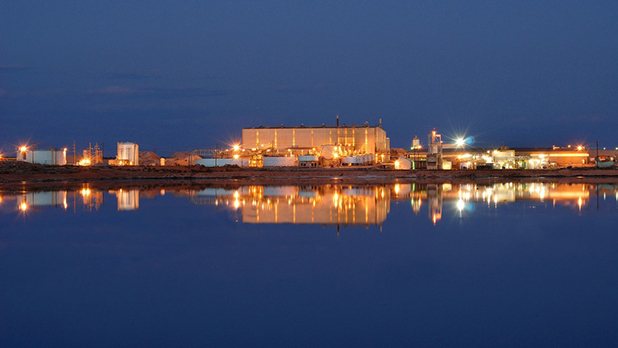
Minerals producer Energy Fuels, now led by a new CEO, reports it has reached a new milestone in its quest to become a major American producer of rare earth oxides for magnet manufacturing. The company has successfully produced its first kilogram of terbium (Tb) oxide at its White Mesa Mill in Utah. Using monazite ore sourced from the southern United States, the team achieved a purity of 99.9% Tb at pilot scale, which meets the specifications of global manufacturers of rare earth permanent magnets.
Announced in late March, the latest achievement follows the company’s earlier accomplishment of producing nearly 30 kg of 99.9% pure dysprosium (Dy) oxide production, another critical “heavy” rare earth oxide REO used in permanent magnets. The ore is mined from monazite deposits in Florida and Georgia.
“This success proves we can process and produce high purity ‘heavy’ rare earth oxides economically and at scale in the U.S.,” said Energy Fuels CEO Mark Chalmers, who has since retired from the company. “North America will soon have a reliable and secure U.S. commercial source of these vital critical materials ensuring availability for high-performance magnet and defense technologies. This is just another example of the outstanding team the company has at both the Mill, and elsewhere, as the company continues to advance our strategy of becoming a world significant critical material producer.”

In a planned succession, Ross Bhappu has been appointed as CEO to succeed Chalmers effective April 15, 2026. He has been president of the Denver, Colorado-based company since August 2025 and has more than three decades of leadership across mining, critical minerals, finance, and international resource development.
Now, Energy Fuels believes it is the first U.S. company in many decades to produce high-purity Tb oxide from a primary mineral feedstock and publicly disclose actual production volumes and purities that are sufficient for downstream metal/alloy validation. Like its Dy oxide, the Tb oxide has been requested by multiple magnet manufacturers and OEMs around the world to begin product validation. Both Dy and Tb are subject to Chinese export controls, highlighting the demand for secure, western supply chains.
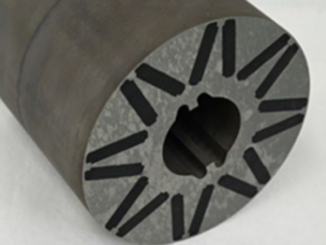
Adding Dy and Tb to permanent magnets makes a superior product for electric vehicles, drones, robotics and defense technologies by improving operational capabilities in high heat conditions and enabling smaller, lighter, more powerful motors and actuators. The mill expects to continue producing terbium oxide at an approximate rate of one kilogram per week in its existing pilot circuit, followed by pilot production of Sm, Eu, and Gd oxides.
Other plans include expanding heavy rare earth element production capability at its existing mill circuits for the planned commercial-level recovery of Dy, Tb, Sm, Eu and Gd, with the ability to separate other heavy rare earth elements such as Y and Lu if market conditions warrant. Subject to receiving regulatory approvals and sufficient quantities of monazite sand feedstock, the expanded commercial circuit is expected to be operational as early as 2027, with planned production recovery of up to approximately 35 tons of Dy, 12 tons of Tb per year and potentially other heavy rare earth elements, in addition to the 850 – 1,000 tons of NdPr, from processing up to approximately 10,000 tons of monazite per year through existing circuits.
The company also plans to further expand its NdPr, Dy and Tb production capability and potentially other REE material production capability through the development of its stand-alone Phase 2 Circuit as early as 2029. It is expected to increase the mill’s rare earth oxide production capacity to over 6,000 tpa of NdPr oxide, along with approximately 80 tpa of Tb and 288 tpa of Dy oxides. This would provide the capability to produce sufficient NdPr for up to approximately 7.0 million EVs/hybrid EVs per year, says the company.
Moving forward, it expects to continue purchasing monazite concentrates from U.S. companies and to import additional significant quantities from allied nations, including its “shovel-ready” Donald Project in Australia, massive Vara Mada Project in Madagascar, and prospective Bahia Project in Brazil. It also is planning to install circuits at White Mesa for processing mixed rare earth concentrates for both “light” and “heavy” rare earth oxides. See www.energyfuels.com.