
ThinKom Solutions is leveraging its innovative VICTS phased array antenna technology to unlock high-power microwave systems for directed energy weapons in military markets, while also developing new ground stations for satellite communications.
The “Variable Inclination Continuous Transverse Stub” phased array antennas use magnetic induction to drive the stub discs within the antenna that rotate to steer the beams. While magnetic induction is the core principle for rotating the internal passive layers or platters to control the phase distribution and steer the antenna beam, systems from Thinkom also employ high-torque permanent magnet brushless DC motors to enable speedy satellite switching. Because of significant internal investment, the company has already made rapid strides in development and testing, proving VICTS phased arrays to gigawatt-level power handling.
“ThinKom prides itself in providing the best performing antenna solutions regardless of the market,” explained Bill Milroy, CTO and co-founder at ThinKom, which is based in Hawthorne, California. “Building on our long heritage of ground and airborne satcom systems, we realized that our antennas are uniquely suited for handling extremely high power levels and are investing heavily to develop HPM systems for the warfighter.”
VICTS phased array antennas excel over other phased array solutions—such as electronically scanned arrays—in many ways, says the company. Their technology enables significantly higher peak power handling, which translates into more power on target and longer ranges. In addition, they consume less prime power, which enables integrations on constrained platforms. The VICTS antennas also have higher gain and better performance over scan, allowing for a wider field of view.
“We are strategically investing in the rapidly evolving HPM market and will continue to develop solutions for multiple platforms and applications, conducting additional testing and demonstration throughout 2025 and 2026,” said Milroy.
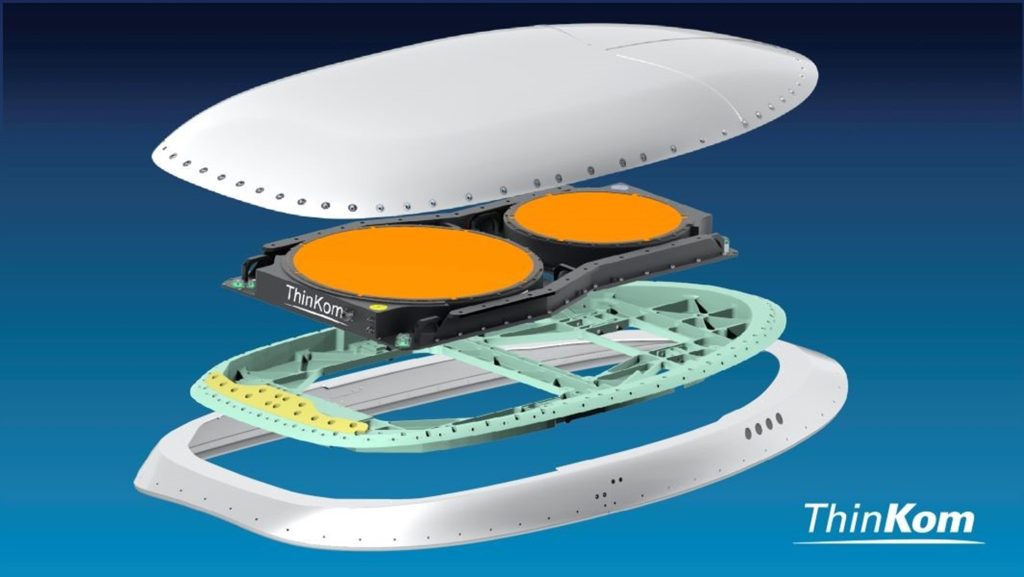
VICTS antennas employ layers of lightweight platters that rotate a center axis to steer the beam and control polarization. Each of these layers is completely passive, significantly reducing the power draw and increasing the antenna efficiency. The motion is all contained within the antenna, so it’s particularly reliable and you see no moving parts.
Partnering with KSAT on new earth observation ground station

In another product area, ThinKom is working with KSAT (also known as Kongsberg Satellite Services), located in Tromso, Norway, to develop a commercially viable receive-only ground station. The goal is to boost overall network capacity as well as operational efficiency. The effort combines ThinKom’s expertise in active phased array antenna technology with KSAT’s experience operating a large ground station network. ThinKom will develop a Ka-band version of its scalable digital array that enables multi-beam, multi-orbit, multi-constellation operation via a modular, waveform agnostic, open architecture for global deployment of ground stations.
The core antenna module uses an active phased array design based on its Ultra technology with no beam-walk over the full frequency range. Ultra builds on the company’s VICTS technology, with additional key features. These include a true time delay design to support ultra-wideband operation sensing applications. The software-defined beamformer provides dynamic target tracking and real-time adaptability to manage the proliferation of satellite constellations in multiple orbital planes.
ThinKom’s Ultra array antennas use a mechanical, steerable phased array architecture along with passive RF layers and digital beamforming rather than magnetic manipulation for beam direction. The beam is steered using high-torque permanent-magnet brushless DC motors, which manipulate the physical orientation of the array elements within the housing, rather than using magnetic fields to electronically steer the beam.
“At KSAT, we take pride driving and adopting new technology solutions and continuously striving to improve the efficiency of our global satellite ground station network,” noted John Heskett, CTO of KSAT. “Phased array antennas have been around quite a while and offer enormous potential, however, finding solutions that meet the demanding requirements of our Earth Observation tracking ground stations has proven challenging. We are excited to partner with ThinKom on their solution and look forward to collaborating with NOAA to evaluate its performance against the JPSS satellites.”
KSAT will evaluate the multi-beam performance, simultaneously tracking and processing wideband Ka-band downlinks from multiple satellites. Program testing will be performed in collaboration with the National Oceanic and Atmospheric Administration’s (NOAA) Joint Polar Satellite System (JPSS) Program from ThinKom’s headquarters in California. For more info, see www.thinkom.com, www.ksat.no.