Bolstered by a $1.2 million award from the U.S. Department of Defense and now with the commissioning of a new strip casting furnace from Consarc, Vulcan Elements is building up operations at its new pilot magnet manufacturing plant in North Carolina. A key objective is to develop fresh alternatives for a secure, domestic supply chain for magnets used in critical Air Force systems.
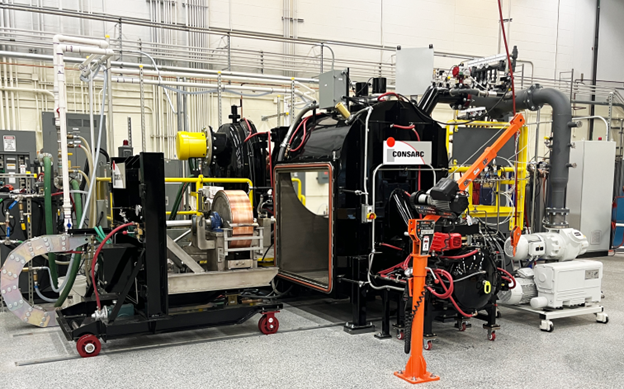
The state-of-the-art furnace, engineered and manufactured by Consarc in New Jersey, is now fully operational at Vulcan’s facility in North Carolina’s Research Triangle Park, the companies announced in June. The furnace enables the rapid solidification of Neodymium Iron Boron (NdFeB) alloys—critical materials for high-performance magnets used in electric vehicles, defense systems, wind turbines and advanced electronics.

“Vulcan Elements’ mission is to onshore a secure, traceable, and transparent rare earth magnet supply chain,” said John Maslin, CEO. “To meet that mission, America needs a strong and resilient manufacturing equipment base. As demonstrated by this newly-commissioned strip casting furnace, Consarc is a core part of that ecosystem, and Vulcan Elements is committed to developing and galvanizing domestic equipment production by working with partners like Consarc.”
As a supplier of both pilot and production-scale strip casting furnaces, Consarc was selected to supply the furnace, beginning a partnership that can grow with Vulcan’s expanding operations. “As a wholly U.S.-owned manufacturer of vacuum induction melting (VIM) technology capable of casting NeFeB and other critical alloys, Consarc is proud to play a vital role in reestablishing America’s rare-earth magnet manufacturing base,” said Jai Narayan, president of Consarc, which is a company of the Inductotherm Group.
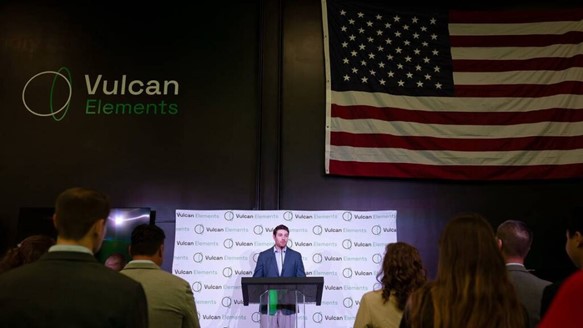
Founded about two years ago, Vulcan held a grand opening ceremony at the state-of-the-art manufacturing and R&D facility on March 31. The newly-commissioned, 21,000 square foot facility will manufacture rare earth magnets, specifically Neodymium Iron Boron (NdFeB) magnets, for Department of Defense programs and commercial applications using a proprietary process that enables production in the United States. The site also serves as the company’s research and development hub, supporting its ambitions to become a supplier for more defense programs including those of U.S. allies.
Previously, Maslin served as an officer at the U.S. Navy’s Nuclear Propulsion Program in various roles including as the financial manager for the Ballistic Missile Submarine Program, executing a $2B annual budget to finance and procure sensitive materials and components for nuclear reactors on the Navy’s newest aircraft carriers and submarines. He received his MBA from Harvard Business School, a Master of Accounting from the University of Cambridge, and a BS from the University of Colorado Boulder.

The event also featured remarks from Dr. Nadia Schadlow, senior fellow at the Hudson Institute, who was the architect of the 2017 National Security Strategy of the United States: the document that put strategic competition with China on the map. Dr. Schadlow reflected on the Department of Defense’s dependence on China for rare earth magnets for many of its most critical military platforms and the vulnerabilities, for example, that led DoD to pause the F-35 program in 2022 after discovering Chinese material in the F-35’s magnets. Vulcan Elements, she concluded, is an example of the exact type of supply chain shifts that the Pentagon needs now.
Aiming to help the US Air Force enhance its supply chain for rare earth magnets, the DoD grant began in September and is scheduled to end at the end of 2025. Working directly with senior research scientists at Air Force Research Laboratory’s Materials & Manufacturing Directorate (AFRL/RX), Vulcan is charged with translating its work in laboratory development up to pilot scale development and small-scale production that would help bring alternative sources of rare earths to production and integration into Air Force systems.
The project allows Vulcan to design and develop its materials and processes in a way which can qualify these alternative sources as they are discovered. While the entire process of stripcasting up to magnetizing is crucial to quality, the first half of the process – including stripcasting, hydrogen decrepitation, jet millings, and axial/alignment pressing — has significant metallurgical processes that define how well the resulting material will perform as a magnet. Vulcan’s focus under this project is to commission and conduct process R&D in a pilot factory capable of producing NdFeB magnets for prototyping. This requires a significant process, metallurgy and magnetics engineering campaign to scale up processes from the laboratory volume in grams to pilot scale volume in kilograms.
For more info, see www.vulcanelements.com and www.consarc.com.