Research & Development

The Final Magnet for the High-Luminosity Upgrade of the Large Hadron Collider Leaves Berkeley Lab

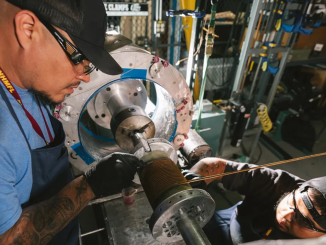
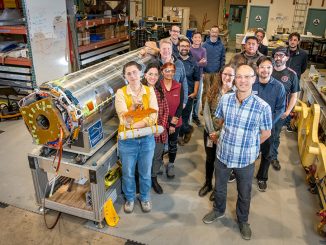
The last of 21 new superconducting quadrupole magnets for the High-Luminosity Large Hadron Collider Accelerator Upgrade Project, or HL-LHC AUP, has left the U.S. Department of Energy (DOE)’s Lawrence Berkeley National Laboratory (Berkeley Lab) for testing before shipment to CERN in Switzerland for installation in the LHC, the world’s most powerful particle collider. […]
Research & Development

“Double” Superconductivity Discovered at MagLab

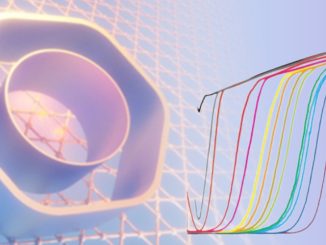
Scientists working at the National High Magnetic Field Laboratory have discovered “double superconductivity,” a surprise finding that could provide new insight into how certain materials carry electricity without resistance, possibly opening avenues for quantum computing and other applications. […]

Research & Development

Making Magnets: At Los Alamos National Laboratory’s MagLab, Magnets are Designed and Built for Research in High Magnetic Fields

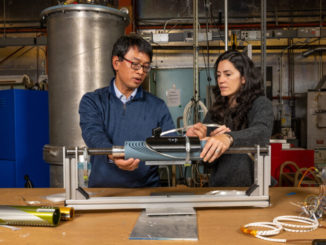
The magnets at the MagLab—the Los Alamos National Laboratory branch of the National High Magnetic Field Laboratory—are some of the strongest in the world, capable of reaching 100 tesla. (For comparison, a refrigerator magnet is about 0.005 tesla, and the Earth’s magnetic field is about 0.00005 tesla). […]

e-Power Technology

Researchers Design Cryogenic Storage & Delivery System for H2 Aircraft 

Researchers at the FAMU-FSU College of Engineering have designed a cryogenic liquid hydrogen storage and delivery system that could help make zero-emission aviation a reality. Their work outlines a scalable, integrated system that addresses several engineering challenges at once by enabling hydrogen to be used as a clean fuel and also as a built-in cooling medium for critical power systems aboard electric-powered aircraft. The research was conducted at the National High Magnetic Field Laboratory which is headquartered at FSU in Tallahasee. 
[…]

Research & Development

Building Better Magnets for Biomedical Breakthroughs

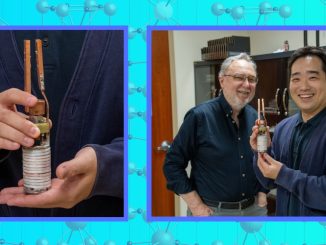
The National High Magnetic Field Laboratory is developing new magnet technology aimed at enabling the next generation of groundbreaking biomedical research. With a new $2.4 million grant from the National Institutes of Health, the lab’s Applied Superconductivity Center will demonstrate that a cutting-edge high-temperature superconducting material can be used to build a nuclear magnetic resonance (NMR) magnet. […]