Big magnets and big money are at the core of a high stakes race to commercialize fusion energy, aiming ultimately to transform the world’s energy supply with the immense power of zero-carbon fusion. This article highlights the progress of two pioneering companies located only a two-hour drive apart — General Fusion in Richmond, British Columbia, Canada and Helion in Everett, Washington in the U.S. The technologies of both companies rely on powerful electromagnets, eschewing the use of more expensive and complex superconducting magnets typically used in tokamaks.
With another $22 million in fresh financing coming onboard in August, Canada’s General Fusion is stepping closer to fully cranking up its LM26 Magnetized Target Fusion demonstrator, seeking to hit scientific break-even by 2026. Across the border and supported by a $425 million fundraising earlier in 2025, American company Helion has begun construction on a plant for its technology, located alongside the Columbia River in eastern Washington.
General Fusion
Backed by a portfolio of leading institutional, sovereign, family office, and high net worth investors including Amazon founder Jeff Bezos, as well as support from the Canadian government, General Fusion’s two decades of extensive fusion research, development and demonstration have advanced the company’s uniquely practical MTF approach and positioned it to achieve near-term transformative technical milestones on a path to delivering fusion power to the grid by the mid-2030s.
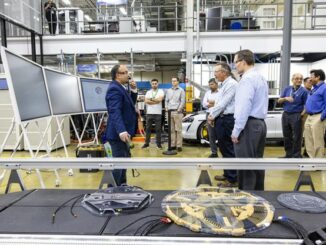
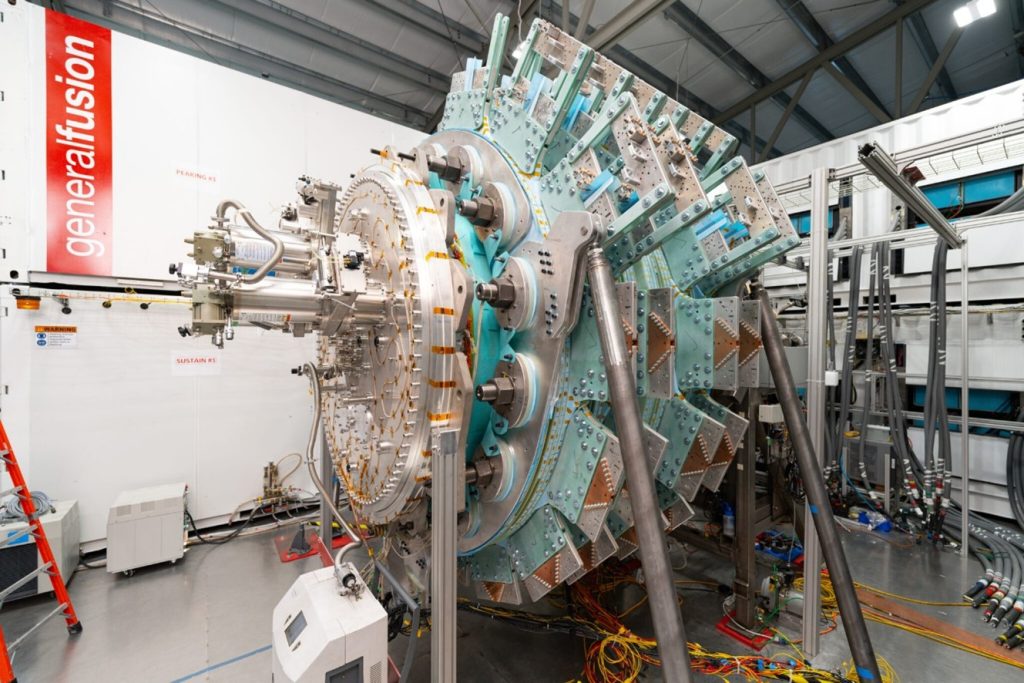
At its facility in Richmond, British Columbia, the company operates Lawson Machine 26—the industry’s first large-scale MTF fusion demonstration machine. Announced in mid-2023, General Fusion designed, built, and began operating LM26 in under two years. The machine is designed to demonstrate MTF at 50% commercial scale and achieve milestones of 10 million degrees Celsius (1 keV), 100 million degrees Celsius (10 keV), and ultimately, scientific breakeven equivalent (100% Lawson).

“We’re driving forward to achieve transformational technical results with LM26,” said Greg Twinney, CEO, when the latest funding was announced in August 2025. “This new funding from a strong mix of existing and new shareholders is a group that deeply supports our mission to transform the world with practical MTF. This financing is not only a vote of confidence in our technology but our extraordinary team, who designed, built, and began operating our world-first machine in less than two years, which speaks to the depth of their experience and dedication to our mission.”
The technology is designed to scale for cost-efficient power plants. It uses mechanical compression to create fusion conditions in short pulses, eliminating the need for expensive lasers or superconducting magnets. An MTF power plant is designed to produce its own fuel and inherently includes a method to extract the energy and put it to work.
LM26 is a world-first Magnetized Target Fusion demonstration. Assembled in December 2024, the machine achieved first plasma in February 2025 and another major milestone, first plasma compression, in April 2025. It is advancing towards a series of results that will demonstrate MTF in a commercially relevant way: 10 million degrees Celsius (1 keV), 100 million degrees Celsius (10 keV), and scientific breakeven equivalent (100% Lawson).
“LM26 is the only machine of its kind in the world, designed and built to achieve the technical results required to scale a fusion technology to a practical power plant,” says Twinney. “It is backed by peer-reviewed scientific results published in 2024 and 2025 issues of Nuclear Fusion, making us one of only four private fusion companies in the world to have achieved and published meaningful fusion results on the path to scientific breakeven. We are also the only one with the machine already built to get there.”
“Our mission has historically been supported financially by a mix of strong private investors and the Canadian federal government. We have been competing against aggressive nationally funded fusion programs around the world. We have risen to global leadership by charting a distinct course—founded on entrepreneurship and commercial focus—while others follow government-led or academic pathways.”
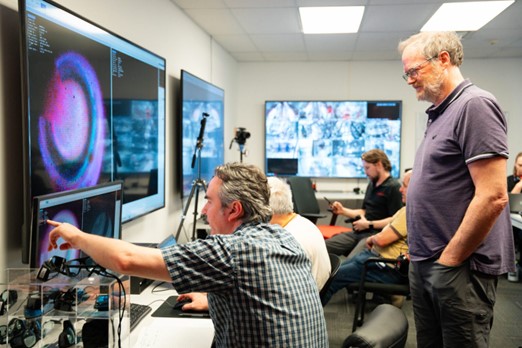
“On April 29th, we achieved a transformative milestone at our Vancouver, B.C., headquarters in Canada—we successfully compressed a large-scale magnetized plasma with lithium using our world-first LM26 fusion demonstration machine,” said Twinney. “The full, integrated system and diagnostics operated safely and as designed, and an early review of the data indicates we saw ion temperature and density increase, and our lithium liner successfully trapped the magnetic field. This was an incredible success for our first shot!”
Simple electromagnets, not superconducting magnets, key to MTF technology
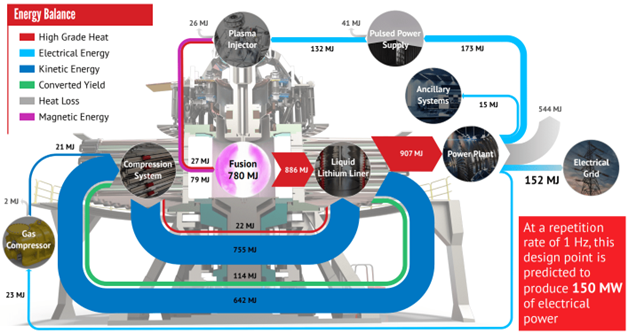
The core technology uses very strong magnetic fields to confine the plasma in which fusion takes place inside vacuum machines. The magnets are primarily located in the plasma injector, which is responsible for creating and shaping the magnetized plasma target. These electromagnets create the magnetic field that traps and confines the plasma.
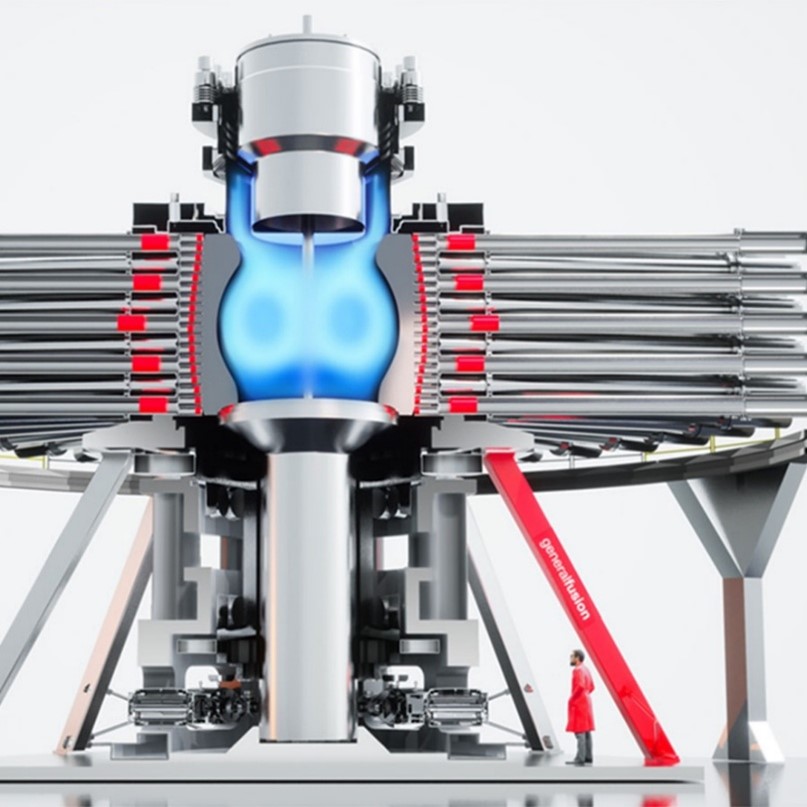
The plasma injector forms a ring of plasma that has a magnetic field embedded within it. Initially, this field is linked back to the electromagnets that created it. The plasma injector also uses a large pulse of current through the plasma that forces the plasma ring forward into the center of the liquid metal cavity. As it moves forward, it drags the magnetic field forward with it. The plasma and magnetic fields change shape as they disconnect from the field in the injector. This results in a closed doughnut-shaped bubble of plasma with a strong magnetic field wrapping around it and passing through it.
Plasma particles flow along the magnetic field lines, which now circulate without ever touching the wall. In this way, the magnetic field prevents the hot fusion plasma from touching the liquid metal and cooling off. The magnetic field works as an excellent thermal insulator as the core of the plasma is heated to a temperature hotter than the sun. During the process, the walls of the tank stay cool enough to operate as part of a power plant.
The integrated design allows GF to use simple and easy to manufacture electromagnets, a feature cited by the company as one of its key advantages in reaching commercialization, unlike fusion technologies that require huge and expensive superconducting magnets.
MTF operates on a pulsed basis where fusion conditions are reached briefly but in a repeated cycle. The system relies on the magnetic field to provide thermal confinement during the compression pulse that generates fusion. Because the magnetic field required in MTF is relatively small, it can use readily available copper electromagnets to create the magnetic confinement field and enable a fusion machine that is significantly smaller than other approaches.
In contrast, superconducting magnets are made from special materials like niobium-titanium. These materials have no resistance to electricity when they are kept cold, allowing a coil of the wire to carry large electrical currents for a long time without dissipating energy as heat. However, these materials only have superconducting properties at low temperatures – near absolute zero. As a result, superconducting magnets require large and expensive cryogenic cooling systems to operate. In addition, superconductive alloys are more costly to produce and fabricate into wires and coil structures than standard materials like copper.
LM26 is designed to significantly de-risk the commercialization process, providing technical performance in the near term while shortening the technical path from GF’s next near-commercial machine to a commercial plant. Founded in 2002 by physicist Michael Laberge, GF has now raised close to $500 million in its efforts to reach the point where the wall of liquid metal can be superheated enough to be circulated through a heat exchanger to generate steam for spinning a turbine.
Multiphysics simulation from Veryst Engineering and COMSOL software
Multiphysics simulation has played an important role in analyzing the internal behavior of LM26 and predicting its performance. Expertise came from Veryst Engineering, a COMSOL Certified Consultant specializing in highly nonlinear simulation and material modeling. Sean Teller, a principal engineer at Veryst, worked alongside Jean-Sebastien Dick, an engineering analysis manager at GF, to develop material models that enabled the team to accurately simulate the response of the machine’s lithium liner.
As Teller explained, “We used COMSOL Multiphysics simulation with integrated experimental plans and validation to enable the team at General Fusion to quickly iterate on designs of LM26. The predictive models are critical for achieving fusion conditions on the road to viable and abundant clean fusion power.”
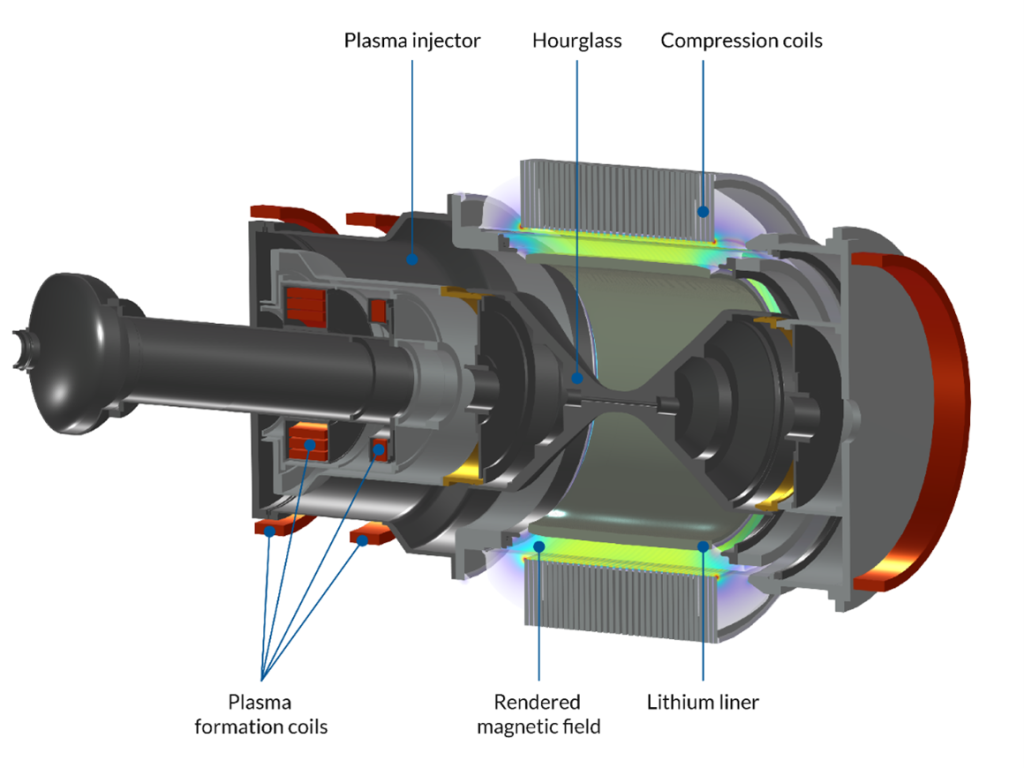
Different LM26 designs were able to be analyzed simultaneously. During the validation campaign of the models, 40 lithium liners were compressed electromagnetically. The team conducted physical experiments using a small-scale prototype of the compression system. Modeling and simulation enabled General Fusion to adjust the impedance of the power supply, see how design alterations would impact the performance, and maximize compression efficiency.
“The framework of COMSOL has allowed us to incrementally build in complexity, build confidence in our design intentions, and avoid having to reiterate the design phases,” Dick said. “We have not had to change any major parts of these experiments. They were always behaving as intended.”
Helion magneto-inertial fusion technology
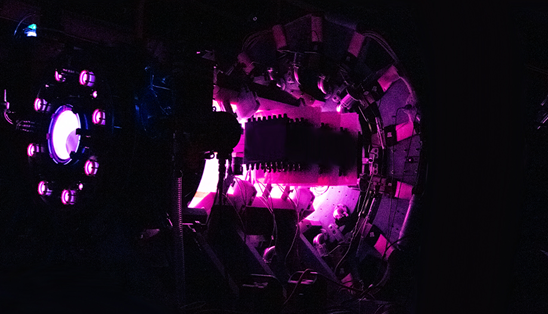
Helion’s magneto-inertial fusion technology combines aspects of magnetic and inertial confinement fusion for an ultra-efficient fusion solution. By directly capturing electricity, the approach is designed to provide a fast path to putting fusion electricity on the grid. As the plasma expands, it pushes back on the magnetic field from the machine’s magnets. By Faraday’s Law, the change in field induces current, which is directly recaptured as electricity, allowing Helion’s fusion generator to skip the steam cycle.
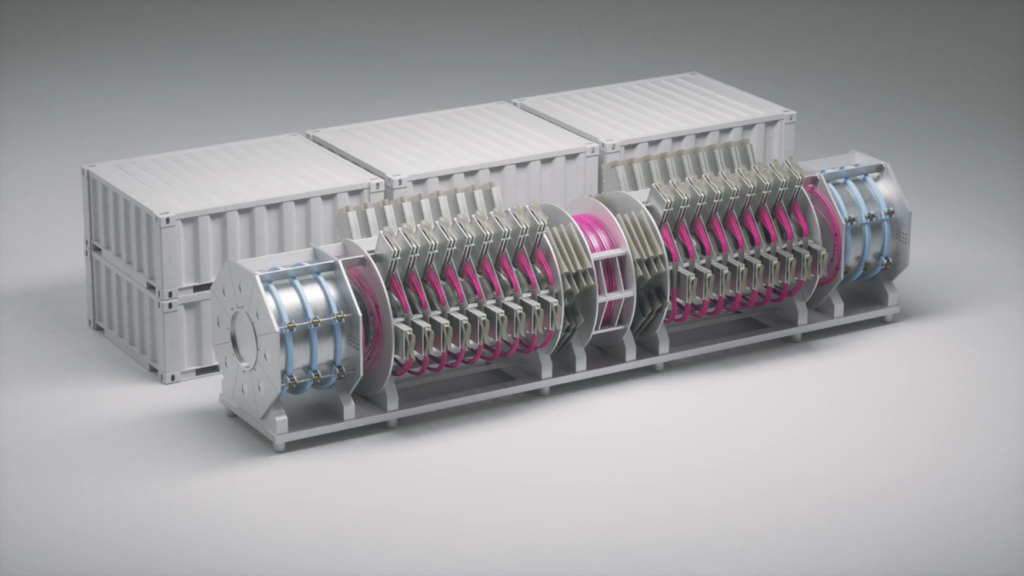
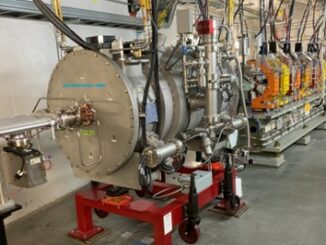
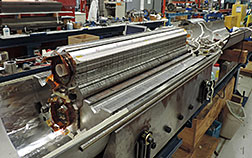
Helion uses pulsed electromagnets instead of the energy-intensive, cryogenic superconducting magnets used in some other fusion approaches. Its pulsed electromagnet system generates the magnetic fields needed to contain the plasma and directly convert the fusion energy into electricity. The electromagnets are standard, non-superconducting electromagnets made of aluminum, pulsed with a large electric current to create the magnetic fields.
Its pulsed approach to magneto-inertial fusion means it doesn’t need the constant, powerful magnetic fields that cryogenic superconducting magnets provide to maintain a stable plasma for long periods. Instead of boiling water to spin a turbine, the expanding plasma from the fusion reaction directly pushes back on the magnetic field, inducing a current that is then recaptured as electricity. The method eliminates the need for the immense energy input of cooling superconducting magnets.
The reactor is a field-reversed configuration. The magnets surround an hour-glass shaped reaction chamber with a bulge at the point where the two sides come together. At each end of the hourglass, the plasma spins into doughnut shapes that are shot toward each other at more than 1 million mph. When they collide in the middle, additional magnets help induce fusion. When fusion occurs, it boosts the plasma’s own magnetic field, which induces an electrical current inside the reactor’s magnetic coils, generating electricity that can be harvested directly.
The latest round of funding brings the total invested in Helion to over $1 billion from blue-ribbon investors including SoftBank, OpenAI’s Sam Altman and BlackRock, along with a commitment from Microsoft to purchase electricity for its data centers from Helion’s new facility nearby.

“We are on the brink of delivering a transformative energy solution that can meet the world’s increasing electricity demands while preserving U.S. energy leadership,” said David Kirtley, Helion’s co-founder and CEO. “Our mission has always been focused on rapidly developing and deploying safe, reliable fusion generators that provide abundant, affordable electricity.
Helion recently began operating its 7th generation prototype, Polaris, which is expected to demonstrate the first electricity produced from fusion. With its previous prototype, Trenta, Helion was the first private company to achieve a fuel temperature of 100 million degrees Celsius, generally considered the required operating temperature for a commercial fusion power plant.
“I am very excited for what this funding will enable for us,” said David Kirtley, CEO of Helion. “We will be radically scaling up our manufacturing in the U.S. – enabling us to build capacitors, magnets, and semiconductors much faster than we have been able to before. This accelerates the construction of the world’s first fusion power plant and then all our plants to come.”
For more info, see www.generalfusion.com, www.helionenergy.com, www.veryst.com.