HTS-110, a specialist manufacturer of high temperature superconducting (HTS) magnets located in New Zealand, has been selected recently by two advanced research facilities in Europe to provide high-field magnets for neutron science. Most recent is a project for the emerging European Spallation Source (ESS) in Sweden to design and manufacture a 14 tesla high-field magnet for neutron spectroscopy. The contract follows HTS-110’s recent delivery of a world-first 12 tesla all-HTS magnet to the French Alternative Energies & Atomic Energy Commission (CEA) for neutron science at the Institut Laue-Langevin (ILL) located in Grenoble.
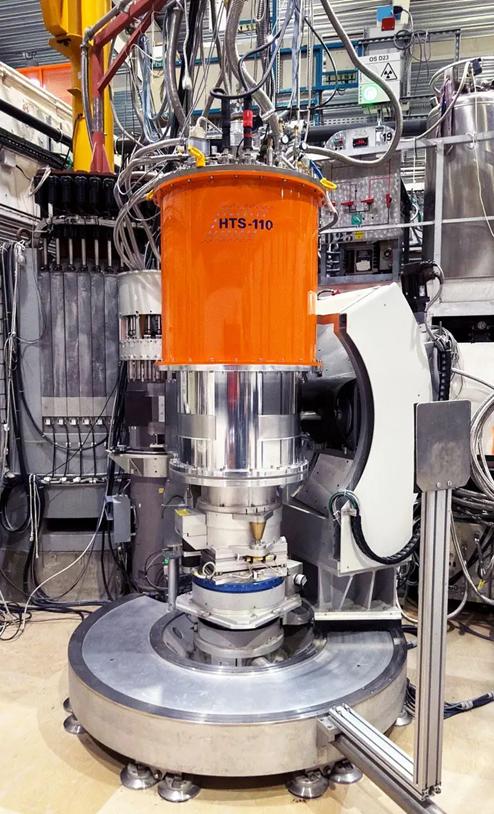
Scheduled for delivery in 2027, the new system will be deployed on the Cold Chopper Spectrometer (CSPEC) and Bispectral Chopper Spectrometer (T-REX) instruments at the ESS in Lund. It represents a significant leap forward in magnetic sample environments, offering researchers a symmetric vertical field of up to 14 tesla combined with a variable temperature insert which will support normal operation from 1.5 K to 325 K, and allow the insertion and cooling of a dilution refrigerator and/or a He³ ultra-low temperature insert.
The system reflects a deep technical partnership between HTS-110 and the ILL, mirroring the successful collaboration model established during delivery of the 12 tesla system to CEA. As with that previous project, HTS-110 is responsible for manufacturing the complete magnet system, while the temperature insert will be designed by the ILL team. This continuity allows the ESS to benefit from a proven interface between magnet and sample environment, leveraging HTS-110’s manufacturing capabilities alongside ILL’s 50 years of expertise in cryogenic systems.
Overcoming the challenge for conventional LTS magnets
The primary challenge for conventional low-temperature superconducting (LTS) magnets in neutron scattering applications is the risk of quench. Neutron scattering instruments and sample environments typically incorporate mechanical structures made of aluminum and other metals. In such environments, a magnet quench can induce transient eddy currents in surrounding metallic structures, resulting in significant electromagnetic forces that may cause damage to the magnet system and beamline components.
HTS-110’s solution leverages the inherent thermal stability of high-temperature superconductors. Unlike low-temperature superconductor counterparts, HTS coils are robust against rapid discharging, thereby eliminating the risk of generating unbalanced forces that could damage the magnet system.

As explained by Dr. Taotao Huang, Principal Magnet Designer at HTS-110, “The magnet will be designed using second-generation HTS wire, offering the potential to achieve significantly higher magnetic fields. Compared to conventional LTS conductors, 2G HTS wire provides superior current-carrying capacity in high magnetic fields, enhanced thermal stability, and a much lower risk of quench, making it ideal for demanding neutron scattering environments. The success of this project will pave the way for the development of next-generation 20 T split-pair magnets for neutron scattering.”
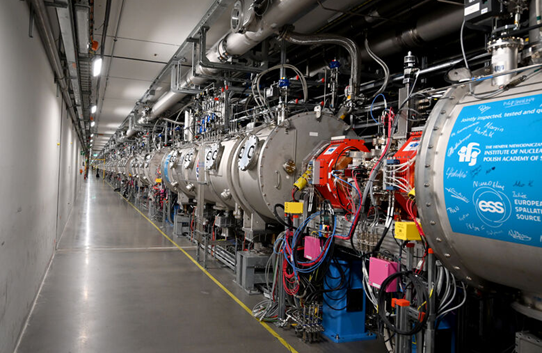
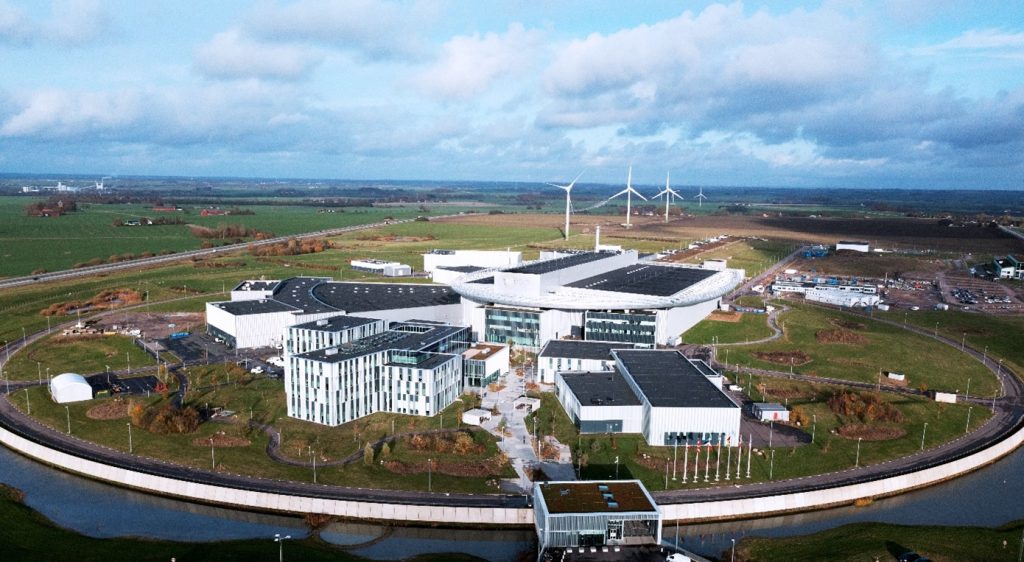
The magnet will serve as a key component in unlocking discoveries in quantum materials, superconductivity, and functional materials at the atomic level. ESS is a multidisciplinary research facility under construction in Lund, Sweden, with its Data Management and Software Centre located at the Technical University of Denmark in Copenhagen. Owned by 13 European countries, ESS is being built with extensive contributions from many European partner institutions and is projected to be operational by 2028. Upon completion, it will be the world’s leading accelerator-based neutron source, hosting 2,000–3,000 researchers annually.
The ESS is one of the largest science and technology infrastructure projects being built today. The facility design and construction include the most powerful linear proton accelerator ever built, a five-ton, helium-cooled tungsten target wheel, 15 state-of-the-art neutron instruments, a suite of laboratories, and the supercomputing data management and software development center.
The ILL is an international research center at the leading edge of neutron science and technology operating the world’s most powerful continuous neutron source. The ILL provides scientists from its member countries and around the world with a very high flux of neutrons feeding some 40 state-of-the-art instruments, which are constantly being developed and upgraded. It is funded and managed by France, Germany and the United Kingdom, with scientific partnership from 10 other countries.
For more info, see www.hts-110.com, www.ess.eu, www.cea.fr.