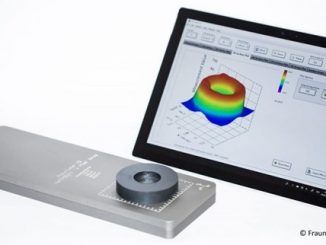
Magcam has developed a high-temperature variant of its established MiniCube3D magnetic field camera, which measures fast, high resolution 3D magnetic field distributions of permanent magnets using a proprietary sensor chip containing a 2D array of integrated Hall effect sensors. With the new MiniCube3D HT it is now possible to monitor the localized magnetic field distribution of permanent magnets in situ during temperature cycles up to 120°C, revealing where and when magnetization degrades and whether the demagnetization is reversible.
This new development answers the market’s need for characterizing permanent magnet behavior in applications where magnets are exposed to high temperatures, such as electric motors, sensor systems and consumer electronics.
What the MiniCube3D HT does
The magnetic field camera measures full 3-component magnetic field distributions, enabling detailed maps of small magnets and assemblies. The in-house developed MagScope Measurement & Data Analysis Software provides visualization and advanced quantitative analysis for fast interpretation and reporting.
Apart from making the MiniCube3D hardware compatible with high temperature operation, Magcam extended its existing high-precision calibration procedure to the new temperature range, in order to ensure accurate measurement results, also at these elevated temperatures.
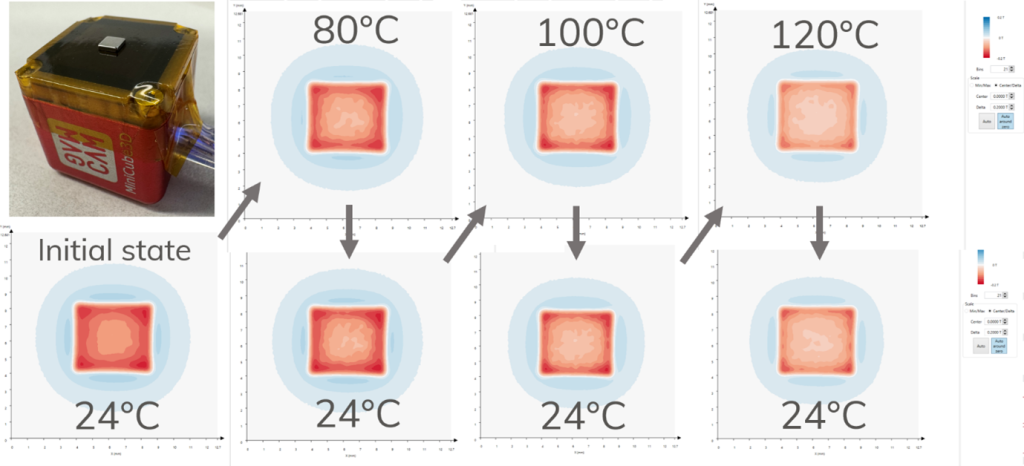
In order to demonstrate the capabilities of the new MiniCube3D HT magnetic field camera, several magnet samples were measured both at room temperature and at elevated temperatures up to 120°C. The measured magnetic field distributions reveal how the magnetic field, and therefore the internal magnetization, of the magnet changes with temperature and whether these changes are reversible or irreversible when coming back to room temperature. It was found that both the material/grade and shape of the magnet play a role in the reversibility of thermal demagnetization. Analyzing the measured magnetic field distributions with MagScope’s advanced analysis features allows to dig deep into the internal structure of the magnet. However, such analysis is beyond the scope of the present article.
Validation — real sample, real insight
In one validation test, a 5 × 4.5 × 0.5 mm (48H) block magnet was measured at room temperature (≈24°C), then at 80°C, 100°C and 120°C, returning to room temperature after each step. Results showed irreversible demagnetization beginning at 80°C in the magnet’s center, progressing to the edges by 100°C. After 120°C the magnet lost roughly 40% of its initial magnetization. These spatially resolved measurements make it possible to:
- determine the temperature at which irreversible changes start,
- localize the affected regions,
- compare reversible vs irreversible effects during cooling cycles.
Applications & value
- Motor & actuator R&D: optimize magnet grades and thermal management to prevent torque loss.
- Sensor/encoder validation: ensure field stability across operating temperature range and avoid intermittent failures.
- Quality control & failure analysis: identify production or material issues before they leave the factory.
How this converts to savings
Early detection of local demagnetization reduces costly redesign cycles, shrinks validation time, lowers warranty failures and helps select magnet grades or protective measures.
About Magcam
Magcam is your partner for advanced inspection of permanent magnets, axial- or radial-flux permanent magnet rotors and other magnet assemblies.
Our experts support you in unlocking your magnets’ secrets and optimizing your magnetic products, whether you use our measurement and analysis services or purchase a system for in-house magnet inspection.
Get in touch
Contact Magcam for your magnet quality inspection or high-temperature magnet characterization needs.