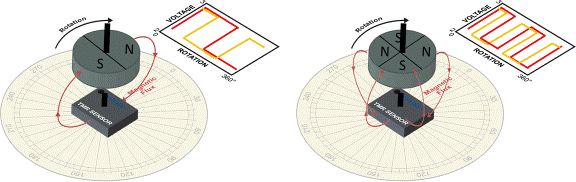
NVE has developed an ultrasensitive, ultralow power, digital-output rotation sensor that uses tunneling magnetoresistance (TMR) technology to provide accurate, absolute rotational quadrant information from a rotating magnet. It’s the world’s most sensitive off-axis rotation sensor, says the company.
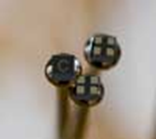
The new ADT501-10E works with two-pole and multipole magnets, and works just as well off-axis as it does on-axis. TMR technology enables it to work with as little as 0.4 millitesla magnetic field, allowing small magnets and extremely wide airgaps. Featuring a simple interface, the heart of the unique sensor is an array of four TMR elements, one for each quadrant. Two binary outputs correspond to the sine and cosine of the rotation.
In TMR devices, the electrical resistance changes depending on the relative alignment of the magnetic fields of two ferromagnetic layers separated by a thin insulating barrier. When the magnetic layers’ magnetizations are aligned parallel in the same direction, the resistance is low, in contrast to antiparallel alignment which results in higher resistance.
Support for design engineers is available via a breakout board which has a pre-soldered sensor, a standard header, and a card-edge connector for easy connections. The breakout board can be used separately or with NVE’s Arduino Shield demonstration and development board. The Shield has 60 LEDs to indicate angle and direction of rotation, and is compatible with a number of NVE TMR angle and rotation sensors.
It becomes the fifth model in NVE’s unique line of rotation sensor models which have various operating field ranges and output configurations. For more info, see www.nve.com.