What is Litz wire?
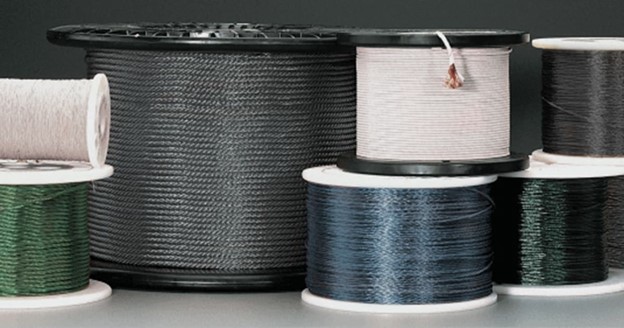
Litz wire is a specialized type of electrical wire made by bundling many thin, individually insulated conductors twisted or woven together. It has special properties that make it suitable for a number of applications. We like this explanation from AWS Wire, a part of The Elektrisola Group, which serves as a great primer on the subject.
The term “Litz” is derived from the German word “Litzen” meaning braided or stranded. Litz wire was designed to overcome two unwanted side effects of transmitting high-frequency alternating current (AC) through a conductor:
- the skin effect (where current flows mainly on the wire’s surface at high frequency)
- the proximity effect (where nearby conductors distort current paths).
By distributing AC Current across multiple smaller strands, Litz wire maintains low resistance and high efficiency in frequencies where ordinary solid wires lose effectiveness.
What are the advantages of Litz wire?
Litz wire carries several compelling benefits for engineers and designers:
- Reduced AC losses in high-frequency applications
- Increased efficiency by mitigating skin and proximity effects
- Lower operating temperatures, preventing “hot spots”
- Minimizes eddy current losses
- Allows for flexible, compact, and customizable designs
- Reduced device size, weight, and long-term energy costs dramatically
- Maintains excellent signal integrity in sensitive applications
- Can be engineered for specific insulation, temperature, or environmental demands
What do the Statistics Say About Litz Wire?
The use of litz wire can have a dramatic impact on efficiency, especially as frequency increases:
- In the low kilohertz (KHZ) frequency range, Litz wire can improve efficiency by more than 50% compared to regular magnet wire.
- In higher frequency ranges, such as low megahertz (MHZ), efficiency can double or better (100%+ improvement) for some magnetic devices.
- Litz wire is most effective below 500KHZ, with optimal performance for most devices up to around 1MHZ before parasitic effects offset some gains.
- Litz wire can be manufactured in a range of sizes from just a few to more than 25,000 individual strands, with strand diameters as fine as 50 AWG and cable sizes up to three quarters of an inch thick in multiple step configurations.
When and How to Use Litz wire?
Litz wire should be chosen when the application involves high-frequency alternating current typically in the range of 60HZ to 2.8MHZ. It excels in any device where minimizing AC resistance, electromagnetic interference, and heat is essential. Designers also use it to allow smaller, lighter constructions as devices miniaturize. To use Litz wire effectively:
- Determine your desired operating frequency (smaller strands for higher frequencies)
- Choose your construction type. Type 1 is individual strands twisted together. Type 2 is multiple bundles of type 1 strands twisted together (also known as multi-stage twisting).
- Choose served or unserved wire.
- Served Litz wire is wrapped with nylon to provide extra mechanical strength to protect the individual strands from scratches or abrasion during handling, processing, or installation.
- Unserved Litz wire lacks the extra nylon protection and only has the insulation of the individual strands
Understanding the Practical Uses of Litz wire
Applications for Litz wire include high-frequency inductors and transformers, radio circuits, wireless power transmission systems, electric vehicle chargers, medical device chargers, stator windings, motors, and advanced sensors. The ability for Litz wire to operate at high efficiency in compact, high-frequency environments makes it popular as electronics become smaller and more powerful.
Questions to Ask Before Choosing Litz wire?
Before specifying Litz wire, consider:
- What is the AC frequency range of your application?
- What current and voltage levels are needed?
- Are there size, flexibility, or environmental constraints?
- What type of insulation best suits your requirements?
- Will reduced weight or increased efficiency add value to your application?
Where Is Litz wire Used? Common Applications
Litz wire has multiple applications including:
- High-frequency transformers and inductors
- Switch-mode power supplies
- Radio transmitters and antenna coils
- Wireless charging systems
- Electric motors, generators, and hybrid vehicle components
- Medical and industrial equipment
- Sonar and marine systems
- Battery-powered electronics
Is Litz wire Right for Your Project? Key Factors to Weigh
Litz wire’s greatest value appears when your project requires high-frequency performance, reduced heat, improved efficiency, and potentially reduced size and weight. Consider upfront cost versus long-term savings in energy, cooling, and maintenance. If your application runs at high or radio frequencies and you need to maximize efficiency or miniaturize your design, Litz wire is a good starting point.
Where To Get More Information about Litz Wire
To learn more about Litz wire, use our Litz wire calculator, and choose the type of Litz wire best for you, visit our Litz wire product page.
How can MWS help you with your Litz wire Project?
At MWS we specialize in finding the perfect Litz wire for your application. We will happily guide you through the process of choosing the correct sizes, constructions, and insulations. We have most common Litz wire configurations already in stock and if we don’t have it, we can make it for you with quick turnaround and low MOQ batches. Should your Litz wire volume requirements increase, we can support larger wire volumes so our service grows according to your needs.
Established in 1968, MWS Wire has built its reputation on delivering wire sourcing solutions with the one of the largest, most varied inventory of magnet wire and specialty wire found anywhere. In January 2014, MWS became a part of The Elektrisola Group – an international, high-volume producer of fine and ultra-fine magnet wire. Elektrisola has manufacturing locations throughout the world, with nine plants located in seven countries in Europe, the Americas, and Asia.
For more information, see https://mwswire.com/ and The Elektrisola Group – MWS Wire