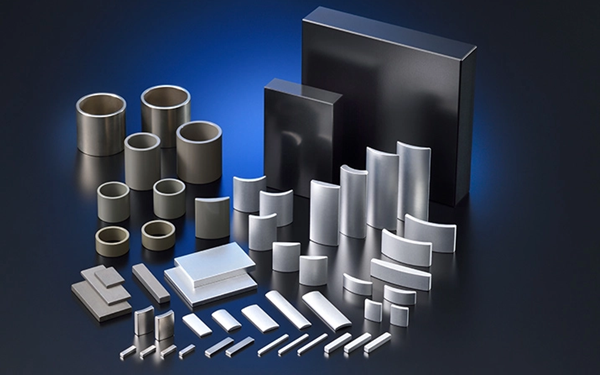
Furthering its research and development into new magnetic materials, Japanese materials company Proterial has developed high-performance heavy-rare-earth-free neodymium sintered magnets with no use of heavy rare earth, and also confirmed the suitability of its Permendur soft magnetic material for motor core material for electric vertical take-off and landing (eVTOL) aircraft – opening a pathway to apply it more widely for cores of other motors requiring small size, light weight and high torque.
Magnets for EV motors need to have particularly high heat resistance since they are exposed to temperatures of 100°C or higher. Given their high magnetic properties, neodymium sintered magnets are suitable for increasing torque and downsizing motors, but to improve heat resistance heavy rare earths are typically added to the mix. However, points out Proterial, there are fewer reserves of heavy rare earths than there are of light rare earths, creating a dynamic that favors reducing proportionately the use of heavy rare earths.
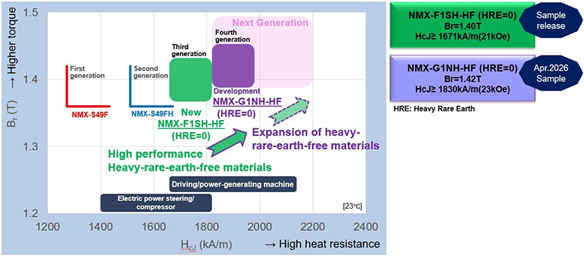
Through unique textural and compositional control technology, the company’s new NMX-F1SH-HF and NMX-G1NH-HF materials can be used for electric vehicle driving motors, with dramatic gains in residual magnetic flux density and coercive force. The NMX-F1SH-HF material has magnetic properties that permit applications for driving motors as well as electric power steering and compressors with Br = 1.40 T and HcJ ≥ 1671 kA/m. Proterial’s mass production plant has already started providing pre-production samples.
The NMX-G1NH-HF material is a heavy-rare-earth-free material that can be used even for driving motors requiring high torque and heat resistance. Research facilities have achieved magnetic properties that enable use in a hot environment of 100°C or above with Br = 1.42 T and HcJ ≥ 1830 kA/m. Proterial will verify mass production potential. In April 2026, the mass-production plant will be ready to respond to requests for pre-production samples.
Proterial has obtained over 600 patents relating to neodymium sintered magnets around the world and has built a portfolio of more than 200 patents in Japan as a result of long-term research and development, manufacturing and distributing the neodymium sintered magnet Neomax. The accompanying figure shows a magnetic property map of the new materials.
The NMX-F1SH-HF material and the NMX-G1NH-HF material have been successfully developed with HcJ and Br dramatically improved from the first-generation NMX-S49F material by controlling impurities and optimizing the composition and process using Proterial’s original manufacturing methods.
The NMX-F1SH-HF material has magnetic properties with Br = 1.40 T and HcJ ≥ 1671 kA/m, permitting applications for driving motors as well as electric power steering and compressors. Furthermore, for the NMX-G1NH-HF material, the research facilities achieved magnetic properties with Br = 1.42T and HcJ ≥ 1830 kA/m to satisfy the strong need for the development of a heavy-rare-earth-free material that can be used for driving motors requiring high torque and heat resistance.
Permendur YEP-2V for motor cores for eVTOL aircraft
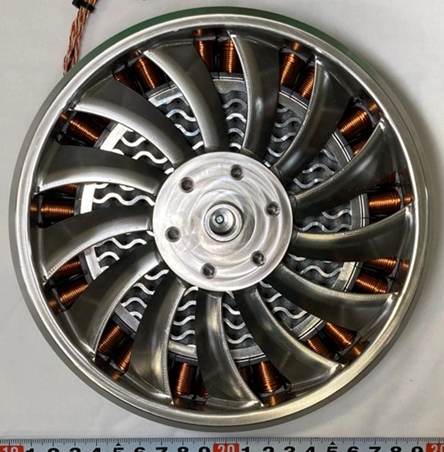
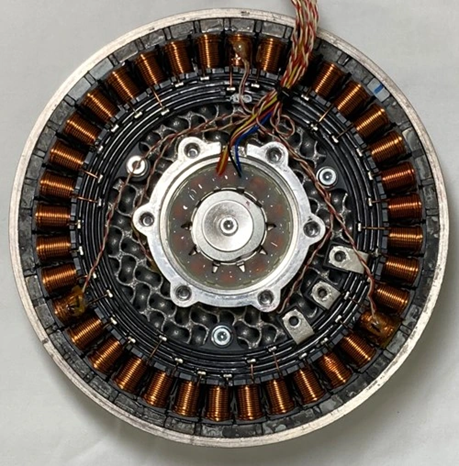
Recent demonstration tests have confirmed the properties of the company’s Permendur YEP-2V soft magnetic material with a high magnetic flux density suitable as a motor core material for electric vertical take-off and landing aircraft. Now, Proterials plans to broaden its application to more motor cores.
It is based on an alloy containing 50% each of iron (Fe) and cobalt (Co), with 2% vanadium (V) added to improve workability. Its composition is described as Fe-49Co-2V, and is a representative composition of Permendur. Compared to high-performance non-oriented electromagnetic steel sheets typically used in motor cores, YEP-2V has a higher saturation magnetic flux density and has the advantage of being able to reduce the current required to produce the same torque. This makes it possible to reduce the size and weight of motor cores and improve energy efficiency, particularly for high-torque motor applications, while also reducing iron loss, says Proterial.
A motor core using the material was designed and prototyped at Proterial and installed in an eVTOL mock-up motor. The test demonstrated that the motor had a 14% higher torque at the same current value, and a 14% lower current at the same torque value, than a motor equipped with a motor core made from a high-performance electromagnetic steel sheet. The test also verified that the current became lower at the same torque value, so the motor generated less heat and reduced the rise in its temperature, improving energy efficiency. For more info, see www.proterial.com.