Combining advanced magnetic navigation technology with ultra-flexible robotic instruments, Swiss medical technology company Nanoflex Robotics is building a next-generation telerobotics interventional platform to enhance access to life-saving endovascular procedures. Spun out of ETH Zurich in 2021, the company has emerged as a pioneer in magnetically controlled medical soft robotics.
Its system employs magnets and magnetic fields to guide ultra-flexible micro robots through intricate blood vessels, ensuring precise navigation without excessive force. The magnetic field unit is compact and mobile, enabling its use in diverse clinical settings. The devices are highly flexible. With a simple console, physicians can control the device tip, bending and orienting it in any direction. This allows them to make instant acute turns in the vasculature, potentially enabling faster, simpler and safer endovascular interventions. The company’s AI-compatible software enables secure, remote connectivity for endovascular interventions regardless of geographical barriers while reducing physicians’ exposure to harmful x-rays.
A series of landmark preclinical studies including the first known transatlantic robot-assisted animal thrombectomy between USA and Switzerland was accomplished last year. Conducted in May, the studies were carried out in collaboration with Inselspital (Bern University Hospital) and University Hospital of Zurich.
Mechanical thrombectomy is a highly effective, but time-sensitive, treatment for stroke. It is typically performed manually in specialized hospitals, making it inaccessible to many patients in remote and underserved regions. The studies evaluated the feasibility of Nanoflex Robotics’ Remote Intervention System (RIS) to enable teleoperated thrombectomy, expanding access to stroke care beyond geographic boundaries.
“This milestone marks a pivotal moment as we enter a new era where precision emergency care can be delivered remotely, through the elegance and accuracy of telerobotic technology,” said Matt Curran, CEO and co-founder of Nanoflex Robotics. “We’re grateful to our clinical partners for their support as we progress towards making our vision a tangible reality.”
In the transatlantic procedure, a neurosurgeon, based in Arizona, remotely aspirated blood clots placed in the extracranial arteries of the study animal at Inselspital in Bern, more than 9,000 km away. The procedures were executed with real-time remote control and visual guidance provided by X-ray and camera systems. The teleoperation was conducted over a secure public internet connection, demonstrating reliable performance.
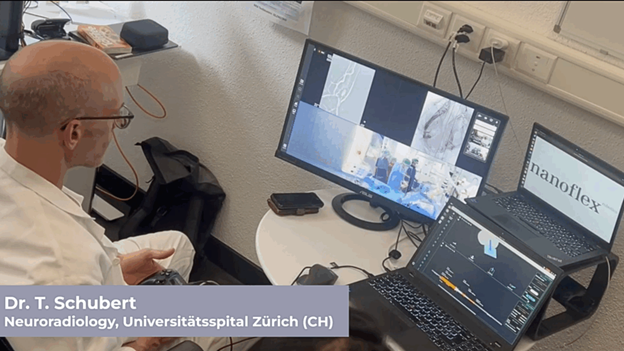
In a separate intra-Switzerland procedure, Dr. Tilman Schubert, Senior Physician, Interventional Neuroradiology at the University Hospital of Zurich, successfully aspirated a clot placed in the right infraorbital artery of the animal model at Inselspital in Bern, while Dr. Tomas Dobrocky, Attending Physician Neuroradiology from Inselspital Department of Neurology oversaw the procedure at the bedside.
“In the study, we achieved accurate navigation and clot removal in a live model in an intra-Switzerland hospital-to-hospital teleoperation,” said Dr. Schubert. “This proves the technical feasibility of remote neuro-interventions”.
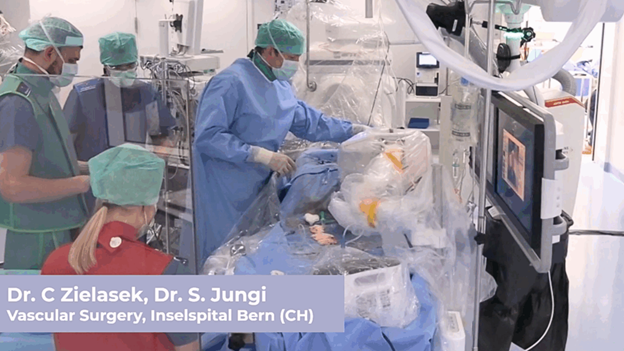
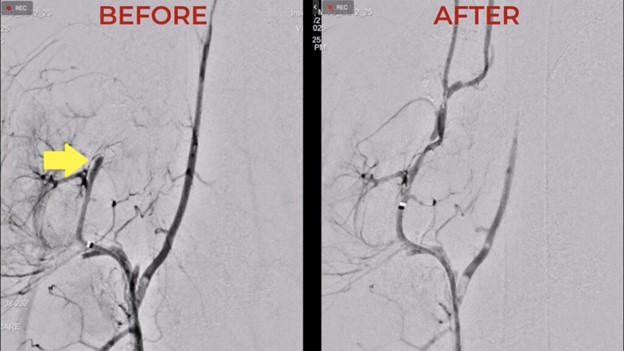
Another study also conducted in May demonstrated the feasibility of the platform for treating conditions in the peripheral vasculature non-remotely, where the physician is by the patient’s bedside. At Inselspital, vascular surgeons Dr. Silvan Jungi, Senior Physician Vascular Surgery and Dr. Christian Zielasek, Deputy Attending Vascular Surgery achieved stenting in four reno-visceral arteries in a porcine model using robotic assistance.
“This animal study provided preliminary insights into the possibilities of robotic navigation in anatomically complex vessel territories,” said Dr. Silvan Jungi of Inselspital Department of Neurology.
The studies used various components of the Nanoflex system, which include:
- A mobile magnetic field generator to generate electromagnetic fields,
- A robotic advancer system to remotely advance and retract guidewires and catheters,
- A control interface consisting of a console and monitors, to manipulate magnetic fields to steer the endovascular devices within the body and track their progress,
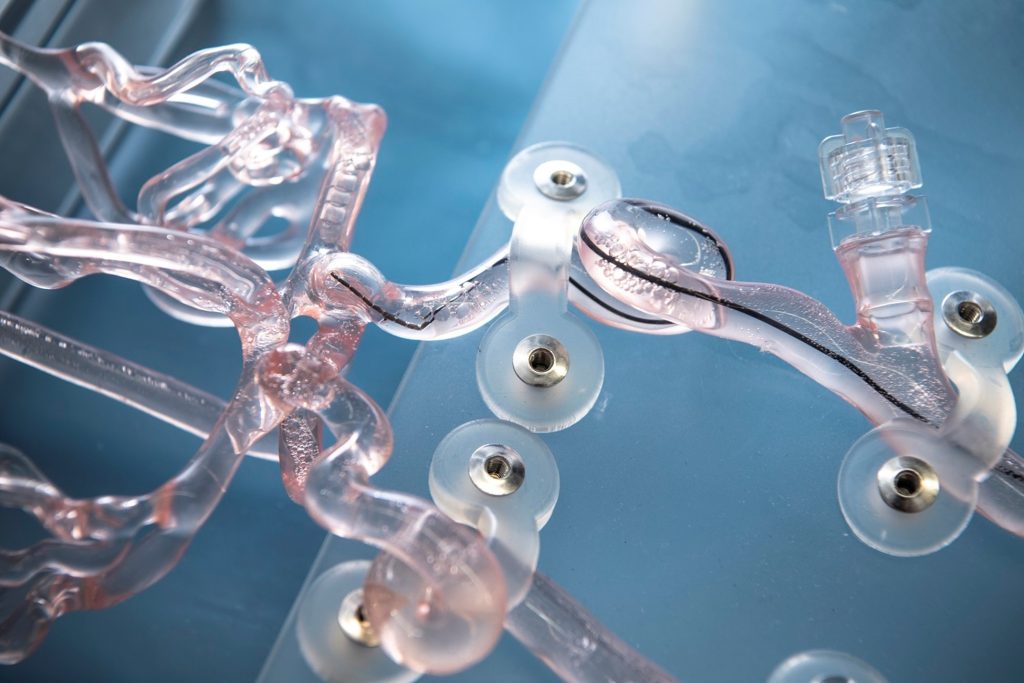
- Proprietary magnetic guidewires and commercial distal access and guiding catheters.
“Overall, we achieved 100% success with navigation and clot retrieval,” said Christophe Chautems, CTO and co-founder of Nanoflex Robotics. “Together with our previous animal studies in coronary angiography, we have now proven the concept of using our system in vivo across neurovascular, cardiovascular, and peripheral applications in both bedside and fully remote teleoperated situations.”
Looking ahead, the company is preparing first-in-human trials for use of its technology in non-remote procedures and has plans to raise additional funding to support continued development and clinical traction.
Located in Zurich, Nanoflex has been lauded by several prestigious award programs, most recently as the winner of the ZKB Pionierpreis Technopark 2025 awards for technological innovation and entrepreneurship. In 2024, it received the TOP 100 Swiss Startup Award for the second consecutive year and was recognized as the top medical technology startup in Switzerland.
Nanoflex was incubated at the Wyss Zurich Translational Center (Wyss Zurich). Embedded within ETH Zurich and the University of Zurich, it is dedicated to advancing innovations in the emerging fields of regenerative medicine, robotics, medical devices and bionics technologies. (Another of Wyss Zurich’s recently incubated companies in the field of magnetics is hemotune, a biotech startup based upon a versatile magnetic nanoparticle platform. It will be covered in a separate article in Magnetics Magazine.) See www.nanoflexrobotics.com, www.wysszurich.com.